
While Chicago still is experiencing unacceptable levels of violent crime, Mayor Brandon Johnson can point to a steadily lower number of homicides over the course of his term as he eyes a potential campaign next year for reelection.
So it’s curious indeed that the man in the mayor’s office most identified with those positive results — Garien Gatewood, deputy mayor for community safety — was summarily fired last week along with Manny Whitfield, director of violence prevention and community safety.
In the days since, Gatewood and Whitfield have told a consistent story to inquiring reporters. They say they lost their jobs in large part because they refused to tolerate the poor work performance of an employee in their office who has close ties to Johnson’s closest and most progressive top aides in his office. They put that worker on a performance improvement plan. They allege that did not sit well with the mayor and his inner circle.
There also were reports that Gatewood filed a complaint back in October with Chicago Inspector General Deborah Witzburg against Johnson’s chief of staff, Cristina Pacione-Zayas, and top aide Jason Lee. Johnson, Pacione-Zayas and Lee told reporters they had no knowledge that complaint existed.
“I think there’s a culture in this office where, if you work to hold people accountable, you become a target,” Gatewood told Fox 32. “And I am not the first person to say that.”
The firings of Gatewood and Whitfield prompted dismay from some key voices on the front lines of Chicago’s public safety battles. A letter from Grow Greater Englewood, St. Sabina Church and Teamwork Englewood, obtained by a Tribune reporter, expressed “immense disappointment,” lauding both men for being “always present” when tough moments came. “Because of that presence, relationship-building and hands-on commitment, we have seen meaningful declines in violence across the city.”
The Rev. Michael Pfleger, longtime St. Sabina pastor, told the Tribune he was worried. “I’m particularly concerned because we’re getting ready to go into the summer,” he said.
The timing looks far from optimal for multiple reasons, including that we are on the brink of the warm-weather months when crime rates typically increase. The firings make little sense politically either, given that a mayor who presumably would like to campaign on his public safety record now has to explain why he became dissatisfied with the people credited for much of that success less than a year before the mayoral election.
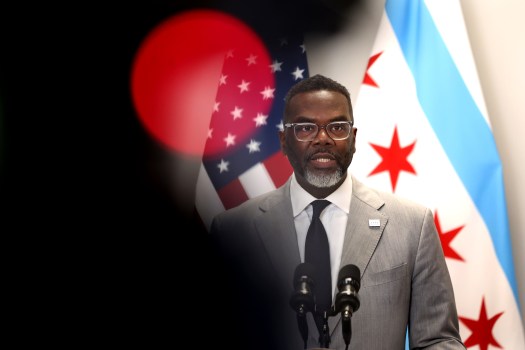
At a press conference Tuesday, peppered with repeated questions on why Gatewood and Whitfield were fired, the mayor struggled mightily to explain his reasons.
Asked what sort of a different approach he wanted to pursue on public safety from those pursued by Gatewood, Johnson effectively said he wanted more of the same. “The direction is ensuring we do more to drive violence down in the city of Chicago,” he said. “No one is patting themselves on the back right now.”
But then he proceeded to, well, pat himself on the back. “We have evidence that our work is working,” he said. Referencing the 2025 achievement of recording the fewest number of homicides in Chicago in 60 years, he said, “That means something.”
For sure. But what about Gatewood’s and Whitfield’s role in that achievement?
“This is not about simply personnel decisions,” Johnson said.
In contrast to Gatewood and Whitfield, Johnson didn’t offer a consistent and believable explanation for why they were cashiered, which naturally causes those of us not privy to the day-to-day machinations of his opaque fifth floor to believe the story that hangs together rather than the one that is, to put it kindly, all over the place.
What the mayor also didn’t do was effectively rebut the two men’s assertion that their primary “sin” was to run afoul of progressive loyalists in his office whose first priority is to protect members of Johnson’s inner circle from threats to their future employment in his administration.
It’s not as if we haven’t seen this dynamic at work before. In 2024, Ronnie Reese, Johnson’s first press secretary, kept his job for months after harassment allegations were lodged against him by female subordinates. Chief of staff Pacione-Zayas famously attempted to induce the complainants to agree to a “peace circle” with Reese to hash out their differences. Eventually, political reality took hold, and Reese had to go. But the process took months and cost both Johnson and Pacione-Zayas substantial amounts of their credibility.
Johnson is entitled, of course, to choose his own deputies. (Shortly after the public safety firings, Johnson learned he will have yet another opening to fill with the abrupt resignation, effective Wednesday, of his human relations commissioner, Nancy Andrade.) But the job of mayor of a big city like Chicago is principally a management task. How a mayor goes about hiring and firing says much about his or her managerial style and abilities.
As he nears a decision on whether to seek a second term with polls showing him deeply unpopular, Johnson is making it clearer with every passing day that he prizes loyalty above all else in who he tasks with running critical components of his sprawling government.
We’d like to see loyalty play second fiddle to results. Especially when they are saving lives.
Submit a letter, of no more than 400 words, to the editor here or email letters@chicagotribune.com.