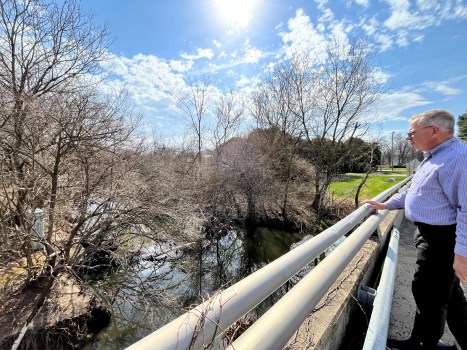

Homer Glen resident Tom Canning has pulled numerous items including a child’s swimming pool and a hot tub cover from Long Run Creek, which runs behind his house.
He has found logs, concrete, pipes and a 55-gallon industrial drum slowly rusting away embedded in the creek bed.
“You can’t budge it,” he said of the submerged drum.
Natural debris and trash has floated downstream. Erosion and invasive species is another problem.
Canning, who lives at the bottom of a valley, has a one horsepower sump pump, a high capacity machine, to help prevent his basement from flooding. He’s elevated a basement couch and bookcase on bricks so they won’t ruin if it floods. He said his basement flooded a mere six weeks after he converted it into a den.
Homer Glen village officials have long heard about flooding from residents living along Long Run Creek, which is part of the larger Des Plaines River watershed that spans southeastern Wisconsin and northeastern Illinois.
Long Run Creek is a smaller portion of the watershed that begins at Tampier Lake in Orland Park and flows west toward the Illinois and Michigan Canal and into the Chicago Sanitary and Ship Canal, said village engineer Brett Westcott. The creek goes through the northern third of Homer Glen, he said.
The Village Board on Wednesday discussed ways to help residents living along the creek, which could include removing some of the blockages caused by downed trees, debris and beavers damming sections of the creek. No action was taken.

Private property floodways and floodplains are mostly affected when extreme weather events occur, village officials said.
“I think we’ve seen 100-year rains more often than not,” Trustee Robert Schaller said.
Westcott said creek maintenance that runs on private property is the responsibly of those homeowners. Some residents have received quotes to remove fallen trees, but it ran $15,000 and $20,000 and were unaffordable, he said.
Because most of the creek runs through private property, the village would need permission to access the area even to study.
Mayor Christina Neitzke-Troike said the village should look into ways to help the residents.
The blockages and flooding likely affects more residents than officials know, she said.
While the creek may only run through one portion of the village, officials and residents have to work together as a team, Neitzke-Troike said. She compared the partnership as similar to when the village sided with residents who were protesting the 143rd Street widening project or advocated for residents who are fighting Illinois American Water’s proposed rate increases.
“We’re community,” Neitzke-Troike said. “It’s all for one, one for all, in my opinion.”
“If we have the upper portion of Homer Glen suffering, we have to take a look at it,” she said. “We have to step up our game on this one.”
Neitzke-Troike said residents can help the village by letting them know where some of the major blockages may be and allowing officials to access to their property.
Westcott said some of the subdivisions along the creek were built in the 1960s and 1970s when proper drainage was an afterthought and fences were installed in floodways.
He said over the years people have dumped chemicals, paint and oil down storm sewers.
“Whatever goes into these drains, whether it’s chemicals, fertilizer, sediment, paint, garbage, it eventually goes through our storm sewer systems and makes its way out to Long Run Creek,” Westcott said. “Do not dump waste down the storm sewer drains.”
Resident Mike McGee said some of the original residents who built their homes along the creek are now senior citizens and can’t remove debris.
McGee, who has two sump pumps and a generator to help prevent his basement from flooding, said he advocates for help for his elderly neighbors.
Westcott said helping residents along Long Run Creek likely goes beyond a clean-up project and may require engineering studies.
Homer Glen attorney Mike Pasquinelli said the village could hire an independent contractor or consultant to identify which areas have potential blockages. A consultant could meet with affected residents and come up with a solution.
“Step number one is we have to assess the problem,” Pasquinelli said.
An outside environmental firm would likely be more efficient, Westcott said, noting the village’s lean staff.
Canning said he believes a committee of invested residents, who can identify key problems, would be a good start.
“If we could address two things, the blockages and the dumping, we can accomplish something,” he said.
Village trustees said they would also like to see whether state or federal funding would be available, especially because the creek runs through other communities and is under the jurisdiction of the Illinois Department of Natural Resources and the Army Corps of Engineers.
Neitzke-Troike said while the village should have taken action long ago, she would like frequent updates on how the village will address Long Run Creek. A resident meeting could be a potential next step, she said.
McGee said he agrees with Neitzke-Troike’s views of “one community.”
“What are we handing off to future generations?” he said. “We can’t draw lines between counties, between villages, between neighbors. We have to work on this.”
Michelle Mullins is a freelance reporter for the Daily Southtown.