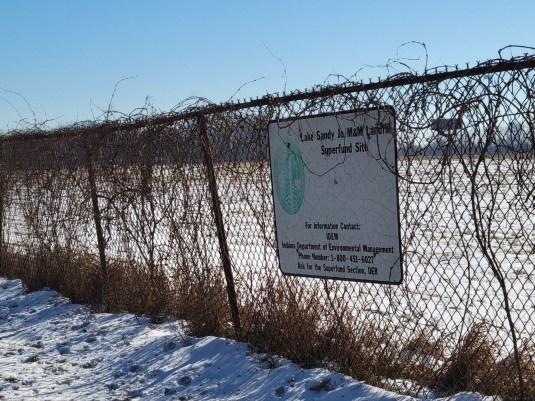

The U.S. Environmental Protection Agency and Indiana Department of Environmental Management are conducting a review of Gary’s Lake Sandy Jo landfill superfund site.
According to an EPA notice, superfund law requires the agency to — at least every five years — review sites where cleanup is complete and waste is managed on-site to “make sure the cleanup continues to protect people and the environment.”
EPA’s cleanup included capping the landfill with clean soil and planting prairie grasses. The agency also extended the municipal water supply to residents and conducted long-term groundwater monitoring, according to the EPA notice.
The review should be completed by July 6, according to the EPA. Anyone can contact the agency with concerns or additional comments about site conditions.
According to IDEM, the Lake Sandy Jo superfund site operated as a landfill from 1971 to 1980, burying various wastes, including construction and demolition debris, industrial waste and drums on-site. The site was added to the National Priorities List in 1983, according to IDEM, and most cleanup was done in 1994.
“Five-year reviews are conducted at sites where waste remains in place to ensure the remedy continues to protect human health and the environment,” an IDEM spokesperson said in a statement. “IDEM is responsible for operating and maintaining the site, including the upkeep of the cap and fence, and monitoring groundwater. IDEM staff will help review draft documents, provide any information from the past five years that EPA needs, and carry out any required updates to the remedy. The last five-year review found that the remedy remains protective in the short and long term.”
Brenda Scott-Henry, Gary’s director of sustainability and environmental affairs, said the review process is extensive. She doesn’t believe cleanup at Lake Sandy Jo will ever fully be complete, Scott-Henry said, but it will be clean enough to create development at the property.
The city has looked for opportunities to develop on the site, and she hopes that might come later.
The Lake Sandy Jo site occupies 50 acres in Gary’s Black Oak neighborhood, according to Post-Tribune archives. In 2021, the EPA pursued a partial deletion from the National Priorities List, which was awarded after receiving public comments.
“Partial deletion is a sign that the remedy at the site was successfully put in place and kept in place to protect human health and the environment through operations and maintenance by EPA and IDEM and will continue until all items in the five-year review are addressed,” EPA’s Lake Sandy Jo superfund website says.
In February 2022, the Gary Common Council voted to rezone the property from residential to light industrial to help future commercial use, according to Post-Tribune archives.
During the last review period, Scott-Henry said the city worked with the EPA Region 5 office’s community engagement division to help organize community workshops dedicated to Lake Sandy Jo.
“We were focused mostly on how we can incorporate ecosystem goods and services into any future development at the site,” Scott-Henry said. “How can we identify uses that will have a natural benefit to the community and people in surrounding areas?”
The site could see added tree canopies, a walking parth using native landscaping, or a designated space for wetland restoration, Scott-Henry said.
“Those not only have economic benefits for a developer, but they are also community benefits for those residents and community organizations that benefit with the site,” she added.
Scott-Henry said it’s important for residents to express their opinions on the site during the review period because of the site’s history. She also believes residents should make their opinions on the site’s future known, Scott-Henry said.
“With any future development opportunities, you need to engage with the community because it’s the right thing to do,” she added.
Carolyn McCrady, Gary resident and member of Gary Advocates for Responsible Development, said she’s been involved with the investigation of toxic waste that lies beneath a cover at the Lake Sandy Jo site. Findings of the investigation haven’t been given to the community, McCrady said, and she believes that needs to happen and development can follow.
McCrady trusts Scott-Henry and city officials to work with the EPA and IDEM, and to prioritize development that’s non-polluting.
McCrady believes the site could have a solar array or some kind of small business, but she doesn’t want to see warehouses, distribution, logistics or a trucking facility.
“That’s not acceptable because the people in that neighborhood are already dealing with (Interstates) 80/94 every day, and all of the pollution that comes from there,” she said. “Whatever goes there, it has to be safe, and it has to be non-polluting.”