
Tax the super-rich? Of course, because they have far more money than they and their families would need in a hundred lifetimes, and poor or working-class families have far less than they need right now.
California and Washington state liberals certainly believe that, as their proposed wealth tax plans indicate.
But can their residents and those of us in states pondering similar revenue generation trust politicians and government officials addicted to their cushy sinecures and protective of their bloated bureaucracies to actually use tax windfalls to improve people’s lives other than their own?
We know that wealthy elites keep getting richer and more powerful, while most middle- and lower-income families struggle, making our representative democracy feel increasingly more plutocratic and less democratic, representative or fair. But proposals that call for tax “reform” and a redistribution of wealth generally fail to gain widespread support because mistrust of government runs so understandably deep that even presumed beneficiaries at the lower end of the wealth spectrum are skeptical enough to vote “no” or not vote at all.
And the wealthy in high-tax states such as Illinois that keep revisiting “tax the rich” schemes? Many pack up and move to low-tax states such as Florida and Texas. Not, as I’ve argued before, because they’re miserly or mean-spirited — many are the most generous philanthropists in their cities or states — but because they simply don’t trust government to use their tax dollars wisely.
Illinois and Chicago are high-tax, big-promise blue strongholds with long, tawdry histories of waste, fraud, patronage, insider deals and blatant corruption. So when pols say, “Don’t worry — we’ll just tax the rich and fix everything,” voters say, “Thanks but no thanks.”
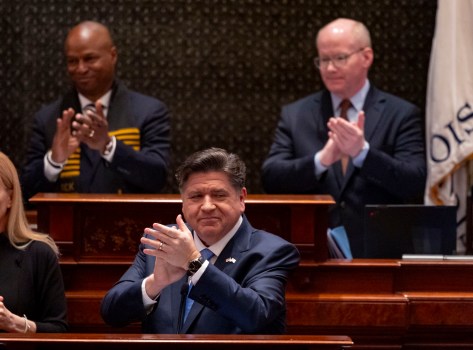
That killed Illinois Gov. J.B. Pritzker’s graduated income tax amendment in 2020, which a majority of voters saw as a blank check to the Springfield sinkhole, and that skepticism hasn’t faded. If anything, it’s gotten worse.
Working- and middle-class families watch their property taxes climb, fees increase and government units overlap like layers in a bureaucratic lasagna. They hear about well-connected developers’ land-grab subsidies, read about no-bid contracts and patronage hires, and watch a procession of crooked officials fitted for orange prison jumpsuits.
Trust is in shorter supply than unicorns or four-leaf clovers.
Reformers and good government advocates, me included, have argued for years that rebuilding trust begins with a serious attack on government waste, fraud, inefficiency, inside deals and cronyism, and more transparency and accountability.
But those suggestions generally fall on deaf ears in the corridors of power, so let me toss out a more tangible idea that, yes, is perhaps way too Pollyannaish — but at least worth briefly considering:
• First, establish a small working group of government, business, civic and labor experts tasked with identifying several top spending priorities — maybe housing and rental assistance, day care and health subsidies, job training, and anti-crime measures, to name a few.
• Next, create realistic staffing and operational budgets for the priorities, along with built-in oversight and accountability measures.
• Identify, at the same time, government programs and offices that can be eliminated or consolidated — e.g., townships — because they’re wasteful, inefficient, outdated, duplicative or simply unnecessary.
• And finally, put the entire package, including a fair, agreed-upon tax increase or revenue-raising plan, in a binding amendment for voters to consider at an upcoming election.
Would it be a challenging, time-consuming, tedious and maybe even combative endeavor? Sure, but it might also be a sound approach to a problem we talk about incessantly without ever solving.
At least it might offer some interesting talking points in the fall campaign season. And, if nothing else, it’s food for thought that might be tasty, at least figuratively.
Andy Shaw is a semi-retired Chicago journalist and good government watchdog.
Submit a letter, of no more than 400 words, to the editor here or email letters@chicagotribune.com.