
“Theater of the Mind” is quite unlike anything else Chicago’s Goodman Theatre has produced in its first 100 years.
That is unsurprising, because David Byrne’s infinitely curious collection of geeky grey matter is quite unlike that of most unapproachable rock stars. Right from his beginnings with the Talking Heads, Byrne’s quizzical temperament has fueled a determination both to never resist change and to remain open to all kinds of external stimuli.
In more recent years, especially, Byrne has channeled his multifarious discoveries through a prism of joy. You could feel this especially in his 2019 Broadway show “American Utopia,” the site of bonkers boomer bopping and a piece with a title about as out of sync with most people’s sense of this moment as you could ever imagine.
I would not go so far as to say that Byrne is unique among his peers — after all, Queen’s Brian May got a Ph.D. in astrophysics in 2007. But this Scottish-born artist truly is one of a kind, as is “Theater of the Mind,” his interactive performance piece written with his wife Mala Gaonkar and directed by Andrew Scoville.
For one thing, we’re not at the Goodman Theatre, but in raw space located just north of the Chicago River that has been outfitted with Byrne’s skull as its chief architect.
You do not show up at an appointed hour for a metaphorical curtain to rise. Instead, you enter at an appointed time and walk through the fully realized “rooms” of the show (drywall and all) with a single actor as an attentive guide. In a setup that will be familiar to those who’ve seen immersive theater such as “Sleep No More” or “Masquerade,” you meet up with a small group in an anteroom and then head into the attraction, coming out the other side, more or less intact, after 75 minutes, even as other groups follow 15 minutes behind you with their own guide. This kind of experience was pioneered by theme park masters like Disney, but it has now been embraced by legacy institutions like the Goodman as a way to attract non-theater audiences and, well, mix things up a bit, aesthetically speaking. Not everybody wants to sit in a seat for three hours.
What will you find here? It is better to know as few specifics as possible in advance since so much here relies on surprise. So no spoilers, dear reader. Suffice to say that you on a journey through the various physical and metaphysical locations of a life — kinda Byrne’s life, kinda an archetypal life that could be your own — told mostly in reverse, in that it begins with death and ends with birth.
You are asked to reflect on memory, both its comforts and its limitations, and to probe such matters as the pull of nostalgia, your regrets over roads not traveled, and the question of whether or not you actually are a reliable narrator of your own life. (For the record, the show will convince you that the answer is no, you really are not.)
You watch things and listen to your David, for your narrator will be called David, and you will be given an assumed identity at the start of your wandering and be asked to ponder how people deal with you differently when your name is other than your own.
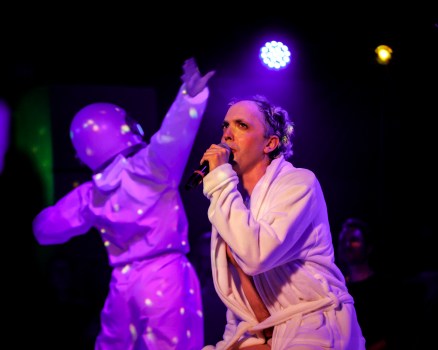
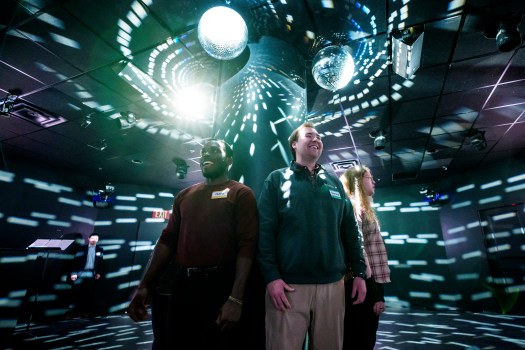
But here’s the real rub. The show also contains a series of what you might call scientific or perceptual or psychological experiments, all designed to further its themes of inquiry and get you to see that your perceptive powers are so subject to manipulation that they offer little that is definitive. Some of these experiments involve props or group activities and they tend to be presented in rooms dedicated to their purpose, rather as if one were on a guided tour of a science museum. A few may startle in their intensity, especially given the intimacy of the groups, but they’re carefully handled and there is nothing to fear from any of them. Some are indeed quite revelatory.
The piece’s biggest problem, to my mind, is the difficulty it has navigating the gap between the specific and the universal.
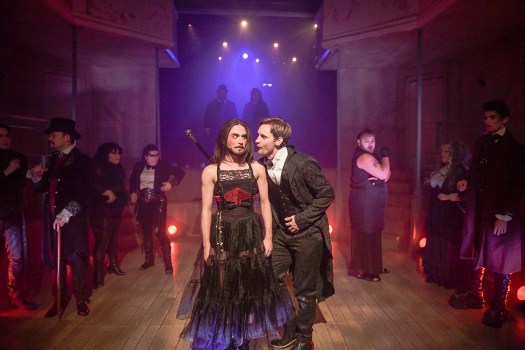
Many people are likely to go because of Byrne, and this is very much Byrne territory (I found myself, as “Diego” for the night, in a pre-show conversation with fellow fans). His voice is there as a comforting guide as is the physical iconography of his remarkable life. But Byrne is not of course present in person and the show tends to get caught between wanting to create rooms that Midwesterners can relate to and using what I’ll call Byrne specifics, for want of a better term. For example, a kitchen you enter is far from a Scottish kitchen (more like one from Wheaton in the 1950s) but a nightclub used in the show feels especially coded to the U.K. in the 1980s. Or so it seemed to me.

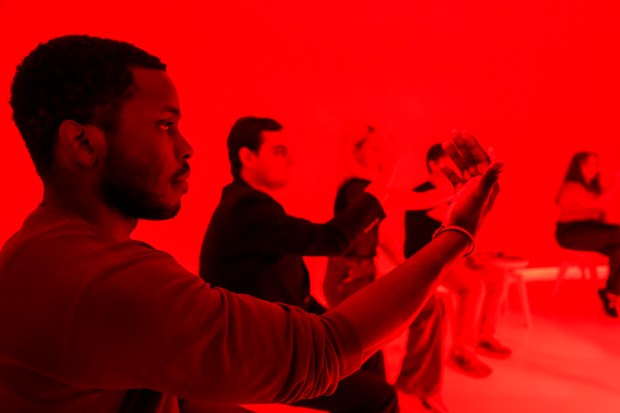
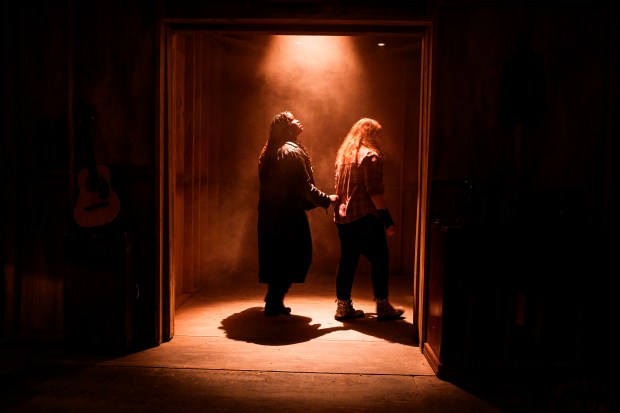
That club was much too big to be fully resonant for me, given the size of our group. But, other than that, the build out of all these rooms (the designer is Neil Patel) is formatively excellent, as were the logistics of the whole complex experience on the night I was there.
As directed by Scoville, “Theater of the Mind” all runs flawlessly and is very much centered on its audience and their needs. It’s never unkind or intimidating and, at least in my group, I watched it draw people closer.
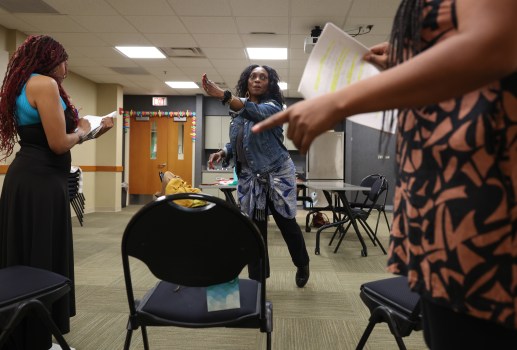
My most empathetic guide, Victor Musoni, had the right blend of amusing gravitas and familiarity. You may instead be led by James Earl Jones II, Elizabeth Laidlaw, Helen Joo Lee, Em Modaff, AJ Paramo, Shariba Rivers, Kelli Simpkins or Lucky Stiff, or maybe yet others, especially if this show catches on as the Goodman hopes and ends up here as one of Chicago’s major visitor attractions for months if not years. Certainly, it will take a while just to move through all of those who saw Byrne’s most recent concerts at the Auditorium Theatre. Plus “Theater of the Mind,” which premiered in Denver but was squelched by COVID, cannot be seen anywhere else.
A lifetime of David Byrne’s curiosity comes together for ‘Theater of the Mind’
That will change in time. I think Byrne and his co-writer Gaonkar should work more to develop the poetry of the script, so that it steps away more from logistics and “please do this now” and heads in the direction more of song lyrics, adding more complex symbolic verbosity to the cool activities baked into the show. That for me is the still-missing piece to what is a really fascinating addition to Chicago’s existing cultural banquet.
Chris Jones is a Tribune critic
cjones5@chicagotribune.com
Review: “Theater of the Mind” (3.5 stars)
When: Open run (tickets on sale through July 12)
Where: Reid Murdoch Building, 333 N. LaSalle St.
Running time: 1 hour, 15 minutes
Tickets: $69-$99 at 312-443-3800 and goodmantheatre.org