


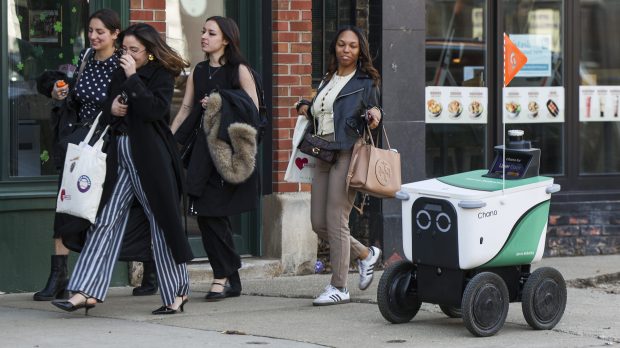

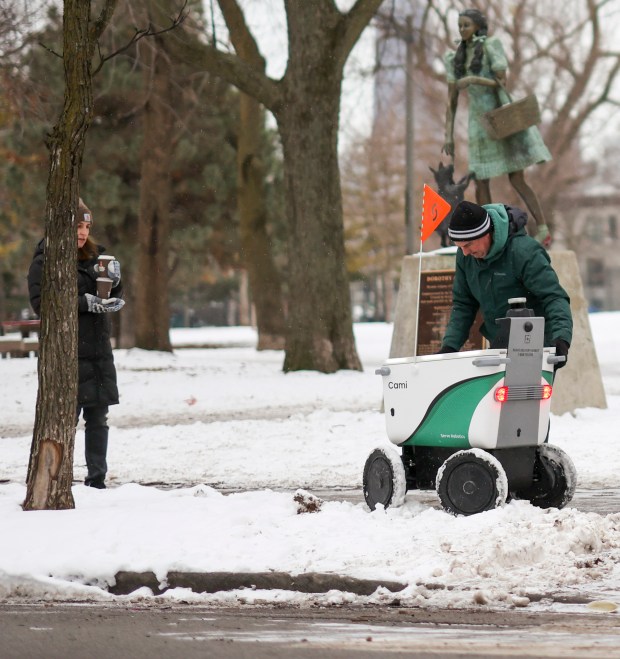

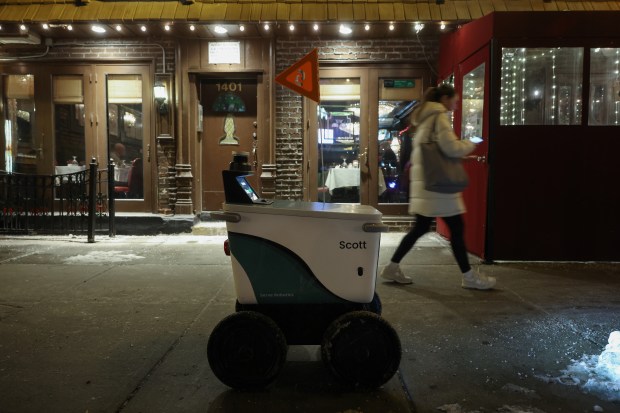

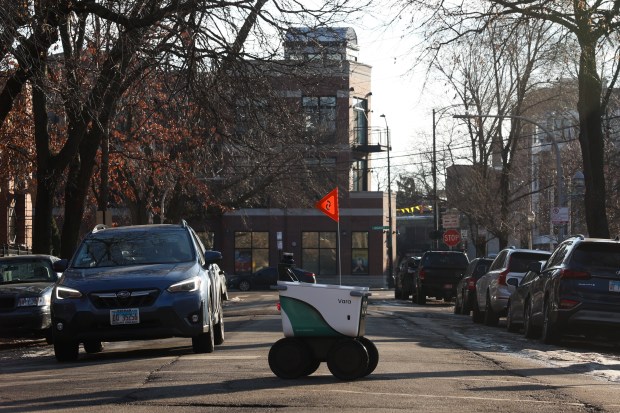


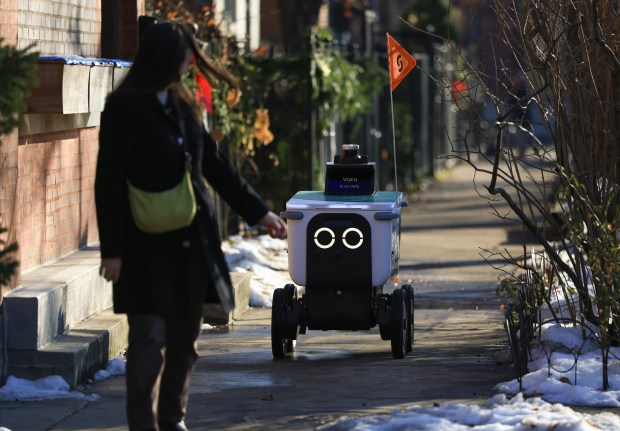

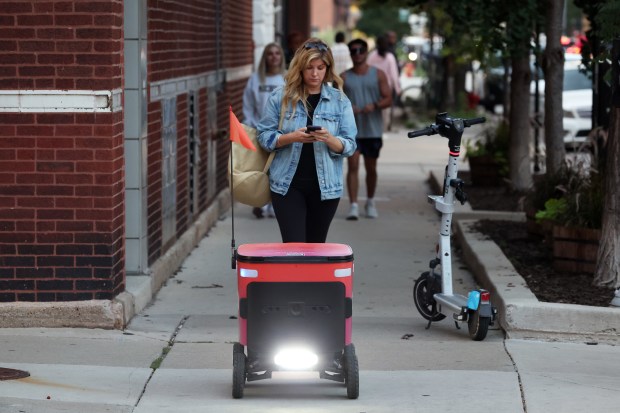
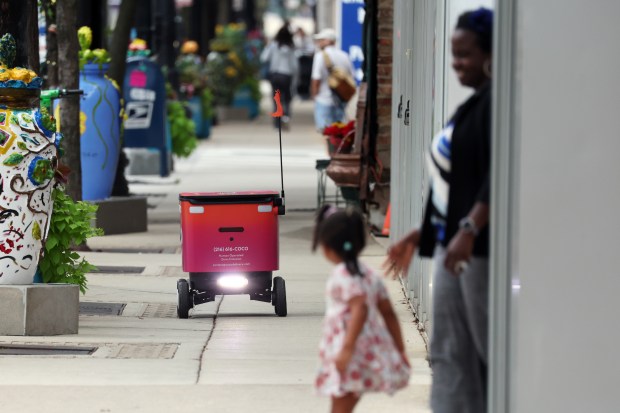
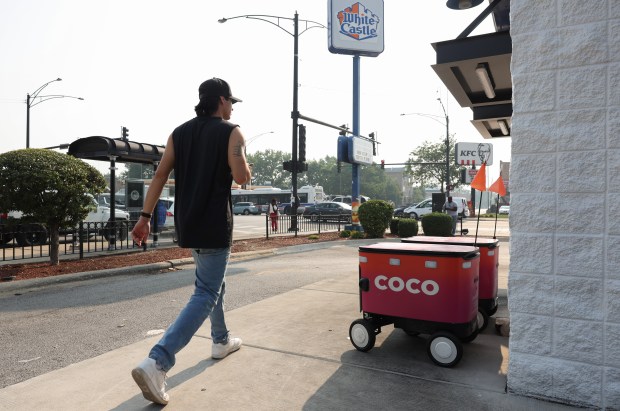

The front-page article (“Serving up food — and some mishaps,” April 19) on the food delivery robots — whose capabilities and business model we have allowed to be tested on our sidewalks — focuses primarily on safety. While I agree that we can’t have bots careening down our sidewalks crashing into bus stops, or worse, I believe that eventually these companies will advance their technology to the point that the robots are not a physical danger to the public. I think the real underlying issue here is how we want to allocate a very valuable public resource: space on our sidewalks.
One of Chicago’s great attractions is our neighborhoods. We have beautiful clusters of shopping, dining and residential areas all connected by sidewalks, making it easy to walk from place to place and enjoy these resources. We do not allow adult-ridden bicycles, scooters or other wheeled vehicles on these sidewalks, so that families with strollers, pets, small children and wheelchairs can all use them unimpeded. I don’t believe that we should force these sidewalk users to yield the right of way to a robot speeding to deliver a latte or a smash burger to someone in urgent need of a snack or drink.
We also have a vibrant community of walkers and joggers in Chicago who exercise using the sidewalks, often to access our beautiful parks or the lakefront. These people do not run in the streets, as that is where we allocate space for cars, bikes, scooters and other wheeled vehicles. Again, should these residents of our great city be forced to yield the right of way to a delivery bot motoring down the sidewalk?
We already have several other viable alternatives to these bots for delivery. There are plenty of car- and bicycle-based delivery services that integrate themselves much more seamlessly into our urban transportation network. I can’t recall ever hearing of a bike messenger crashing down the subway stairs or smashing into a bus stop. And these services provide employment for our residents as opposed to simply profit for some Silicon Valley startup.
I encourage our city leadership to think long and hard about how we want to allocate the public resource of our sidewalks. Should they be reserved for pedestrians, as they are today, for our families, children, exercisers, shoppers and diners, or do we want to secede them to a swarm of motorized robots out to make a buck?
I vote for the former.
— Chris Walvoord, Chicago
Consider delivery robot issues
I’m the organizer of the petition mentioned in the front-page story on sidewalk delivery robots. Over 4,350 (and counting) Chicagoans have added their names to our petition, asking the city to pause the delivery robot program until our leaders have quantified the true impact, weighed pros and cons in a public hearing and set rules ensuring our sidewalks remain people-first.
According to the article, “A review of city records shows the companies have jointly self-reported few incidents.” Shocking!
But give Chicagoans an easy way to report incidents, and the story’s a bit fuller. Over 1,000 of our neighbors have used the petition form’s optional “Incident” field, and I wanted to add to what the article mentions about this by sharing just some of the reports we’ve received this month (trimmed for anonymity and space):
• “I’m a wheelchair user, these things are completely disruptive & dangerous.”
• “(Robot) ran into my dog, then started making jerking movements back and forth in front of us.”
• “I saw an ambulance come to a full stop because one of these robots was crawling through the intersection. Disgraceful.”
• “Robot aggressive, won’t move continues to move forward into legs.”
• “These robots always park outside of my apartment and their bright lights and noises are very distracting and disruptive – especially at night.”
• “It is impossible to get around them with my kids stroller.”
• “robot inexplicably halted underneath narrow scaffolding, forcing older gentleman in motorized wheelchair to wait/ultimately drive out in the street to go around.”
The bot companies claim that every robot trip means one fewer car trip. Maybe. But what if, instead, robot trips replace bike trips? Or what if turning our sidewalks into lanes for these little commercial vehicles leaves the total number of cars in the street unchanged? Economists know that when vehicle trips move to newly added lanes, new trips fill the spaces left behind in the older lanes.
Let’s address emissions and street congestion. And let’s do it in a way that doesn’t make pedestrians’ trips worse.
And by “pedestrians,” I mean humans. The bots are, in the words of Fast Company, “strategically cute,” and the scheme has apparently worked on some cities, with many going so far as to define the bots as pedestrians. But there are also cities, like tech-friendly San Francisco, that have seen through the ruse and restricted them.
We Chicagoans would be wise to decide carefully.
— Josh Robertson, Chicago
City should stop delivery robots
To the Chicago City Council: Don’t allow robotic delivery services to keep plaguing our neighborhoods.
Our sidewalks are not the place for another obstruction to a pleasant stroll. Let’s not add to the trials of being a pedestrian in Chicago, no matter how much money the city might get in return. Chicago is a friendly city where people smile and say hello to others on the street. Dodging these rolling boxes is more than just another distraction that keeps people from interacting, unless it’s to comment on how these obnoxious devices are ruining a pleasant local walk. More importantly is that delivery robots can be dangerous. Too many times, I have seen moms or nannies strolling with their babies stuck behind one of these devices at street corners with no way to get past them. The same can be said for people using wheelchairs or those who find it difficult to walk the sidewalk in the best of conditions.
Again, blocking the sidewalk is more than an inconvenience. Our sidewalks and intersections are not created for these things.
Food delivery is a source of income to human people and for some their only source of income. Economic hardships are seen across the city, and these devices remove an option for many to make a living. In any use, I’d rather get a meal delivered by a person with whom I can communicate, even it is for a brief moment.
Where is the proof that these devices have taken cars off our neighborhood streets? Double parking goes on despite the invasion of delivery robots.
Finally, I suggest we have enough nonhuman contact. Consider artificial intelligence phone systems that only add to the frustration and inhumanity of our lives.
Let’s leave the robots to our telephones.
— Linda Kravitz, Chicago
Let our youths use e-scooters
I support restrictions on e-bikes and scooters, but apparently our state legislators are rubber-stamping approval of restrictions. While I am sure not many of them have children in the age group cited in the regulations, they may have grandchildren in this group. I’ll bet there is a large group involving ages 8 to 16.
If what I read is correct, anyone under age 16 will be prohibited from riding an e-scooter capable of speeds of 10 to 20 mph. I have grandchildren in this age group who use a bike path in the suburbs for riding, and yes, they do use helmets. If I were a manufacturer, such as Razor, I would definitely question parts of this legislation. They would lose a substantial amount of business in Illinois, and additional states, if others adopt our rules.
What I ask at the very least is to amend the age restrictions on low-speed e-scooters. Also, how is law enforcement going to enforce this? I agree that youths don’t obey traffic laws because they aren’t exposed to them until they get a driver’s license at 16. At that age, most want to get into a car to get around anyway.
Restrict the faster scooters, but leave slower ones alone for youths to enjoy. I do get a kick out of watching a game show giving away an e-skateboard capable of a speed of 25 mph, which is a little insane.
Keep in mind that this also affects scooter rentals. I do hope our secretary of state and state House members takes a closer look at this legislation.
— John Urban, Downers Grove
Fires caused by e-bike batteries
State legislation regulating e-bikes and other mico-mobility devices addresses the very serious and growing problems concerning the operation of these devices, but does not address the very real dangers these devices pose when not being operated: catastrophic fires caused by uncertified batteries.
These fires have been well documented and verified by emergency responders around the country. It’s time for legislation banning the sale or use of uncertified batteries in these devices.
Step up, Illinois.
— Laurence Calinda, Chicago
Enforcement has been lacking
The Illinois Senate passed legislation on the use of e-bikes. There is disturbing use by 13-year-olds and those who are older in bike lanes and our once-tranquil walking and bike trails.
It is a great first step. The House will hopefully follow.
As a not-too-elderly cyclist, at 73, I have been riding our streets since my own youth back before any bike lanes, much less dedicated bike paths. Advocacy wins.
Enforcement primarily by parents and law enforcement has been lacking.
— Paul Dieterle, Wheaton
Stacy Davis Gates’ vision for CPS
Stacy Davis Gates’ op-ed (“CPS will be rooted in sustainability, fairness in 25 years,” April 19) offers us a vision of what could be ahead over the next 25 years for Chicago’s public school system and the city. Public schools that function as true community hubs is a goal worth pursuing. The benefits such schools would provide to their neighborhoods should encourage support from all of us, whether or not we have children in the schools.
But it’s difficult to imagine how any of us can commit to full support of such a vision without more details about how we get there. A skilled leader, Davis Gates has the experience to know that we cannot achieve such a vision without a strategy that includes action steps and interim objectives. Measurable ones.
So, the challenge to Gates is this: How are you planning to get there?
— Jeff Epton, Chicago
ARO a hindrance for housing
The editorial regarding the shortage of housing causing increased rental costs (“The reasons for Chicagoland’s rent surge aren’t mysterious. It’s a supply problem,” April 21) was excellent as far as it went. But there is one major factor left out of that piece and in many articles that have been written recently.
I’ve been in the real estate business for over 50 years and have managed, operated and developed numerous properties. I’m also a founder and member of many building owners groups that provide naturally occurring affordable housing. I also sat on the board of directors for 15 years of the city of Chicago’s Low-Income Housing Trust Fund, which helps maintain affordable housing in our city. I understand private sector and public sector housing. I support the need for both.
Everyone talks about zoning, construction costs, financing costs and long approval times for permits. Those all make development difficult but not impossible. Everyone seems to be silent on the issue that is keeping many neighborhood projects from getting off the ground.
The single item that stops new projects is when the Affordable Requirements Ordinance (ARO) is required, with a set-aside of 20% of the units to be rented at below market prices. Theoretically, it is a wonderful thing that provides affordable housing. The reality is that little or no housing gets built as a result. It can work only in the very highest rental areas of town where the very high rents can buffer this cost. In the neighborhoods of Chicago, it doesn’t!
Even when factoring in some real estate tax relief programs, its reduction to the bottom line is fatal to the projects pro forma. Many possible sites are left as vacant lots or underutilized buildings because of it.
What is the solution? Revise or eliminate the ARO. The ARO has not added a meaningful number of apartments because it stops projects from occurring. Get more housing built. With predictable zoning and without the impact of the ARO as it now stands, you will soon see tens of thousands of apartments under construction.
Developers will always oversaturate the market and cause a glut. In this case, a glut would bring lower rents. When we look at areas in this country where there is overdevelopment, such as Austin Texas, rents are decreasing.
I hope a solution can be found to bring sorely needed construction back to this city.
— Mike Chioros, Chicago
Submit a letter, of no more than 400 words, to the editor here or email letters@chicagotribune.com.


