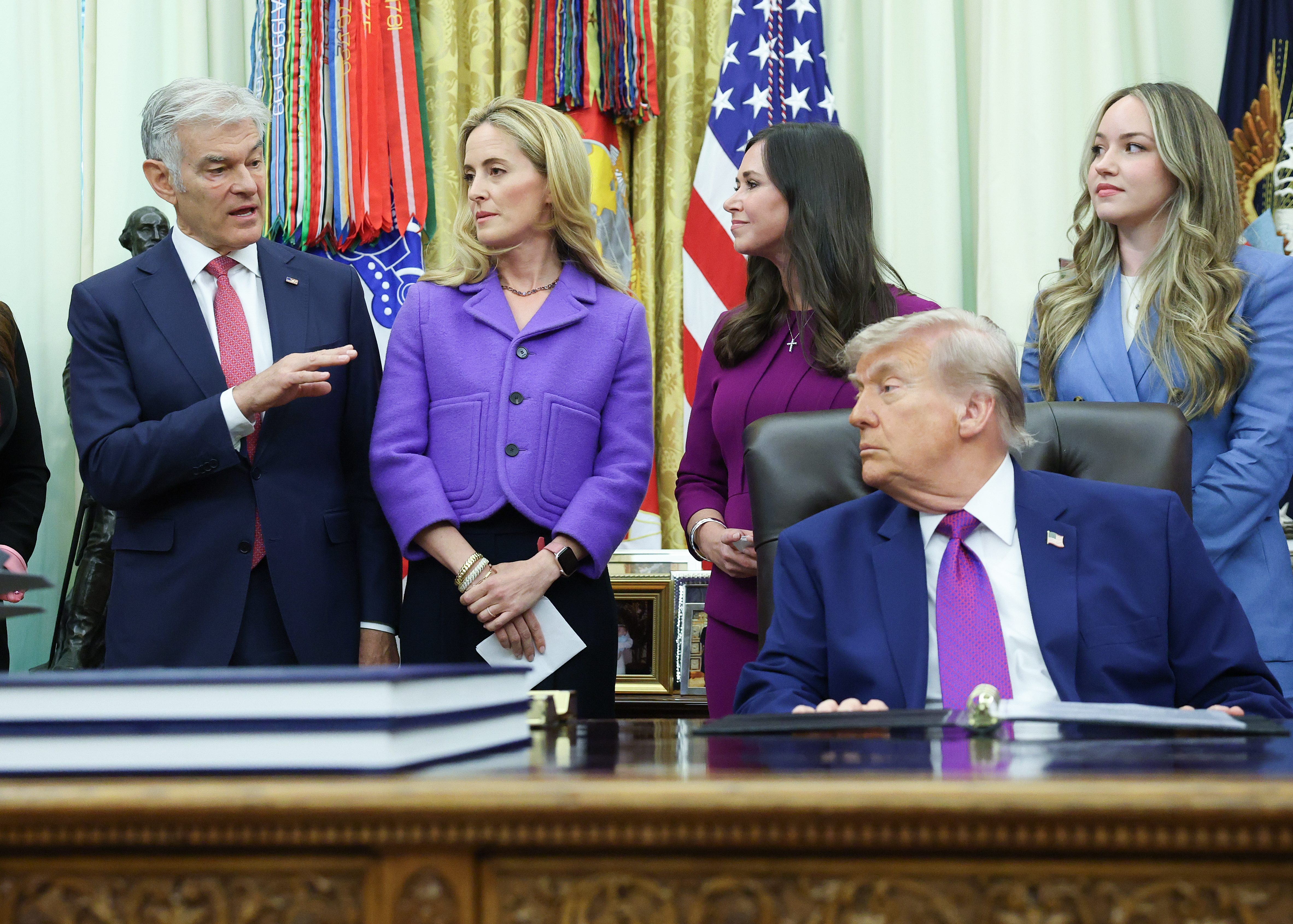

It was just my luck last week that as my column on the fertility crisis was being laid out in newspaper pages and posted to websites, the sharpest minds of the Trump administration were gathered in the Oval Office to hold forth … on the fertility crisis.
Bad timing is an occupational hazard. But something made it a little more painful for me. As President Donald Trump struggled to keep his eyelids open nearby, Dr. Mehmet Oz, who heads the Centers for Medicare and Medicaid Services, stated the gravity of the crisis in terms our nation will not soon forget.
One in three Americans, the former TV personality and cardiothoracic surgeon intoned, are “under-babied.”
Eh?
“That means that you either don’t have any children or you have less children than you would want to have,” he said. “We have a crisis that’s causing our fertility rate to drop below 1.5 (per woman). Replacement rate is 2.1.”
“So, we’re way below what we need just to even replace the people that we have in America,” he added. “And one of the challenges is that rural America, where there’s 60 million people, has a maternal mortality rate, when they have babies, that’s about 30% higher than if you live in an urban area.”
Flanked by Oz and other top public health officials, the president signed an executive order to establish Moms.gov, an official website offering helpful information to expectant mothers.
Yet, as Oz praised Trump for having “saved Medicaid,” it did not go unnoticed by reporters or the president’s Democratic critics that the president signed cuts to the health program into law last year, which led to dropped coverage and clinic closings in the same rural America that Oz praised the president for “saving.”
While Oz’s neologism got a great deal of attention, it would be useful to pause and consider his remarks as we grapple with what may or may not be an ongoing economic and political problem.
If we all assume that population growth is necessary for America’s continued economic welfare, the problem is of a fundamentally different nature for the right and the left/center in American politics.
Let’s revisit Oz’s concern that we “replace the people that we have in America.” There are really only two ways to do this: raise the birth rate and/or increase immigration.
The American right is a diverse sphere of opinion, even if MAGA populism is currently driving the bus. With some exceptions, including the folks at the libertarian Cato Institute, a good portion of the American right is critical of increased immigration. Aside from arguments about supposedly elevated crime rates and costs to the public purse that immigrants present, which Cato scholars and many economists dispute, what the right is left with is arguments about identity.
Many in the center and on the left worry about raising the immigration rate as well, but their concerns tend more to focus on standards of living, who wins or loses in the labor market, and other fiscal and economic concerns, although some are also swayed by identity.
I heard from a lot of readers after the last column, some who agreed with me and others who took exception to my characterization of pronatalism. But nearly all seemed to feel that money and personal responsibility were paramount factors weighing on their family plans.
As a fellow parent, I long ago learned to avoid having more children than I could afford to support, if possible.
I also found little dispute that financial pressures seem to weigh more than any other factor for young couples planning a family.
I think the public debate on fertility would be a lot more fruitful if we grounded it as a facet of the problem of maintaining steady economic growth and living standards — or, to use another current buzzword, affordability.
When our income grows faster than our expenses for the necessities in life, and when we reasonably expect that trend to continue, that’s called affordability. And when affordability reigns, we act differently from when the opposite condition obtains, as has been the case for years in the minds of many Americans. It’s not just personal responsibility that directs our actions but also public policies on taxation, healthcare funding, education and housing, which all affect affordability.
And that’s where we often see a political stumble. Conceptually, it should be simple. As I recall the late conservative icon Jack Kemp advising: “If you want less of something, tax it. If you want more, subsidize it.”
That’s how I look at programs like family leave, daycare, preschool and other nice projects for family support. Yet conservatives are the least likely to support government help even when it produces social behaviors and goods that all agree on. Democrats are widely perceived to support government support programs, but especially recently they have done a poor job of selling or defending them.
In our polarized and dysfunctional political era, it’s getting hard to remember a time when the parties could come together to do helpful things to improve the lives of ordinary people.
And that is one of the reasons why many Americans fear bringing kids into the world.
Email Clarence Page at cptimee@gmail.com.
Submit a letter, of no more than 400 words, to the editor here or email letters@chicagotribune.com.