















Once the tornado hit Lake Village on the night of March 10, the 911 calls came in to Newton County’s dispatch in rapid succession.
At 7:17 p.m., a call referenced a house hit, with three people inside. Two minutes later, there was a report of severe damage in the area of County Roads 600 W and 900 N, with a request for a full response from Lowell, Morocco and Lake Village Township fire departments.
A minute later, there was a report of several houses with heavy damage or gone. “SEND OUT AN ALL PAGE// NEED ALL THE HELP WE CAN GET,” noted the 911 call log, provided to the Post-Tribune by Jim Large, Newton County’s E-911 director.

The log and interviews with Newton County officials and weather experts paint a picture of how a small community grappled with a rare EF3 tornado that killed an elderly couple and injured six people in Lake Village, and the steps officials took as the tornado came bearing down to do what they could to keep residents safe.
Early warning signs of severe weather
The morning of Tuesday, March 10, Matt VanDrunen, Newton County’s Emergency Management Agency director, attended a monthly meeting of the District Planning Council held at the MAAC First Responder Training Campus in Valparaiso.

The meetings include officials from all the counties in the district – Lake, Porter, Newton, Jasper and LaPorte – and the National Weather Service sent a representative to talk about what they could look forward to in terms of the weather.
“He told us the weather that day, to be on the lookout,” VanDrunen said.
The humid weather in the 70s had the weather service on heightened alert because cooler temperatures in the 50s and 60s were on their way and would bring storms, VanDrunen recalled.
“That storm system had been brewing,” Newton County Sheriff Shannon Cothran said.
At 4 p.m. that afternoon, the National Weather Service of Chicago issued a tornado watch, in effect until 11 p.m., per the dispatch log. By 5:49 p.m., officials sent out weather spotters to track the skies, Large, the E-911 director, said.
That included spotters just over the state line in Illinois who, at 6:52 p.m., reported the tornado was on the ground and making its way east. A minute later, the county activated its north end sirens.
The National Weather Service issued a tornado warning at 7:08 p.m.
“We had already set the sirens off because we witnessed the tornado,” Large said. According to 911 dispatch records, the sirens went off another time when the weather service issued its warning.

Large, VanDrunen and Cothran were in the conference room at the EMA office in Morocco when the weather service issued its warning.
“The three of us were sitting in here, in this room, and walked outside before everything broke loose,” Large said.
“We were ahead of the game by having trained spotters out monitoring the weather,” VanDrunen said, and already knowing about the touchdown across the state line in Kankakee and Aroma Park, Illinois.
Newton County received 117 calls to its 911 dispatch center after the tornado hit.
Dispatchers were able to answer 43 calls, Large said, and the rest rolled to backup dispatch centers in surrounding counties. Jasper County is Newton County’s primary backup, followed by White County.

When Lake Village Township Volunteer Fire Department Chief Rob Churchill reported damage, “and to send as much help as possible – I think that was what his words were,” VanDrunen said he and the others headed to Lake Village to coordinate services and make sure the calls were getting addressed.
Churchill said he was one of four firefighters trained as weather spotters who were out the night of March 10. He and a lieutenant from the fire department were in Illinois, tracking the tornado as it moved through communities across the state line and headed east.
“When the tornado was still west of Momence Park, we had eyes on it,” Churchill said.
At 6:58 p.m., per the 911 dispatch log, the National Weather Service advised weather spotters to abandon their posts and seek shelter immediately.
Churchill said he and the other spotters from the fire department had watched the tornado’s path as it made its way to County Roads 600 West and 950 North.
“We went towards town because we could see the destruction,” Churchill said.
‘How do you train for an EF3 tornado?’
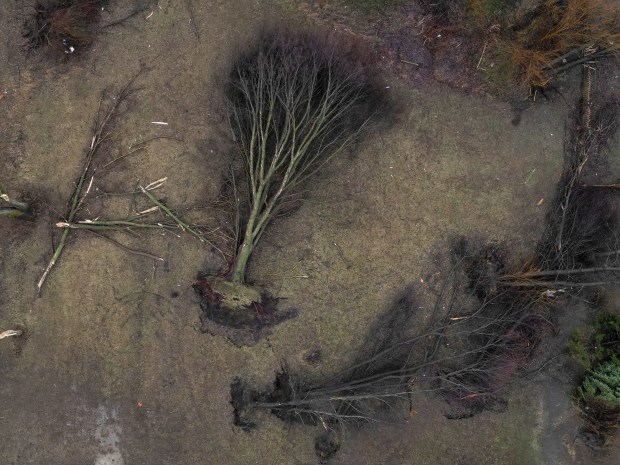
Eric Lenning, meteorologist in charge with the National Weather Service’s office in Romeoville, Illinois, helped conduct a damage survey on March 11 to verify tornadic damage, determine the tornado’s strength, and plot its path, length, width, maximum intensity and timing.
“Usually there’s something on the radar that leads us to believe it’s tornadic,” he said. On radar, that can be a hook, visible like a tail.
The weather service also gets reports and photos of the damage, so surveyors often know in advance that a storm was tornadic.
“Certainly on that day, it was very clear it was a tornado,” he said.
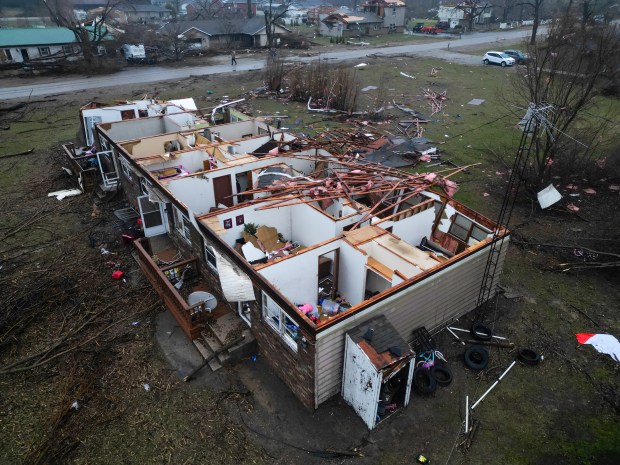
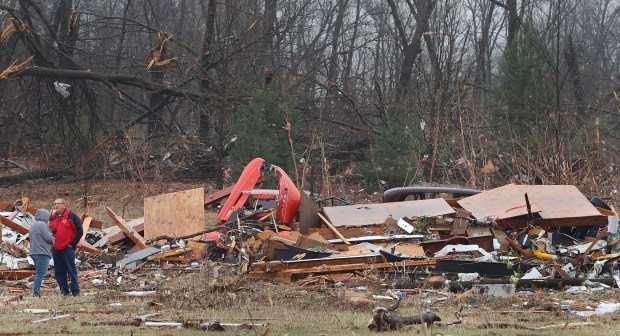
Lenning was on one of three teams dispatched to the scene that day. His team started just west of Lake Village, at the site where Edward and Arlene Kozlowski died in their home, one of the areas worst hit by the tornado.
“Two of the three homes in that area were swept clean of their foundation,” he said, adding that the type of home and how it’s constructed also play a role in how badly it could be damaged by high winds.
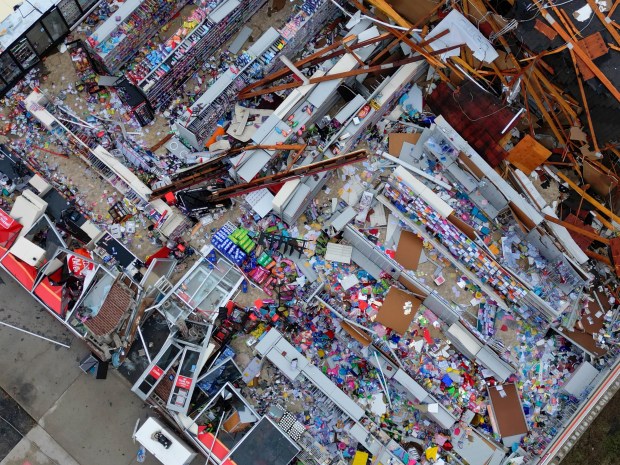
Parts of the storm were EF2, including where Family Dollar and the Citgo station sat, and likely were hit by 120 mph winds, Lenning said.
“120, 130, 140 mph is still very much in the ballpark of a very strong tornado,” he said.

The first call for the fire department was to Family Dollar, at 8635 N 300 W, where three people were trapped inside.
“To be honest, it was a blur,” Churchill, the fire chief, said. “It was just constant calls. I don’t know how many were back-to-back.”
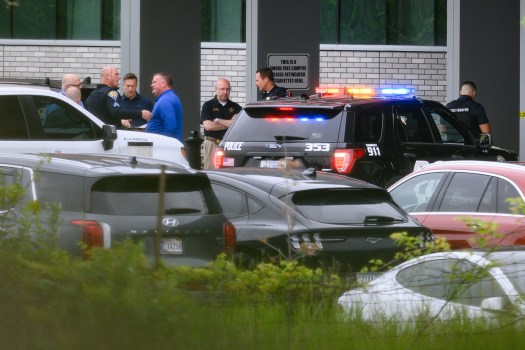
When Cothran, VanDrunen and Large left the EMA office in Morocco to head to Lake Village, “as far as we could get was the Family Dollar and the Citgo station,” which is across the road from the discount store, Cothran said.
Cars were lined up along U.S. 41, parked along the side of the highway, the sheriff said. He wasn’t sure if people were there to help or take a look at the destruction.
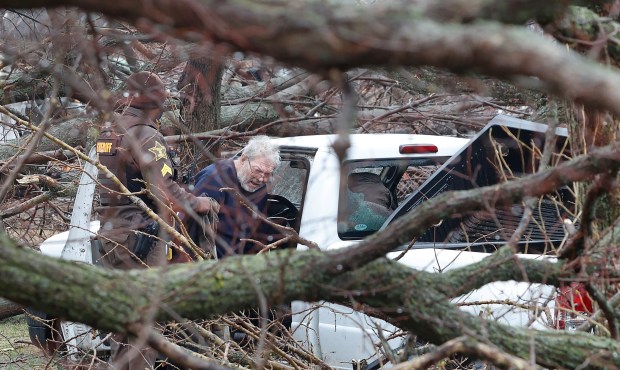
“Our No. 1 priority was high visibility patrols,” he said, adding that many people couldn’t find their cellphones or lacked service in the aftermath of the tornado, but would be able to flag down help if they needed it, “and that happened quite a bit.”
Starting immediately after the tornado, Cothran also took to the sheriff department’s Facebook page to share live updates about what was going on. Those continued until late that night and started back up the following day.
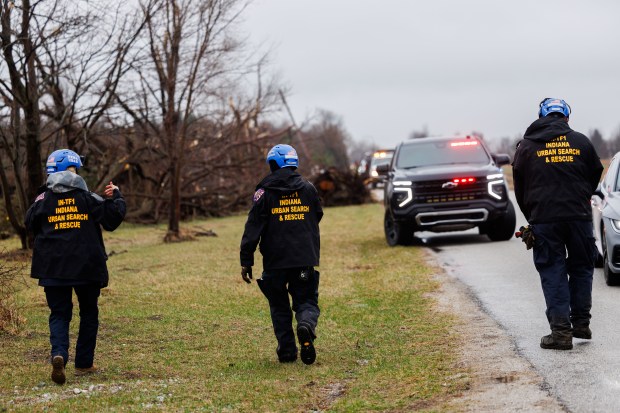
“Everything that was affected, there was a search done that night,” said Churchill. Some secondary searches were conducted that night as well, he said, and Indiana Task Force 1 assisted with search and rescue the following day, but everything was found during the primary search. “We were pretty proud of that.”
The homes of a couple of firefighters, Churchill said, were seriously damaged by the tornado but once they knew their families were safe, “they still knocked on doors and kicked in doors. That says a lot to me.”
Officials are also glad they sounded the tornado sirens in advance of official notice from the National Weather Service, based on what their own weather spotters witnessed. They credit the advance notice with preventing more casualties from the storm.
“How do you train for an EF3 tornado?” Churchill said. “I felt very confident in our people and the responding agencies.”
EF3 tornadoes ‘don’t happen very often’
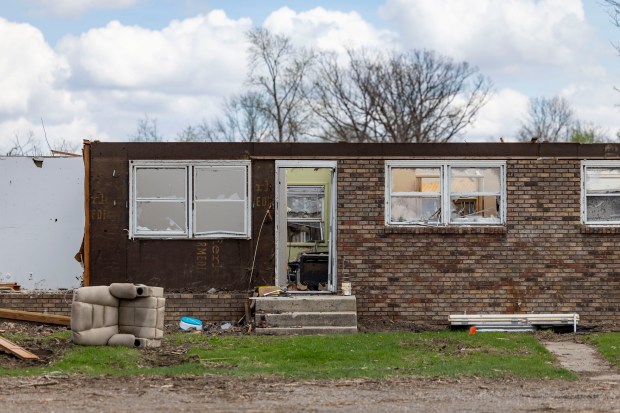
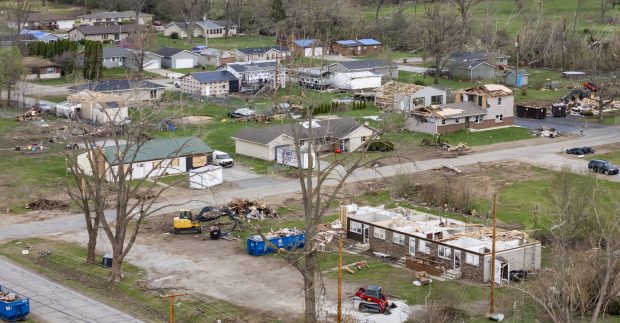
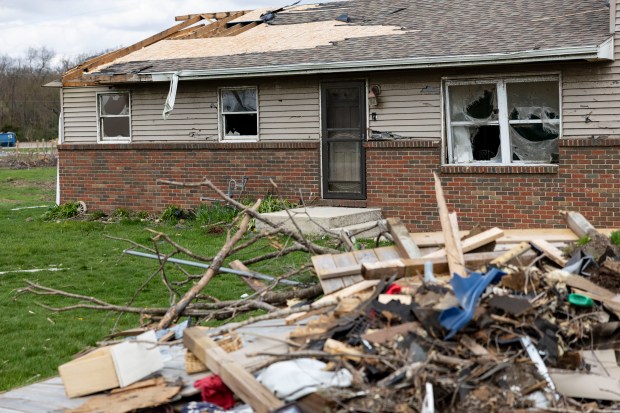
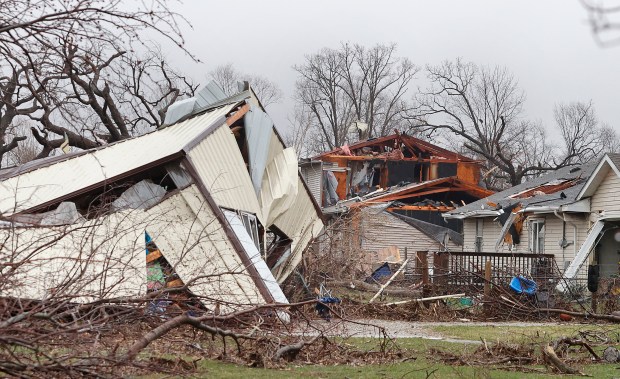
In the weeks after the tornado, the damage was still painfully visible. Blue dumpsters lined County Road 300 W, and tarps covered many roofs.
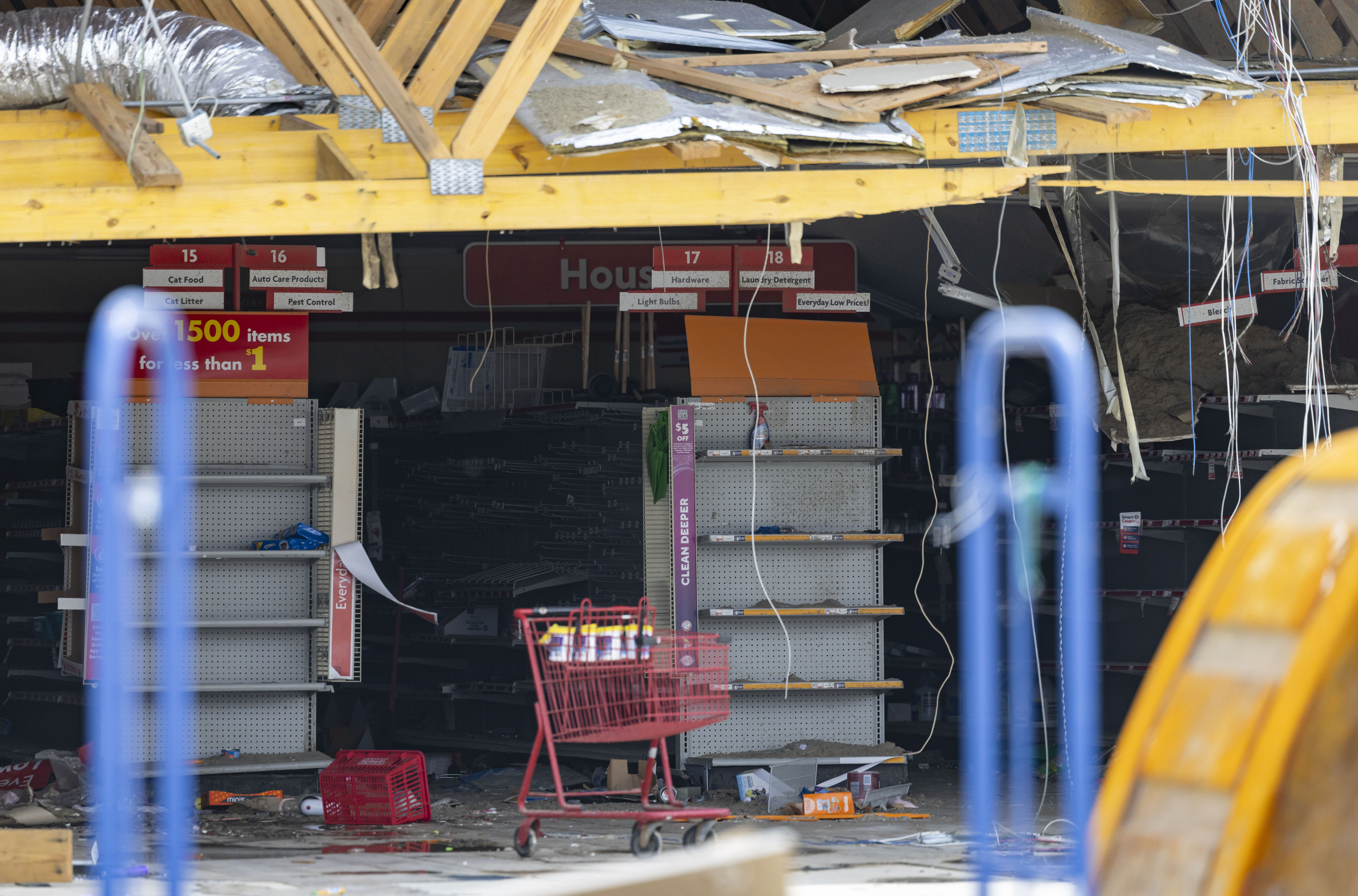
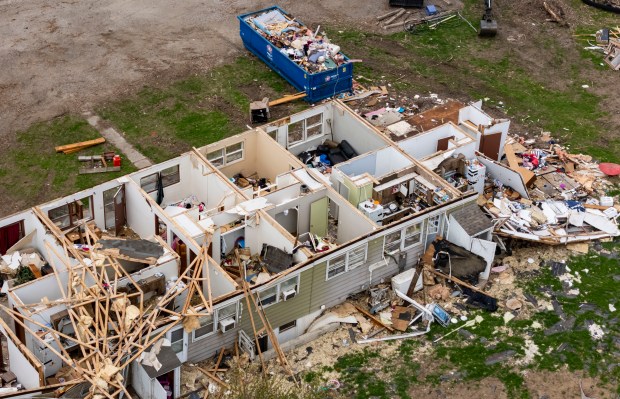
Family Dollar was cordoned off with chain link fencing, a small American flag placed on the fence. The roof trusses were visible, and excavators sat silently outside what was left of the building.
The remaining windows had orange and red stripes, the chain’s hallmark colors. Bunny slippers, a fire extinguisher and fake purple flowers were part of the debris strewn around the site, along with a stray shopping cart and a deflated, black and purple balloon with “Family is everything” on it.

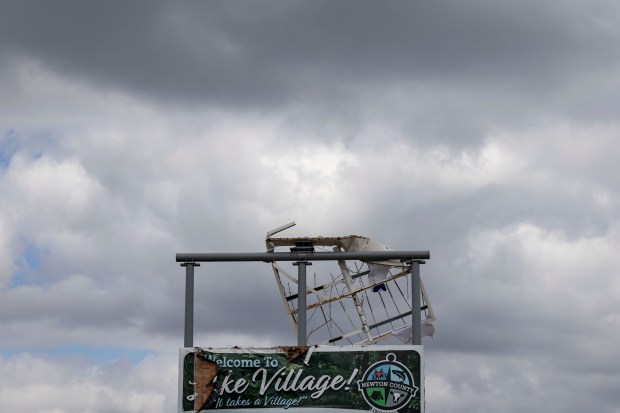
A tattered “Welcome to Lake Village” sign sat not far from the Citgo gas station across the road, also fenced off. The storm toppled the Citgo sign, leaving it hanging by the closed convenience store, but a couple of people arrived at the site.
Justin Gill, a laborer from St. John, said he was working for a general contractor that handles cleanup and teardowns.
“We’ve never dealt with a tornado,” he said.
An EF3 tornado, said Leanne Blind-Doskocil, staff meteorologist and adjunct faculty member at Valparaiso University, has speeds of 136 to 165 mph. The wind speed is estimated by the damage on the ground.
The EF scale, or Enhanced Fujita scale, goes from 0-5, with an EF0 tornado starting at 65 mph and an EF5 tornado being over 200 mph, she said.
The tornado that traversed through Kankakee, Illinois, and into Lake Village and nearby areas had a peak wind speed of 160 mph, she said, just shy of the classification for a stronger EF4 tornado, which starts at 166 mph.
“Most tornadoes are rated EF1 or lower, approximately 77%, and almost all tornadoes, 95%, are below EF3 intensity. Those this strong don’t happen very often,” she said.
Two things cause severe storms: Instability, such as a moist, warm environment that provides the ingredients for a thunderstorm, and wind shear.
“That’s just the change in wind speed or direction with height,” Blind-Doskocil said. “This wind shear is important because it supports the length and intensity of strong storms, and also the rotation.”
The U.S. is “the tornado hotspot of the world,” Blind-Doskocil said, and they most often occur in the Great Plains, Midwest and Southeast because of their geography and terrain.
The National Weather Service’s Storm Prediction Center predicted a moderate risk for severe storms or tornadoes on March 10, she said, which is a Level 4 out of 5, “so we knew this was going to be a big day.”
The predictions are made four to seven days out and are pretty reliable for high-end storms, she said, though determining which storms will produce tornadoes is harder to predict.
142 properties damaged in Newton County
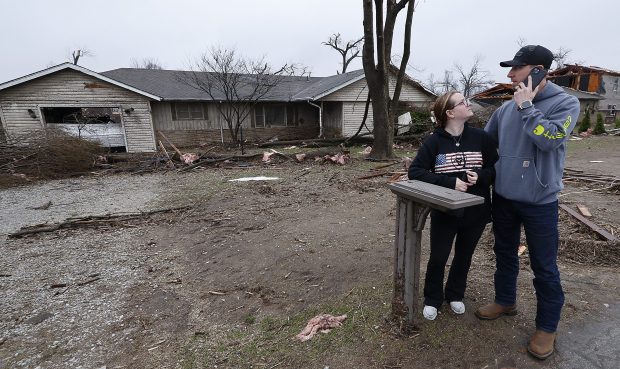
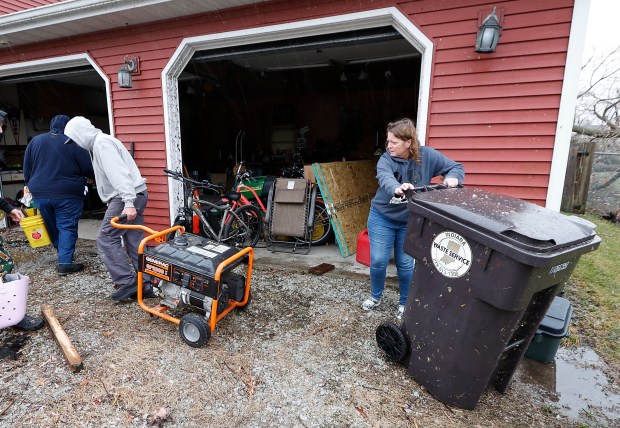
Lake Village residents are still trying to put their lives and their homes back together. On a morning in mid-April, signs for construction and restoration companies dotted homes, while the sounds of heavy equipment could be heard in the distance in the tiny town of 478 people, per 2020 U.S. Census data.

Lake Village Township Trustee Nikki Hanger pulled up in front of what was left of her house and talked about balancing the needs of the community as an elected official with handling the damage to her longtime home.
“It’s been a little difficult for me,” she said, fighting back tears. “It’s hard. You want to help everyone else but your house is gone, not totally, but has to be torn down.”
Hanger, 65, had lived in the badly damaged home not far from County Road 300 W for 36 years.
“You know how I know that? My husband told me before we left, ‘We’ve had tornado warnings before. We’ve lived here 36 years. We’re going to be all right,’” she said.
She and her husband Scott had just left their home before the tornado struck because their children kept asking them to leave. The Hangers made it to the fire station before the tornado hit their house.
After the storm passed, Scott Hanger came back to see how their house fared. They will be tearing it down and rebuilding on another property in Lake Village, Nikki Hanger said, and are renting a place for now.
In all, VanDrunen, the county’s EMA director, said that, per an Indiana Department of Homeland Security damage assessment, about 142 commercial and residential properties in Newton County had some level of damage from the tornado. A financial estimate of the damage is not yet available.
A few blocks away, Bud Bushman was on his front porch, awaiting the delivery of shingles to repair his roof. Bushman, 77, said he’s lived his entire life in Lake Village. He retired 21 years ago as assistant plant manager after working at Rieter Automotive in Lowell for 35 years.
He said he was “standing right here on my porch, watching it” when it rolled through town. He went inside briefly, chased there by large hail, the size of which he demonstrated by making a circle with his fingers, and then came back out.
“You could hear it coming and the wind was ungodly,” he said.
He lost a few shingles and said while other parts of town suffered considerable damage, including the block where Hanger lived, “it missed me.” He also had a few trees down, including one that landed on a power line, and had to leave his home after the storm and stay with family because of a gas leak.
“We’ll all survive,” he said. “It just don’t look the same.”
alavalley@chicagotribune.com