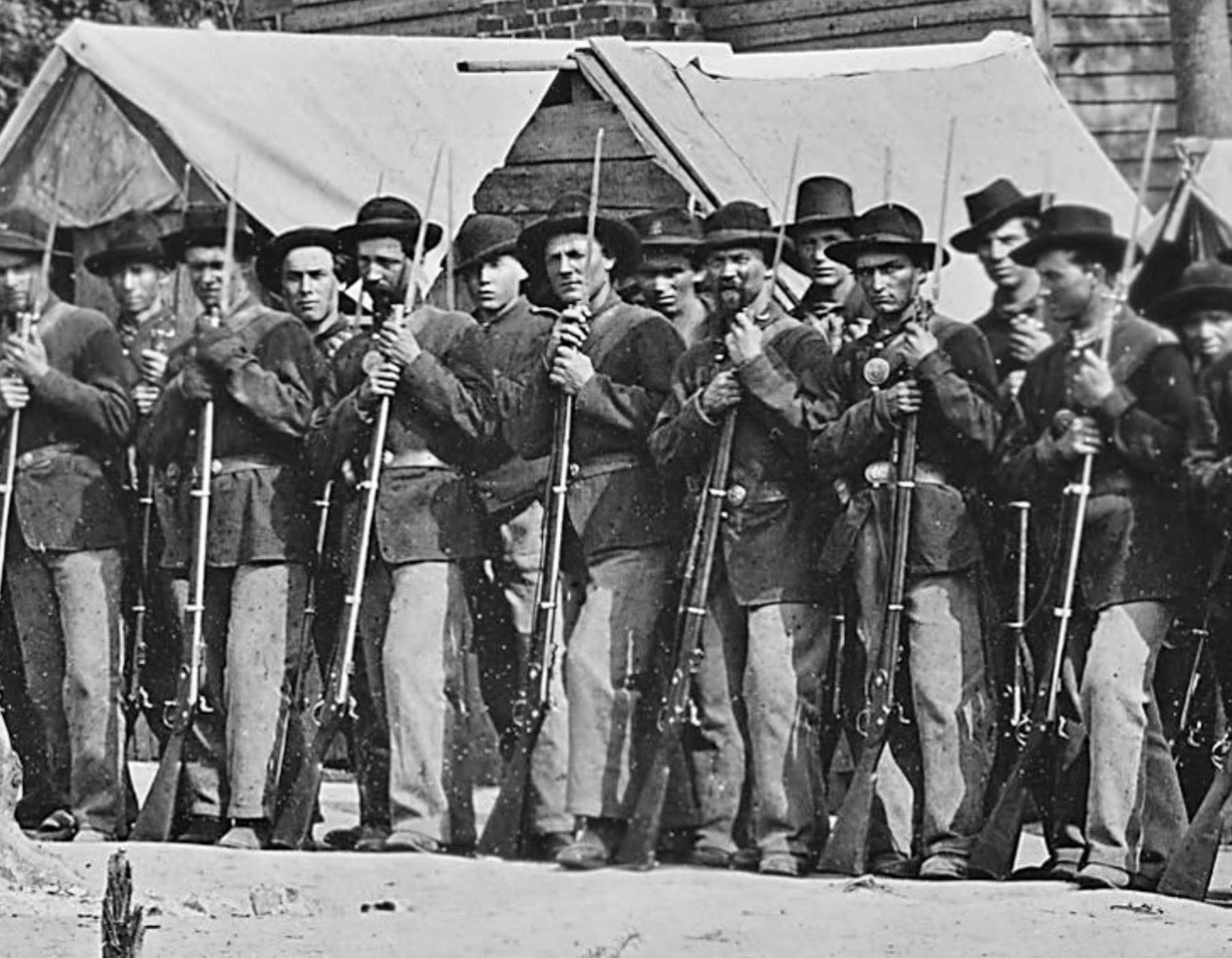

At the cusp of the Civil War in 1860, Porter County had only 10,313 residents but participated in a large way, sending 1,200 of its sons to fight for the Union cause.
There were at least 171 who never returned, losing their life on the battlefield or to a just as deadly adversary – illnesses and infections that had no antidotes in those days.
Those who did come home left their lasting mark on the local community.
David Canright, the former managing editor of the Chesterton Tribune daily newspaper, for years has studied Porter County’s participation in the Civil War. In connection with Memorial Day, he gave his presentation, ” North Porter County in the War of Rebellion,” on Thursday for the Duneland Historical Society, which met at the Hawthorne Park Community Building in Porter.
“They went just about everywhere and did just about everything. They were in all ranks from private to general…. They marched up and down mountains in the rain, slept in the mud, drank bad water, and ate bad food,” Canright said. “They saw slavery up close and ended it. They saved the Union.”
Even before the war, Charles Osborn, who lived in Jackson Township, was recognized as a pioneer of the abolitionist movement. William Lloyd Garrison, who became the nation’s best-known abolitionist, credited Osborn as being “the father of all of us abolitionists.”
The 1860 election of Abraham Lincoln became the turning point. Chesterton was then known as Calumet and usually a Democratic stronghold.
Republicans who met on election night in the city of LaPorte at the Huntsman Hall, according to contemporary accounts at the time, knew that when Lincoln had won the community of Calumet, their candidate was likely to win.
Five months later, after the Confederates fired on Fort Sumter outside of Charleston, South Carolina, on April 14, 1861, people rallied outside the Porter County Courthouse in Valparaiso to begin the recruitment of troops to fight. More than 100 responded, the first of many from Porter County.
One of the leading local voices at the time was Robert Cameron, a Republican activist, who edited the Valparaiso Republic, a weekly newspaper.
Cameron later left his editorial post to enlist and by the end of the Civil War, rose to the rank of brevet major general.
The Battle of Shiloh in southwest Tennessee on April 6-7, 1862, brought home the savagery of the war as there were more than 24,000 casualties on both sides.
The Valparaiso Republic carried a long list of casualties from the 9th Indiana Infantry Regiment, which had a large contingent of soldiers from Porter County, Canright said.
Isaac C. B. Suman was another Porter County resident who distinguished himself in his service with the 9th Indiana Infantry Regiment, rising to the rank of colonel.
During the Battle at Stones River in Murfreesboro, Tennessee, on Dec. 31, 1862, Suman was shot twice, with one musket ball severing the artery in his arm, and the other penetrating his body and lodging between two ribs.
Rev. John Whitehead, who was from Westville and served in the 15th Indiana Infantry Regiment, administered first aid to Suman. Whitehead was later awarded the Medal of Honor for his heroic actions that day.
“One boot was filled with blood and he was bleeding his life away,” Whitehead said in describing Suman’s wounds.
But after Whitehead dressed the wounds, Suman insisted on returning to the battle.
When he returned home from the war, Suman settled in Jackson Township and later served as mayor of Valparaiso.
Two prominent men who lived in Calumet, Dr. Hiram Greene and Henry Tillotson, were instrumental in organizing local soldiers to form Company E of the 73rd Indiana Infantry, which operated out of South Bend.
Greene started as captain, but soon resigned to become the regiment’s assistant surgeon. He also worked at a military hospital before returning to Calumet, where he served for years as the town’s doctor and druggist.
Henry H. Tillotson was a colonel but ran into the misfortune of being captured in May 1863. Sometimes, the two sides would exchange prisoners but the Confederates were hesitant to release ranking soldiers.
Tillotson ended up being a prisoner of war until the end in April 1865.
“They told him you can go home, Henry,” Canright said.
When Tillotson returned, he settled his farm on what is now the land of the Coffee Creek Preserve and Center development off Ind. 49.
Another 73rd Infantry member who became prominent on the local scene was Nathan DeMass.
DeMass was known as a master carpenter. Angel Goins, a Duneland Historical Society member in the audience, noted that DeMass worked on the free-standing staircase at the Brown Mansion, which she called “a remarkable piece of carpentry.”
Canright said that is fitting, because the Brown Mansion is the current home of the Westchester Township Historical Society, which has a copy of the daily diary that DeMass kept when he was a soldier.
Much of the diary details the routine days of a soldier. But there is one instance where DeMass talks about his men picking cotton at a Tennessee farm and the next day, “rebels came and burned the place and shot one white man and four negroes.”
On a recent trip south to tour Civil War landmarks, Canright said he decided to visit the Fort Negley site mentioned in the DeMass diary.
Canright said that Fort Negley is on a bluff, overlooking the city of Nashville, and that efforts are beginning to restore it.
One of the last slides in Canright’s presentation was of the National Cemetery in Danville, Kentucky. It was in 1868 that the United States Commander in Chief John A. Logan ordered the observance that was first known as Decoration Day, but became Memorial Day.
Across the road from the cemetery in Danville is where the Confederate soldiers are buried.
“Either we’re all brothers and we’re one country or the battle lines are facing each other for all eternity,” Canright said.
Jim Woods is a freelance reporter for the Post-Tribune.