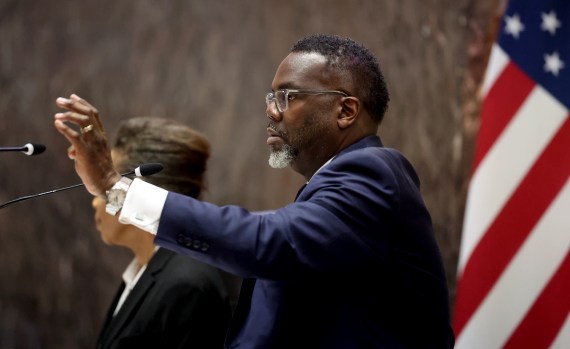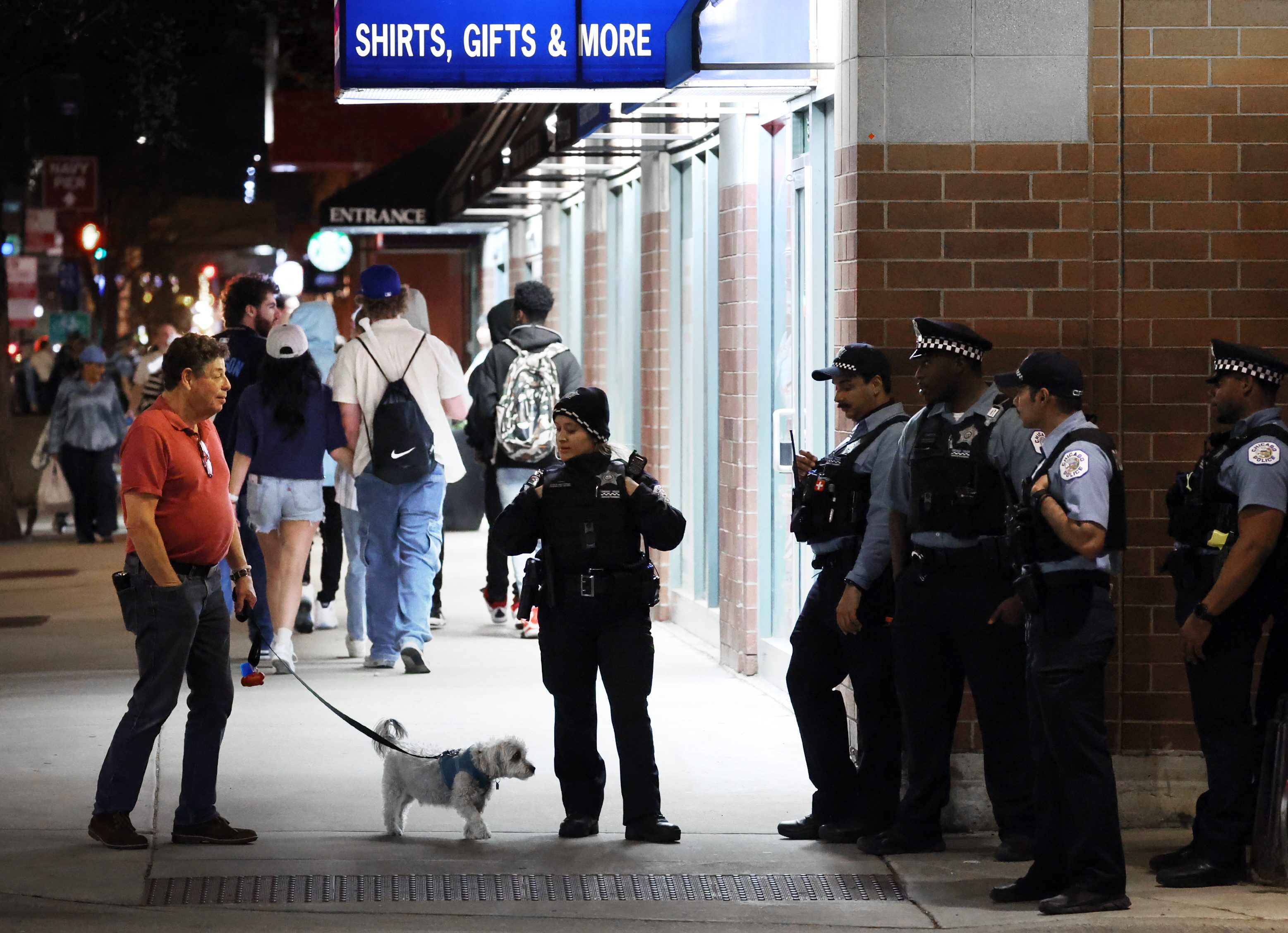

Mayor Brandon Johnson’s statement after five Chicago police officers were struck by a car at an after-prom teen takeover early Sunday was, once again, a master class in saying nothing. “Unauthorized large gatherings.” “Safe spaces.” A call for parents to “know where their children are.”
We have heard this script for years, and it has not stopped a single takeover.
I lived in Streeterville through waves of these events. I watched squad cars climbed on, businesses overrun, residents trapped in lobbies and tourists wide-eyed on the sidewalk wondering what kind of city they had walked into. Most of the kids in those crowds were not breaking the law. That has never been the point. The point is that when hundreds of teenagers flood an intersection at 2 a.m., the bad actors come with them, and things escalate fast. A 14-year-old was killed in the Loop in November. Five officers were taken to the hospital on Sunday.
This is not a “teen trend.” It is a pattern, and the city keeps treating it like a branding problem.
I eventually gave up and moved to Lincoln Park. That is the quiet story behind these gatherings: People leave. They stop walking to dinner. They stop bringing visitors downtown. Businesses lose customers, then they lose staff, then they close. The cost of the mayor’s inaction is not abstract. It is paid block by block by the residents he is supposed to represent.
Atlanta has shown there is another path. After a Beltline takeover earlier this year, police arrested participants, recovered 11 firearms and announced that parents who let their children roam past curfew would be charged. Tampa and Orlando in Florida and Washington, D.C., are moving in the same direction. Chicago, meanwhile, gets a tweet from the mayor about “opportunities and safe spaces” while officers are wheeled into emergency rooms.
Young people do deserve programming, mentorship and somewhere to go on a Saturday night. None of that is in tension with enforcing the curfew that already exists, prosecuting those driving cars into police officers and holding parents accountable when their children are downtown at 3 a.m. with weapons.
Chicagoans are not asking for cruelty. We are asking for a mayor who will say the word “takeover” out loud.
— Jay Klauminzer, Chicago
Seek out teens to interview
Yet again, the Tribune covers a youth-oriented phenomenon, the “teen takeover,” without troubling to talk to even one young person (“Anti-violence workers, police dig in for summer,” May 26). The interview subjects, as always, switch from official sources (Chicago police Superintendent Larry Snelling) and adult community organizers. A lot of assumptions are presented as to why kids meet up in public places (Snelling says that their “actual goal” is to “create chaos”) without the story going to the source.
It might enhance the story to note that free recreational opportunities in the neighborhoods are declining — over half the Boys & Girls Club locations in Chicago closed since a loss in federal funding in 2025, and YMCAs have been in retreat in the past decade — leaving fewer places where teens can just hang out. One might also talk about the extreme stress that teens have suffered in recent years with neighborhood violence and privations during the COVID-19 shutdown.
This isn’t to deny that serious problems arise from these unorganized events (including shootings, which resulted in a death last November) or that they arouse adult distrust of kids, leading to more punitive measures.
Still, I would expect the Pulitzer Prize-winning local news team to be more curious about what lies beneath these events.
— Paul W. Mollica, Chicago
Camping ban upends lives
Street homelessness is one of the worst things you can experience. When I was 18, I was kicked out of my parents’ house and lived on the street in Fox River Grove. I starved during winter and lived out of the train station so as not to freeze to death.
Fox River Grove in McHenry County has fewer than 5,000 people. Being in a rural community, I had no transportation — the closest Pace bus is in Crystal Lake, 7 miles away — and didn’t know where to go to get help. The closest homeless shelter is McHenry County PADS, more than 10 miles away, but nobody told me about that option. I tried to get help from a food pantry but couldn’t because I didn’t have an identification card to prove who I was. I have a bipolar diagnosis, and mental health resources in rural areas are very scarce, requiring you to go one or two towns or counties over to get the support you need. Though I struggled with drug and alcohol addiction during that time in life, I was sober while I was homeless.
After six months on the street, my parents secured a place for me in a nursing home to help me manage my mental health and addictions. I’m grateful to say I have lived in stable housing with my wife in Zion for 10 years now.
State lawmakers are discussing House Bill 1429 to decide how a community should respond to people who are unhoused like I was. Communities in Illinois have passed public camping bans, making it illegal to sleep on public property like I had to. Cops can show up any time to throw away your belongings. This bill would prevent Illinois cities and towns from passing these counterproductive ordinances.
People overlook how hard it is to get housed if your ID or medication is thrown away. Replacement documents need a receiving address and can take weeks to arrive. You need transportation to get to the pharmacy and ID for prescribed medications, which have limited refills. I notice a significant change if I cannot take my bipolar medication when I’m supposed to.
Instead of passing camping bans, cities and towns should be partnering with nonprofits to address homelessness, connecting people to the services they need.
I hope state lawmakers do the right thing and pass HB1429 so more people have a chance to get help and find housing like I did.
— Stefano Medansky, Zion
We need drug affordability
Everyone in Springfield wants to talk about the affordability crisis. It’s good politics. But talk is cheap. For the families rationing insulin or stretching a prescription across two months, what matters isn’t the conversation; it’s whether lawmakers will actually do something.
This session, they have a real opportunity. And we wanted to know exactly what it’s worth.
When advocates and legislators began pushing to establish a Prescription Drug Affordability Board in Illinois, one of the first questions was practical: What would this actually save? Through a public records request, we obtained the data needed to model what Illinois could save by adopting Medicare’s already-negotiated prices as upper payment limits statewide. The answer, documented in a new report from the Coalition for Prescription Drug Affordability, is more than $190 million, and that’s just the start.
That figure reflects only the first 10 drugs Medicare has negotiated. It doesn’t account for the dozens of additional medications slated for negotiation in coming years or the broader authority a PDAB would have to act on high-cost drugs Medicare hasn’t yet reached, including insulin and epinephrine. What Senate Bill 3496 would create isn’t a one-time savings event but a durable, compounding mechanism for relief, a pipeline that expands every year as Medicare negotiates more drugs and Illinois extends those savings to everyone, not just seniors.
The stakes are significant. Illinois spends billions annually on prescription drugs through Medicaid and state employee health plans, and every dollar recovered can go toward schools and services. But the stakes are even higher for the 1 in 4 Illinoisans who report rationing or skipping medication because of cost. Prescription drugs only work if people can afford to take them, and right now, too many people in this state cannot — not because treatments don’t exist, but because a pricing system without meaningful accountability has put them out of reach.
Other states aren’t waiting. Colorado became the first to set an upper payment limit through its PDAB; a single price cap on Enbrel is projected to generate up to $32 million in savings. Maryland is next, with limits on Jardiance and Ozempic set to take effect. Illinois doesn’t have to build from scratch; it has federal price negotiations to build on and three years of careful stakeholder work behind this bill. SB3496 has already passed the House and now awaits a Senate concurrence vote.
The data is clear. The savings are real. What Illinois needs now is for its lawmakers to follow through.
— Julia Warheit, policy manager, Citizen Action/Illinois, Chicago
Submit a letter, of no more than 400 words, to the editor here or email letters@chicagotribune.com.