
The most encouraging redistricting news of the year came from two states that did nothing.
Illinois lawmakers adjourned without drawing new congressional maps. South Carolina legislators, including Republicans, rejected a President Donald Trump-backed remap that would have tilted the political playing field. Better yet, it was a bipartisan move — Republicans joined Democrats in opposition.
Given this news, we were left hoping the mid-decade redistricting wars were slowing down.
But just when it looked like the mid-decade redistricting wars were cooling, New York reminded everyone that the next battle may already be underway.
Last Wednesday, the New York’s Democratic Party-controlled legislature advanced a proposal that would significantly weaken New York’s current independent redistricting system and give the legislature much more control over drawing political maps. Under current law, New York’s constitution explicitly prohibits drawing districts to favor or disfavor political parties. If ultimately approved by both chambers of the legislature and New York voters, the proposal could clear the way for mid-decade congressional redistricting before the 2028 election, leading to more seats for Democrats.
New York voters approved an independent commission in 2014 to help draw congressional and legislative districts and to limit partisan gerrymandering. Now, voters may have to decide if they want to undermine that commission.
As California Gov. Gavin Newsom in February said of the Democrats, “we need to fight fire with fire.”
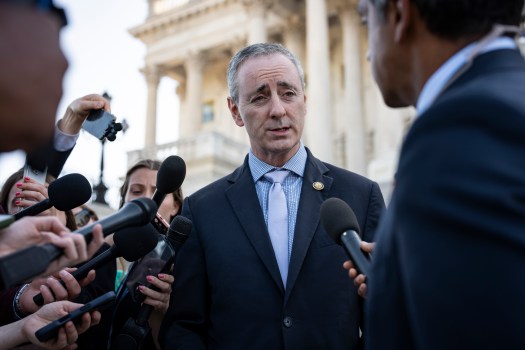
But we view things more along the lines of Republican New York Assemblyman Josh Jensen.
“If another state manipulates its maps for partisan gain, that doesn’t make it virtuous,” he said. “If Republicans somewhere do something wrong, Democrats doing the same thing doesn’t make it right.”
Still, it’s hard to ignore the number of states that have engaged in the redistricting war. The National Conference of State Legislatures has been tracking which states have made — or attempted to make — changes to district maps between the 2020 and 2030 redistricting cycles, beginning in late 2025. Nearly 20 states have considered mid-decade redistricting, with 10 successfully following through, by the NCSL’s tally.
Virginia voters in April approved a similar voter-approved constitutional amendment that would’ve advantaged Democrats, which the state Supreme Court rejected in May.
Republican legislatures and Democratic legislatures alike are increasingly treating district maps as political weapons that can be redrawn whenever circumstances change. That’s a bad thing.
The battle kicked off in Texas last August when Lone Star state legislators approved a new map that massively favors Republicans.
California fired back, adopting a map via ballot measure last November that would give Democrats five more House seats.
In May, Tennessee adopted a Republican-tilted map. Florida Gov. Ron DeSantis also signed into law last month a new map that favors the GOP, and was sued in short succession.
Georgia state legislators are expected next week to consider redistricting legislation during a special session.
Given that so many of the states that have moved to redistrict have done so to benefit Republicans, we understand Democrats’ instinct to respond in kind.
But as the libertarian Cato Institute put it, “good gerrymandering can’t cure bad gerrymandering.” And as California and New York have proven, Democrats aren’t exactly innocent bystanders.
Some experts have argued the only solution to this problem is to implement some sort of federal limits to partisan gerrymandering. And yet the federalist structure of our government — largely giving states the power to determine their own fates — complicates that idea. Others suggest that pursuing term limits could be a natural antidote to longtime incumbents tempted to gerrymander.
In our view, the best solution is still to leave it to the states, which should have independent commissions create maps based on geography, not politics.
That would require something increasingly rare in U.S. politics: People willing to do the right thing.
It’s not an impossibility, as South Carolina proved. So, too, did Indiana, when that Republican-controlled state last December defied the president’s wishes that the Hoosiers adopt a GOP-friendly remap.
The partisan redistricting wars weaken our democracy, and once redistricting becomes untethered from the census, every election cycle becomes a potential redistricting cycle. We’ve written before that the redistricting war is a form of political mutually assured destruction. If maps can be redrawn whenever one party thinks it can gain seats, what exactly is the limiting principle?
Americans already endure endless campaigning. They should not have to endure endless redistricting, too.
Submit a letter, of no more than 400 words, to the editor here or email letters@chicagotribune.com.