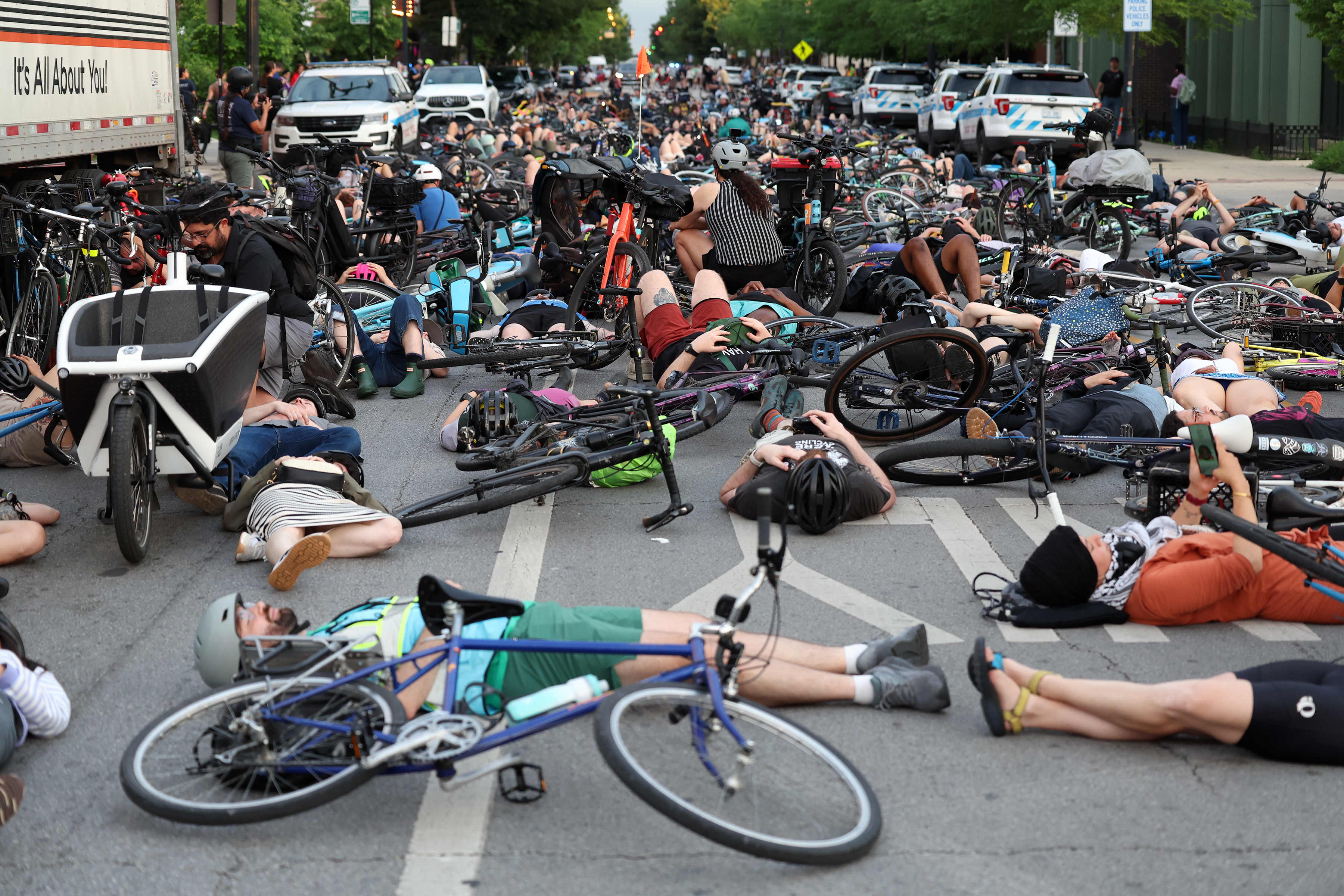

For several minutes Monday evening, no cars drove down Halsted between 31st and 32nd Streets.
Hundreds of cyclists lay down in the street on that stretch of Halsted as part of a memorial bike ride and vigil for Riley O’Neil, a Chicago Department of Transportation worker who dedicated much of his career to bicycle safety and infrastructure in Chicago.

O’Neil died Friday in a traffic crash while riding his bike on Halsted Street in Bridgeport.
O’Neil, 35, worked at Chicago’s Department of Transportation as a planner and project manager for Complete Streets, a city program dedicated to making Chicago’s streets safer, particularly for bicyclists and pedestrians. Before working on Complete Streets, O’Neil led Chicago’s bike parking program for several years, according to CDOT.
On Monday, those who knew him spoke of O’Neil’s love for public service. Some also called for change, saying more needs to be done to prevent traffic deaths in Chicago.
Vig Krishnamurthy, a colleague at CDOT, remembered O’Neil as someone who “embodied what it means to be in public service.”
“He would always say things like, ‘I’m just pumped,’ and ‘I’m really jazzed,’” said Krishnamurthy, managing deputy commissioner at CDOT, in an interview with the Tribune. “And I was like, Wow, are we working in a fitness studio? Just the amount of sheer enthusiasm for the work is the thing that sticks with me the most,” he said.
“People loved him,” said David Powe, an assistant commissioner at CDOT. “Not just respected him, not just admired his work. They loved him. I loved him.”
Through April this year, 10 pedestrians and four bicyclists or motorized scooter users had been killed in traffic crashes in Chicago, according to Transportation Department data.
Speaking at Monday’s vigil, Bridgeport resident and cyclist Andrew Mack said enough was enough.
“This public health crisis of traffic violence plaguing every corner of our city has remedies,” Mack said. “And after 100 years of squeezing cars into every square inch of the city, it is past time … we rethink our relationship with the automobile.”
The lanes on the portion of Halsted where O’Neil was killed are painted, not protected by a physical barrier. Cycling safety advocates typically criticize those painted lanes, arguing that they are insufficient to protect bikers from drivers of cars.
In Chicago, some efforts to build protected bike lanes have sparked organized pushback, with one common complaint being concerns about the loss of parking spots. Cycling safety advocates frequently express frustration at a dynamic they say prioritizes parking spaces over lives.
“We don’t debate the need for safe drinking water, and we shouldn’t debate the need for safe streets either,” Mack said.

On Friday, O’Neil was heading south on Halsted when the driver of a white sedan opened the car’s door as he biked by, a witness and police source told the Tribune. O’Neil swerved to avoid the door, but still made contact with it and was thrown to the street, sources said, where the driver of a large truck ran him over.
A witness who spoke with police on the scene described more or less the same sequence of events, telling cops that someone in the parked car opened the driver’s side door into the bike lane, forcing O’Neil into traffic as he tried to avoid the door, according to the traffic crash report.
O’Neil was taken to Stroger Hospital, where he was pronounced dead. The Cook County Medical Examiner’s office later attributed his death to multiple injuries from a collision with a semi-truck.
At the scene of the collision Friday, police issued four citations to a 31-year-old man. The citations were for unsafe opening or closing of a door, prohibited parking, driving on a suspended license and operating an uninsured vehicle.
No one was arrested. On Monday, the Chicago Police Department said its Major Accident Investigation Unit was continuing to investigate the case.
According to the traffic crash report, the man cited by police claimed he had not been driving but had been sitting in the front seat getting something out of the car. The man told police that the car’s door was already open, a narrative seemingly contradicted by the witness account contained in the same report.
Ald. Nicole Lee, in whose 11th ward the crash occurred, released a statement about O’Neil’s death on social media over the weekend. She referenced efforts to install protected bike lanes elsewhere in her ward and a traffic study for the area.
Lee said she would “provide a full update on the timeline for the traffic study and potential next steps in the days ahead.”

In a statement Monday, CDOT spokesperson Erica Schroeder said the department was coordinating with Lee’s office “on the early stages of a community planning process focused on developing a network of low-stress bike routes in the area and advancing other traffic safety improvements.”
“CDOT is taking a comprehensive look at the area, analyzing potential improvements to increase safety for all road users, including detached curb bump-outs, traffic circles, speed humps, and other improvements,” she said.
On Monday evening, cycling advocates and friends of O’Neil biked through the neighborhood en masse. The ride, planned by the group Chicago, Bike Grid Now, included the demonstration on Halsted Street.
Before the sun set, the cyclists lay down in the street, their bikes to their sides or laid across their ankles. After a period of quiet, someone called out, “Rise up for Riley,” and the crowd of cyclists stood up and applauded.
They rang the bells on their bikes, which sounded like chimes.