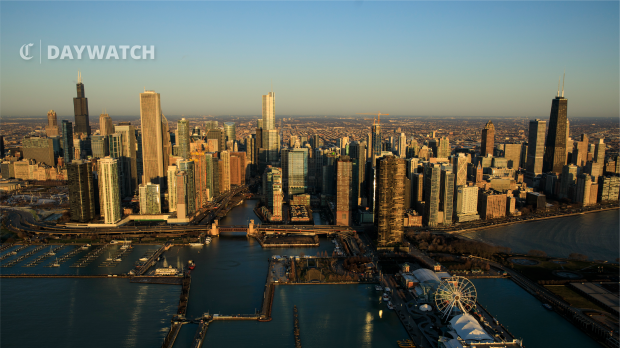
Sears Tower`s pending sale has subtly, almost imperceptibly, begun changing the imagery associated with the world`s tallest building.
The 110-story tower has always been a cold, hard, slick-skinned piece of work incapable of evoking much affection, let alone Chicago-style jocularity. Nobody ever gave it so warmly an anthropomorphic nickname as ”Big John” (the monicker hung on the calculatedly brawny-looking John Hancock Center when it was built in 1969).
It never had to endure Bronx cheers for resembling a pair of corncobs (as Marina City did), or for thumbing its nose at practically the whole world of architecture (as the State of Illinois Center did).
Sears Tower, for all its obvious might and altitude, was not only cold, but . . . well, almost anonymous. It made no aesthetic statement, nor did it visually declare its rootedness in the steel-framed Chicago School of structural expression. It offered no gesture of grace, no hint of spirit, or even commercial avarice (which is as much a Chicago trait as anything).
The neutrality of the tower is now undergoing further dilution. If at one time it at least insinuated that it was a symbol of a grand old name in Chicago mercantile history, that imagery is slipping away. The tower has become a mere piece of real estate in a 20th-Century business world where corporate identity is a chimera of layered ownership, indecipherable logos and CEOs, a world with a sense of history that seldom dates back further than the last fiscal quarter.
Much of this is not peculiar to Sears, of course, and all of the facts are not yet in on such matters as whether the tower`s buyer will allow Sears to keep its name on the building (as it wishes to).
Still, the 15-year-old tower, for all its odd blandness, has acquired a history that is worth recounting as it moves forward toward a future that may bring surprises.
No one put out any mandate to construct the world`s tallest structure when Sears hired the Chicago architecture firm of Skidmore, Owings & Merrill to design its new office building at 233 S. Wacker Dr. Gordon Metcalf, a former Sears board chairman, said shorter twin towers were among the alternatives considered for the three-acre site.
Skidmore`s two top Chicago performers at the time, architect Bruce Graham and structural engineer Fazlur Khan, collaborated on the final design.
”This was not a matter of symbolism, of corporate might,” Khan said after the building was completed. ”Sears probably would have settled for a squatty, 50- or 60-story building-something sturdy and efficient and durable. But we wanted something that wouldn`t be too prismatic, and then Bruce began looking at the bundled tube idea, and I felt it constituted a whole new architectural vocabulary which could be made to display itself with a variety of volumes. That`s how the whole thing began.”
Graham and Khan earlier had used a rigid, tapering steel tube, with externally expressed X-shaped bracing, as the key to the relatively lightweight but immensely strong framework supporting John Hancock Center.
They did essentially the same thing at Sears, but omitted the taper and bundled nine 75-foot-square tubes together. The nine tubes rise from ground level to the 50th floor, where two of them are terminated. At this point, the building takes on a modified Z-shape until the 66th floor, where two more tubes are lopped off to give the structure a cruciform configuration. At the 90th floor, three tubes come to an end, leaving only the last two soaring to the summit.
This irregular profile denies the tower the strongly thrusting vertical quality and the potential for a touch of panache at its summit (a spire, a beacon) that would have distinguished it in the manner of other world-famous skyscrapers. The tower`s most unflattering profiles are seen from due west or east, where its uppermost section seems out of scale with its lower stories.
The slick skin of black aluminum and glass that cloaks the tower further deprives it of character. Unless you have studied the building in advance, you cannot possibly know at first glimpse that nine tubes compose its skeleton. And hiding a building`s bones is a highly uncharacteristic way of doing things in Chicago, where the skyscraper was invented.
Yet from the beginning, the sheer height of the Sears Tower (1,454 feet to the roof, plus twin 253-foot broadcasting masts rising above that level)
was what most people really cared about. This was true on a cold and windy morning in May of 1973, when the last steel beam was hoisted to the summit at traditional topping-out ceremonies.
”I want to thank Sears for staying in Chicago when so many are leaving,” said the late Mayor Richard J. Daley, already grappling with business and industrial flight to suburbs and other states. For Daley, the spectacular height was just a fringe benefit.
The job of building the tower was not without human cost. Three weeks before Daley gave his talk, five workmen were killed in two accidents at Sears, only four days apart. Yet as such jobs go, the safety record was not bad.
Months before the Sears topping out, a flurry of craziness already had begun over a chance to rob Chicago of its upcoming tallness title.
New York`s Empire State Building had held height honors (at 1,250 feet)
from its completion in 1931 until the opening of Manhattan`s twin 1,350-foot World Trade Center towers in the 1970s. The fact that Chicago millionaire Henry Crown owned the Empire State for many years did not take the sting out of New York`s skyscraper dominance. Besides, ownership of the Empire State had passed back to New York hands by the time Sears Tower went on the drawing boards.
In any case, just before Sears Tower`s completion, the Empire State people admitted they had been secretly planning to add 244 feet to the top of their building, which would make it 40 feet taller than the 1,454-foot Sears. That scheme would have required removal of the Empire State`s 200-foot dirigible mooring mast, used on only two occasions for stunts, and never much more than a hokey way of making the skyscraper taller.
When it was decided that the 244-foot addition would be too expensive, and ugly as well, the Empire State owners dropped the idea.
The whole height madness game was revived this summer when Chicago developer J. Paul Beitler and his colleagues said they hoped to build a slender, 125-story Loop skyscraper that would be taller than Sears. The Sears people, in turn, hinted they were thinking about thwarting Beitler by adding 16 stories to their tower. By July, the Chicago height competition had become truly bizarre. Those who followed world architecture closely, however, figured that if some stupendously and unbeatably tall new skyscraper were built, it would probably be in Singapore or Hong Kong, anyway.
Yet the tallness of Sears cannot be dismissed as mere corporate swaggering, for it is a marketable quality of dear price. The buyer of the tower will be purchasing the American notion of prestige that almost always accompanies bigness-not to mention a tall platform for broadcasting antennas that bring in millions. He also will be buying a skyscraper whose most obvious functional deficiencies were corrected a few years ago when Sears spent $25 million on a new entrance atrium, structural changes on lower level retailing floors and an additional entrance on Jackson Boulevard.
In exchange for all this, Sears will take its profits and several thousand of its employes to Hoffman Estates, where it will construct a new office building that will almost certainly be low, full of ficus trees and surrounded by an enormous parking lot.
If, under terms of the sale, the new owner is permitted to re-name the downtown tower, it is hard to say what will happen. A new anchor tenant willing to lease a lot of space might get to put its name on it. For all we know, the top of the tower may one day sport a Japanese ideogram in neon, Ginza-style.
Other prominent Chicago buildings whose names have changed offer only tenuous clues about the potential effects of a Sears switch. Every Chicagoan is familiar with the belovedly baroque, domed and drummed 1926 structure first called the Jewelers Building, then Pure Oil, then North American Life Insurance and today simply 35 E. Wacker Dr. The name changes seemed to upset no one. Old timers still refer to the Palmolive Building at 919 N. Michigan Ave., which was later called the Playboy for 20 years until Hugh Hefner recently decided to move out.
The only thing almost totally forgotten about Sears Tower at this point is the man whose name it carries.
Richard Warren Sears, reared in rural Minnesota, sold wood and coal to farmers and Indians in the 1880s until he found out he could make more money peddling flashy cut-rate watches. When he teamed up with a Chicagoan named Alvah Curtis Roebuck, a new kind of mercantile empire was born.
So he`s the Sears in Sears Tower, that sky giant rising with such icy imperiousness in the southwest corner of the Loop. But his homey image began disappearing from American merchandising several decades ago.
Today, real estate titans wearing $1,500 three-piece suits sit at computer terminals in Toronto, Tokyo and Houston, pulling out numbers that tell them whether Sears Tower would fit their investment portfolios.
And as they do, the architectural image of the world`s tallest building somehow swims out of focus like the Cheshire cat. It`s corporate sale time, and a dollar is a dollar. Never mind Fazlur Khan`s bundled tubes, or the fact that the skycraper was born, refined and brought to perfection as an art form in Chicago. Most corporations care little for history and less for municipal pride. The tallest building might be called Jell-O Tower if a financial rationale could be found. It is the American way.