Because its leading men tend to be highly creative and even more egotistical, the world of architecture would seem to be a natural for the stage and screen. But with two significant exceptions — “The Fountainhead,” the 1949 movie based on Ayn Rand’s novel of the same name, and “Shining Brow,” the 1993 opera about the life of Frank Lloyd Wright — this mother lode of material has gone unmined. Or at least it did until “Three Days of Rain,” the moving and illuminating play at Steppenwolf Theatre through April 4.
The terrific thing about “Three Days of Rain” is that it doesn’t give us Hollywood architects making earnest speeches about saving the world with shining glass towers, as the fictional Howard Roark did in “The Fountainhead.” This is, instead, a play that uses architecture as a way of expressing a much grittier and far more universal theme: Children never really understand what shaped the character, and especially the shortcomings, of their parents.
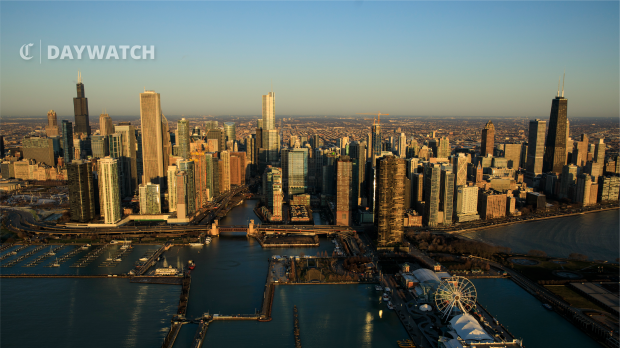
It’s not just architecture that propels the story in “Three Days of Rain” but the cumulative product of architecture — cities. The play isn’t about just any kind of city but big, dense cities such as New York and Chicago that are swarming with people — and where you can run into anyone, serendipitously, on any corner or in any park, and then fall in love. This is theater about the theater of public places.
Here are the bare bones of the plot: It is 1995, a somewhat dilapidated, spartanly furnished apartment on a winding street in lower Manhattan. A famous architect has died. His two grown children, a son and a daughter, wonder who will inherit his greatest work, a modern house that won widespread attention after it appeared in the pages of Life. But there’s a twist: The architect had a business partner. And the partner’s son, it turns out, was closer to the architect than either of his children.
Then we flash back to 1960 and to the same apartment, whose furnishings now include a drafting table and pigeon holes for blueprints. We meet the famous architect, his hugely ambitious partner and the lovely but daffy Southern woman both of them love. We see the partners as they struggle to design the modern house, originally a copy of Ludwig Mies van der Rohe’s masterful Farnsworth House of 1951 in the far western suburb of Plano. We learn what really transpired in the romantic triangle, leading the architect to cryptically note in his journal: “Three Days of Rain.”
All this is, of course, made up, but the play dances close enough to the borders of reality that it is enormously persuasive. That’s because the playwright, Richard Greenberg, has framed a simple but effective structure, the flashback, which allows us to grasp just how misguided are the children’s perceptions of their parents. And he has hammered out lots of convincing details that drive his message home. Simply put, he gets architecture.
The famous house, for example, is described by the architect’s son as lunar, like something carved from the moon, or a mirage, which is precisely what architects, following Mies’ example, wanted their steel-and-glass houses to look like around 1960. Also, we are told, there are people who don’t want to visit the famous house because that would spoil their experience of seeing it in the Life photograph.
That wry observation, which comes in the play’s opening seconds, gives “Three Days of Rain” instant architectural credibility. For leading modern architects of the postwar era customarily would hire the distinguished architectural photographer Ezra Stoller to capture their work in the best possible light. All too often, however, the “Stollerized” image of the building was far better than the reality.
There’s much more to these convincing moments than satisfying the architecture aficionados in the audience. If architects pick materials — brick or steel, glass or stone — playwrights select material — storyline, characters, subject matter. The subject matter of architecture serves Greenberg wonderfully, allowing him to inject his story with dramatic tension.
Think about the initial conflict in the play: Who gets the house?
The characters aren’t battling over a trust fund, a stock portfolio or something else you can’t touch. It’s the home they want, and who can’t relate to that? Our houses are much more than physical things. They’re repositories of our hopes and our memories, the future and the past. Home is more valuable than cold cash. The architect’s son even is willing to trade his huge inheritance for the house. Why? Because it will give him everything he lacks — a sense of belonging, a sense of place, a sense of being forever linked to something and to someone (the father with whom he couldn’t connect in life).
Architecture is an equally good device for the latter part of the play, a whodunit not about a murder but the authorship of a masterpiece.
Had the masterpiece in question been a novel, as my colleague Richard Christiansen observed the other day, there would be no question about who was responsible for it. But a building, even as small as building as a house, is a complex mix of art and science, so complex that architects typically work in partnerships. Indeed, Chicago’s architectural history is a litany of great partnerships: Adler & Sullivan, Burnham & Root, Holabird & Roche, Perkins & Will, Skidmore, Owings & Merrill.
As the architect’s son observes, “Two people work together and in the end, there’s no way of telling who’s responsible for what.”
It is no coincidence that the son’s name is Walker. Though we never see the play’s characters in plazas and other public spaces, “Three Days of Rain” celebrates the act of wandering on foot in large cities. As Walker’s father, Ned, confesses late in the play, he’d like nothing so much as to be a flaneur, a wanderer who measures the sum of his life not in grand triumphs and tragedies but in the small bits of day-to-day experience, like a cup of coffee shared with strangers in a cafe.
“I think it would be the best thing. To be this vagabond prince . . . a wanderer through the city. A walker,” he says, making clear the meaning of the name he will give his son.
Steppenwolf’s set for “Three Days of Rain” subtly underscores the meaning of the name, showing us not only the apartment/drafting room where most of the action unfolds but also a cobble-stoned street right outside.
We feel, as a result, the canyonlike denseness of lower Manhattan, the compactness of the winding streets laid out by Dutch settlers, and the adventure of encountering whatever lies around the bend. Nothing could be more different from the new gated communities: orderly, predictable and lifeless.
So let us be glad that a playwright finally has delved into architecture and plumbed it for a rich range of material about American culture. In “Three Days of Rain,” Greenberg hopefully constructs new ways of seeing architecture and cities even as he unflinchingly deconstructs the way we live.