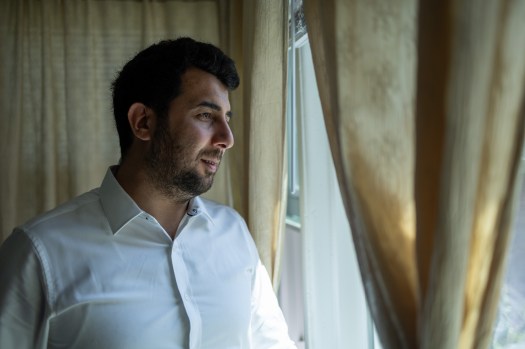
The day after his release from FBI custody, Brandon Mayfield returned to his law office, hoping to start the slow process of salvaging his law practice. But walking into the room where he had been arrested two weeks before, Mayfield only relived the unraveling of his life.
One moment on May 6, he was at his desk in Portland, Ore., working on cases at his solo practice. The next moment, he was handcuffed by federal agents and accused of being involved in the commuter train bombings in Madrid.
U.S. authorities said his fingerprint matched one found on a plastic bag containing detonators near one of the bombing sites.
The print turned out to be a mismatch, and the 37-year-old lawyer was released. But obviously exoneration and an official FBI apology couldn’t return the two weeks he spent in federal custody.
“I’m taking it day by day,” Mayfield said last week. “My life is not back to normal, but it is much better than two weeks ago. Every day, I am just trying to put things back together.”
The arrest devastated Mayfield, but it also delivered a blow to the FBI.
Amid new warnings that an attack on the United States could come in the next few months, the Mayfield case highlights the difficulties of fighting the war on terrorism, and it reveals the delicate balance federal investigators must strike between respecting civil liberties and aggressively searching for militant operatives.
Civil libertarians and other critics say court documents unsealed last week reveal troubling features about the case, including the use of religious profiling and faulty fingerprint evidence, and what they call the arrogance of federal investigators who disregarded doubts of Spanish investigators and who refused to reconsider their analysis until after the print matched another suspect.
FBI officials have blamed the misidentification on the poor quality of a digital image of the fingerprint and will consider establishing new standards for the agency. They also may appoint an international panel to review the case.
Where things went wrong
The unsealed documents offered the first detailed explanation of what went wrong in the Mayfield case, showing that Spanish officials had raised questions about the fingerprint match weeks before Mayfield’s arrest. The records also give a rare window into the government’s hunt for terrorists.
A nine-page affidavit filed in support of the warrant used to detain Mayfield showed how the investigation in Spain led to the offices of an attorney in Portland.
On March 11, when the blasts in Madrid killed 191 people and injured more than 1,800 others, Spanish police found a blue plastic bag containing detonators inside a stolen van near a bomb site.
Several days later, Spanish investigators sent photo images of fingerprints recovered from the bag to the FBI Laboratory in Quantico, Va.
Terry Green, a senior examiner, found several possible matches in a database of 45 million fingerprint records, including one for Mayfield.
Green reported finding more than 15 points of similarity between the prints and declared the Spanish fingerprint a “100% identification” to Mayfield. Two other FBI analysts–and later an independent examiner paid for by the defense–concurred, court records show.
But in mid-April, three weeks before the Mayfield arrest, Spanish investigators told FBI officials that their analysis did not agree. At a meeting April 21 to discuss the discrepancy, FBI officials came away believing Spanish officials “felt satisfied” with the FBI analysis. Afterward, FBI agents submitted the fingerprint as a definitive match in the affidavit requesting Mayfield’s arrest.
Along with the fingerprint, FBI officials offered several other facts that they said supported their suspicions of Mayfield.
Mayfield had represented a terrorism defendant, Jeffrey Leon Battle, in a custody case. Now serving an 18-year prison sentence, Battle pleaded guilty in November to conspiracy to wage war against the U.S.
The FBI also said that telephone records showed a call placed from Mayfield’s home to an Oregon Muslim charity, Al-Haramain Islamic Foundation, whose assets were frozen by the authorities in February pending investigations into suspected links to Al Qaeda.
The government also noted that Mayfield advertised in a local Muslim phone directory that investigators said was run by a person who authorities tied to Wadih El-Hage, a former assistant of Osama bin Laden’s.
Agents did note that they could not find any record of Mayfield leaving the country but speculated that he had traveled under an assumed name.
Embarrassment for bureau
Not until two weeks after Mayfield’s arrest–when an e-mail from the FBI’s legal attache in Madrid notified agency officials that Spanish authorities had matched the fingerprint to an Algerian–did the FBI send examiners to Spain to inspect the original print.
The case is an embarrassment to the FBI, which has long considered itself the gold standard in fingerprint analysis.
“But for the fortuity of the fact that Spanish investigators were able to find a more compelling match, Mr. Mayfield would still be in jail,” said Robert Epstein, an assistant federal defender in Philadelphia who in court has challenged the reliability of fingerprint analysis.
Ann Todd, a spokeswoman for the FBI laboratory, declined to comment pending an internal investigation into the Mayfield case.
Mayfield, who converted to Islam in 1989, was never charged with a crime but instead was held under a federal material witness statute, a controversial tool used since the Sept. 11 terrorist attacks to hold suspects without bond while investigators look for evidence.
“It’s profiling,” said David Fidanque, executive director of the American Civil Liberties Union of Oregon. He said tactics used by federal investigators have alienated members of the Muslim community, the very people some say could be the best source of information in domestic terrorism inquiries.
After the judge dismissed the case against Mayfield on Monday, FBI officials in Washington issued a statement: “The FBI apologizes to Mr. Mayfield and his family for the hardships this matter has caused.”
Mayfield, who is married and has three children, is finding it tough to move on.
“To be popped back into the environment where I was before . . . to be given no assistance, with officials saying, `We’re sorry, get back to normal?'” His voice trailed off. “I have to pick up the pieces.”