He wants to know what we’re doing here.
I have been wandering around a shantytown in Freetown, Sierra Leone, with photographer Sarah Glover, looking for people willing to talk about their lives. Then David confronts me.
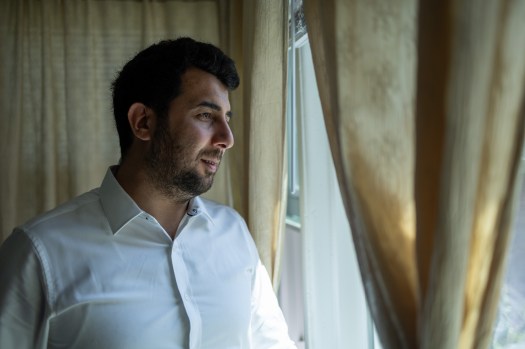
He is a lean man, looks to be in his 20s. His face is dark, scarred, handsome. When I raise my notepad and tape recorder, he waves them down. When Sarah comes over and lifts her camera, he refuses that too. David’s English is not great, but he manages to make us know that he has no interest in being quoted or pictured. And that he thinks we have no business here.
What’s going to happen out of this? he demands. Out of the pictures we take and the interviews we conduct? Will the lives of the people who live down here be changed somehow? Or will we simply walk around and get our fill, marvel at this misery and then go home?
We explain that we were sent here by a newspaper in the United States to produce stories that will tell Americans what it is like here.
After a few minutes of this, he allows us to pass. I can’t tell if it’s because we’ve convinced him. I do know that we haven’t convinced me.
It’s not that what we told him was untrue. It was, however, incomplete.
Meaning that, yes, we will do our job. I will write stories that talk about naked children sitting in dirt, about fetid water and living conditions for which “poverty” is an inadequate description. I will tell America about the man who reached out to me, begging without hands because rebel soldiers had cut them off.
People will read these things in the newspaper and say how sad, how terrible. And then, they will turn the page and forget.
That’s the way it always is and I’m not sure why. Americans are not an ungenerous people. Yet, Africa’s woes never seem to boil to the top of the U.S. consciousness for too long.
Maybe it’s the fact that we have our own poor to worry about, and never mind that the average impoverished American would be a king in Freetown. Or maybe it’s race, the very blackness of Africa that’s off-putting. Except that if we are honest, we must admit that generally speaking, even those of us who call ourselves African-American don’t know much–or worry much–about Africa.
You can make all those arguments, but I tend believe it’s the size of Africa’s woes, the very immensity of its pain, that overwhelms us. There is a sense that trying to help would be like trying to scoop up the ocean with a teacup. You feel paralyzed in your smallness. And so you do nothing.
That ceases to be an option once you’ve been there.
Over the course of my sojourn, I learn that I cannot hide behind the opacity of my professional identity. To do so is to make myself nothing more than a tourist of the wretched, oohing and ogling and walking through other people’s misery.
So a week after David lets us pass, I find myself surfing the Internet, looking for an orphanage, an organization, someone to send my money to. Looking for a way to lift just one life. Just one.
It’s not much. Then I remember the old saying about how no one can do everything, but everyone can do something and I keep searching.
Because as far as I’m concerned, David’s challenge boils down to a question moral people should ask themselves every day: How will this be changed because I was here?
I will probably never see him again, but if I do, I plan to have an answer.
———-
E-mail: lpittsherald.com