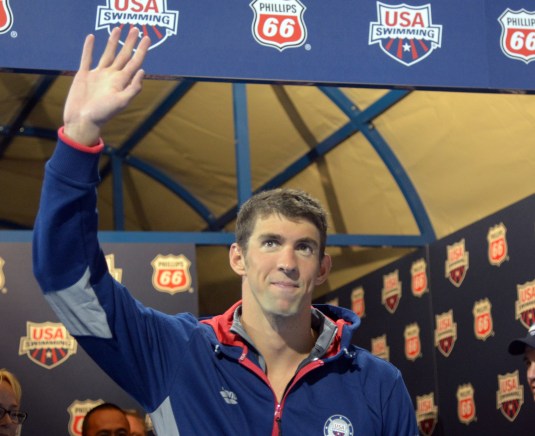

USA Swimming finds itself in a no-win situation as it discusses what penalty to levy against Michael Phelps after his second drunk driving arrest.
While the federation undoubtedly will wait to see how the Maryland courts treat Phelps’ case, he clearly has violated the catchall category of USA Swimming’s 21-section Code of Conduct.
That is article 304.3.19 of the federation’s rule book, which covers:
“Any other material and intentional act, conduct or omission not provided for above, which is detrimental to the image or reputation of USA Swimming, a LSC (local swimming committee) or the sport of swimming.”
That provision allowed USA Swimming to suspend Phelps three months in 2009 after being photographed sucking on a bong at a party, even though there was no evidence of what – if anything – he was inhaling.
This Phelps offense obviously is much worse, given the speed he was traveling (84 in a 45 mph zone), his blood alcohol level, his state of inebriety as described in the police report of his Tuesday arrest on a DUI charge – and, the overriding circumstance, that it was a repeat occurrence of one a decade ago.
“We are very disappointed about this serious situation, as we expect our athletes to conduct themselves responsibly in and out of the pool,” USA Swimming chief executive Chuck Wielgus said in a statement. “His actions were irresponsible and reckless.
“As you can imagine, the due diligence and consideration of all options takes time.”
The clearest option is another suspension.
The question is how long, and that is where this gets complicated, especially since the federation’s rules do not specify such penalties.
A suspension that carries through the World Championships next August could lead the greatest swimmer of all time to end his post-London comeback and swimming career.
That could also have the consequence of setting Phelps adrift, removing the anchor – swimming – to which he returned late last year in part to give his daily life some structure. Without that, who knows where he would be?
Of course, one can argue that even that regained structure was not enough to keep him from getting into serious trouble, the kind that merits a serious sanction.
And even if Phelps, now 29, were to compete through the 2016 Olympics, he already should be preparing to find purpose in a life without swimming. This latest incident may curtail the option of carrying on as America’s Guest for years to come.
Maybe a year-long suspension would serve as motivation for Phelps to show he can deal with the consequences and still make the 2016 Olympic team, for which the trials are 21 months away.
Some wonder if USA Swimming will punish him too severely because he is Michael Phelps, so the federation can show it won’t go easy just because he is the face of their sport, especially to young athletes.
Others may say he should be punished more severely because he is Michael Phelps – that his sky-high profile makes the damage to the sport greater.
If the suspension is relatively short, there will be a feeling USA Swimming has given in to commercial interests – NBC, sponsors – who know how much visibility Phelps’ presence adds to their investment. After all, none of Phelps’ individual sponsors has publicly questioned his latest lapse.
A suspension that effectively drives him from the sport could be an example of taking the moral high ground only to see it collapse in a landslide created by sponsors running from the scene, since their codes of conduct too often are enumerated only by $$$.
The elephant in the room, which Phelps must be made to see, is whether Tuesday’s episode was just a guy going wild one night or whether he has an underlying issue with drinking that needs to be addressed.
In either case, the result was horrifyingly poor judgment in getting behind the wheel – and good fortune that his mistake did not hurt anything but his reputation.
USA Swimming has complete leeway in deciding what action to take against Phelps, who, of course, has the right to appeal any sanction.
He hasn’t made the federation’s choices very appealing.