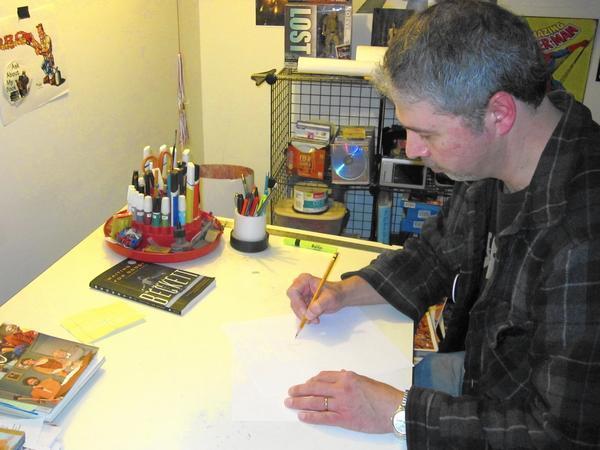

A self-portrait assignment Matt Stinnett had for an illustration class in art school three decades ago has proven successful for him since then, both creatively and financially. His professor encouraged the use of any format, so he picked a format he enjoyed.
“I chose to do mine as a caricature,” he said, “which must have been a success because before I graduated, a fellow student hired me to caricature her and her boyfriend.” That was the first of dozens of caricature portraits Stinnett would be commissioned to do over the next 30 years.
For 20 years, the Lowell resident has had a “day job” with Signature Graphics of Porter, which produces high-quality vehicle graphics for all sizes of businesses, from small, family-owned stores to national companies like Verizon, Time Warner Cable, and Marathon Oil. Stinnett transfers the customer’s design files to a format that can be used on the company’s specialized, computer-driven machines, which draw, cut and print the graphics.
After earning a graphic art degree from the American Academy of Art in Chicago, majoring in cartooning and illustration, Stinnett has been hired to illustrate everything from murals, tattoos, T-shirt designs and advertising art, to event fliers and logos. But he said his most consistent gig has been as a caricature artist.
“It is easily the most challenging and satisfying work,” he said, “because of the reaction of the client to the finished piece. These portraits are not the 10-minute, charcoal sketches that you see at amusement parks — I can’t work that fast — but a thoroughly researched, in-depth study of a person.”
Stinnett explained that he asks his caricature clients to fill out a questionnaire which he uses to add minute details of the subject.
“This makes for a highly personalized portrait, which is a kick for the person who receives it, as well as the person who gives it to them. I try to capture not only a likeness, but a lifestyle.”
Capturing this “lifestyle” is his favorite part of the work, yet also the biggest challenge, he said, trying to illustrate the personality, tastes and history which make a person an individual.
“How do I show in a tangible form this person’s love of B-movie scream queens, his reputation as ‘Mr. Accident-prone,’ her need for speed, his technical engineering degree from Purdue, and work all of it into a composition? It can be tough, as if capturing a likeness isn’t tough enough. But when you nail it, you know it. And when you see the look on the face of the person who receives it, well, there’s no greater satisfaction for me as an artist.”
Stinnett said he’s drawn plenty of celebrity portraits for people, but everyday people are so much more fun to do because, in that portrait, they are the celebrity. “They become a superhero.”
His least-favorite part of being an illustrator, though, is dealing with the business side of things — setting a price for his creativity.
“Often people think because I love what I do, I don’t need to be paid a fair price for it, or at all, in some cases” he said. “They will assume that these illustrations come easy to me because I’m so talented.”
In fact, he said, the opposite is true.
“It takes me many hours of work to achieve a spot-on likeness. Having an aptitude for drawing is only the start. Hard work and thoughtful planning is what makes a successful portrait.”
Stinnett said prices for his custom caricatures start at $250 for a single subject, $350 for a couple, and all prices are negotiable.
As a kid, Stinnett said he set the goal of making a life in the arts, either as an artist, a performer, or both. He started playing in bands while in high school and still writes his own songs today as a hobby. He has other creative outlets, as well, including acting in community theater.
Stinnett advises young artists to be prepared to fight to be taken seriously. He recommends conducting oneself in a professional manner and using the great resources available on the Internet and through social media to promote and market oneself, as well as setting deadlines and meeting them.
“Unfortunately, half your time as a freelance artist will be spent in pursuit of the next gig,” he said, “which are things I still struggle with on an almost-daily basis. And don’t be afraid to take jobs that are outside your comfort zone, which is how you grow as an artist. I took on all kinds of wacky jobs before I discovered what my niche really was.”
Donna Kuhn is a freelance reporter for the Post-Tribune.
Learn more
WEBSITE: mattysmayhem.carbonmade.com
EMAIL: stinnettm@sbcglobal.net