
The Washington Park trees gutted and stripped by the dreaded emerald ash borer have beauty, if you ask Alysandra Rodriguez.
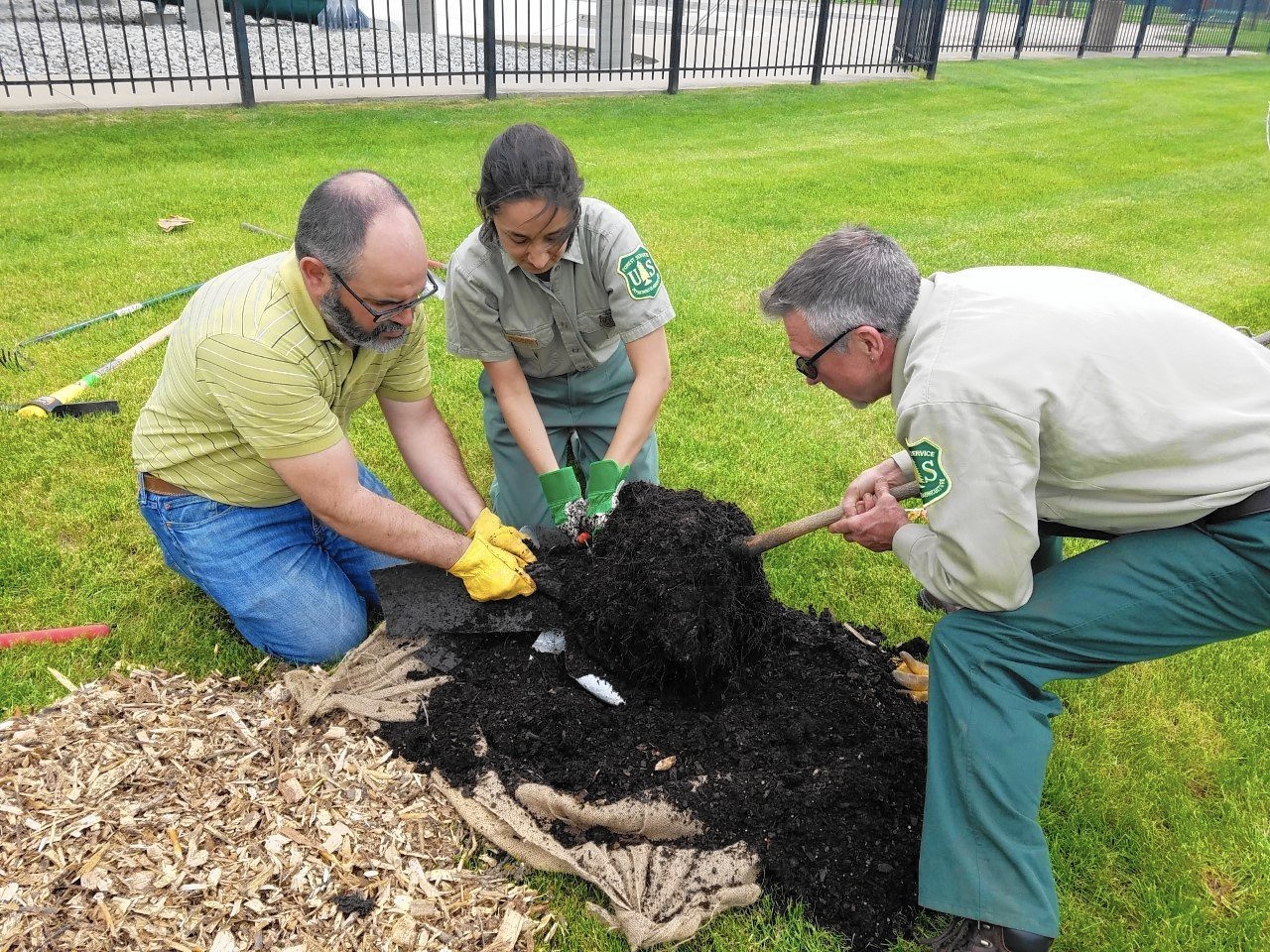
Rodriguez, an intern with the U.S. Forest Service’s Greening Youth Foundation, has seen people carve faces or paint trees that have suffered a similar fate in the Chicago Park District, and they’re really cool to look at, she said. Rodriguez, along with 50 or so other volunteers, descended upon Washington Park in East Chicago last week for CommuniTree, a public-private-partnership devoted to repopulating Northwest Indiana’s urban communities with new flora.
But the problem with changing the damaged trees into art is that you can’t always be sure of their integrity.
“It’s nice to turn them into art projects, but then again, a limb could fall off,” Rodriguez said.
The volunteers planted 30 new trees in Washington Park, said Joe Exl, senior water resource planner with the Northern Indiana Planning Commission.
“Of the 30 trees we’re planting, there are no more than 20 percent of a single family,” said Drew Hart, natural resource liaison for the U.S. Forest Service out of Chicago. “That means we have 15 species within 30 trees.”
Planners took special care in choosing which species would be a fit for Northwest Indiana, Exl said. Chosen were black walnuts, five different oak varieties, persimmon and pecan trees, which are native to Southern Indiana.
“With the way the climate’s changing, Southern Indiana’s weather could become Northwest Indiana’s in 30, 40 years, so we think they’ll be fine here,” he said. “Plus, with the areas in which we have ‘food deserts,’ planting food trees is a natural answer to me.”
The trees first started as seeds collected in the region and sent to nurseries, where they were put in pouches and propagated, Hart said. When they’re ready to plant, holes as deep as the root ball need to be dug. Then, volunteers commit to water the trees at least once a week for two to three years.
So far, there are plans to plant 270 trees among six communities this spring, with more this fall, Exl said. In all, 3,000 trees have been funded through the partnership, but the ultimate goal is 30,000 trees.
That might sound excessive, but the ash borer decimated between 30 percent and 40 percent of the tree population, Hart said, and up to 70 percent in urban areas.
“We anticipated four communities would apply for the program. We had six,” Exl said. “We also have the Kankakee River Basin interested in the program as well.”
Tristen Meyers, 19, of East Chicago’s Harbor section, donned his hard hat and dug in with the all-woman crew from the Student Conservation Association of Chicago. He’d seen the call for people on social media and wanted to help.
“This interests me now because it’s not just digging a hole. We learned why the bottom roots (of a tree) don’t need oxygen, but the top ones do,” Meyers said, referring to the class the budding arborist needed to take before venturing out. “It’s a real process, and I would pursue a career in it.
“And I’m a boy, so I like playing in the dirt and being outdoors.”
Michelle L. Quinn is a freelance reporter for the Post-Tribune.