Three covers, showing different years, of the Sears, Roebuck & Co. catalog. From left is 1894, 1927 and 1896. The 1927 cover is a Norman Rockwell painting.
Richard Warren Sears, left, and Alvah C. Roebuck in undated photos. Sears and Roebuck joined together to form Sears, Roebuck & Co. in the late 1800s.
The birthplace of Sears, Roebuck & Co. was this railroad station in North Redwood, Minn. A young station agent, Richard W. Sears, launched the business in 1886 and moved to Chicago in 1887.
An overall view of the Sears, Roebuck & Co. Administration Building and Merchandise Building, looking to the southwest and across the garden, circa 1908. The mail order plant was bounded by Polk and Grenshaw streets to the north and south and Kedzie Avenue and Independence Boulevard to the east and west in Chicago’s Homan Square neighborhood.
An interior view of the packing department on the second floor of the Sears, Roebuck & Co. Merchandise Building at 924 S. Homan Ave. in Chicago’s Homan Square neighborhood in 1908.
The Sears, Roebuck & Co.’s power plant at its Homan Square headquarters in 1906.
The Sears, Roebuck & Co. complex in Chicago’s Homan Square neighborhood in 1930. The main tower, shown here, was at Arthington Street and Homan Avenue.
The first Sears store opened in 1925 on Chicago’s West Side.
An overall view of the Sears Roebuck & Co. Merchandise Building, Power House and Administration Building, circa 1908. The mail-order plant was bounded by Polk and Grenshaw streets to the north and south and Kedzie Avenue and Independence Boulevard to the east and west in Chicago’s Homan Square neighborhood.
Julius Rosenwald, shown in 1926, was a Chicago businessman and philanthropist. He is best known as the part-owner of Sears, Roebuck & Co. and for starting the Rosenwald Fund, which donated millions to educate rural African-American children in the South.
In 1899, the Sears catalog advertised the Walker Model baby carriage for $9.95., left, and by 1926 the catalog was selling mail-order homes, including the “Alhambra” model for $3,134
An aerial view of Sears, Roebuck & Co.’s mail-order plant, bounded by Polk and Grenshaw streets to the north and south, respectively, and Kedzie Avenue and Independence Boulevard on the east and west, in Chicago, circa 1950.
Genevieve Smith works in the Sears Testing Laboratory testing a textile on Aug. 18, 1949, for Sears, Roebuck & Co.
The Park Forest Sears Roebuck & Co. store in 1964.
After digging out, drivers sweat it out to buy new tires at the Sears Automotive Center in 1964.
Called by some “a landmark in every sense of the word,” the Sears State Street store building, shown June 6, 1968, utilizes a system of steel framing that made possible the modern skyscraper, experts say. It was designed by William LeBaron Jenny.
People wait to get into the remodeled Sears store at State Street and Congress on April 11, 1978. Mayor Michael Bilandic was walking through the store.
Sears’ Homan Avenue complex offered bus services for its employees from the office on Homan and Arthington to the CTA’s Congress line on March 31, 1972. About 1,200 employees use the service morning and night at a cost of about $70,000.
The Sears store at 63rd and Halsted streets in Chicago’s Englewood neighborhood was a magnet for shoppers. It closed in 1976.
Sears mailed out 16 million “Wish Books” in 1980. It spent two years preparing this particular book. The question in the Tribune at the time was, “Would people go for mail-order steak at $16.50 a pound?”
A special press preview of the new Orland Square Sears store was held March 12, 1976, before the grand opening. The mall is located at 151st Street and Route 45 in Orland Park.
The Sears, Roebuck & Co. catalog is on video disc in 1981.
The Sears store on State Street looks from Congress Parkway toward Van Buren Street in the early evening of Oct. 29, 1982. The store had opened to great fanfare in March 1932.
An employee from the Sears Service Center works on fixing a stationary bike at the Center in Deerfield on Jan. 21, 1985.
The catalog sales section of Sears in Schaumburg attracts some interest in 1993. Competitors went after the Sears catalog business in the 1990s.
People shop at Sears in the Hawthorn Shopping Center in Vernon Hills on July 22, 1983.
Estella Barnes, left, and Marjorie Kimmel, center, retag apparel as Lola Snyder checks merchandise at Sears in the River Oaks Center as Sears converted to “everyday low prices” on Feb. 28, 1989.
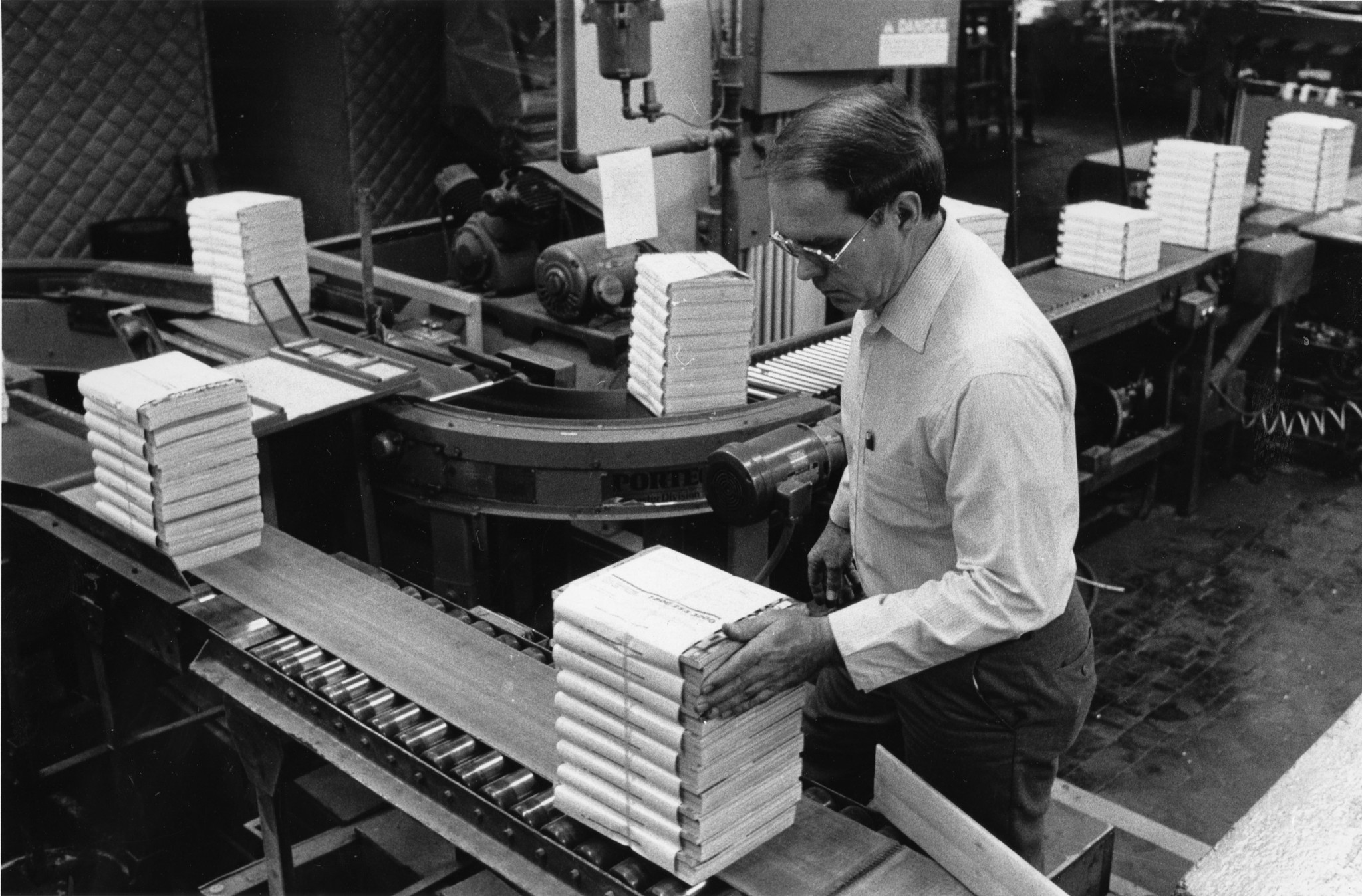
An RR Donnelley worker prepares the Sears apparel catalog for mailing on Dec. 28, 1988.
At the Sears, Roebuck & Co. store in Aurora, customer Tabb Wierengo uses an electronic kiosk for financial service information on June 20, 1985. Experts said electronic shopping was the wave of the future.
Salesman Lenny Vertucci shows a lawn mower at the Sears store in Oakbrook shopping center to Henry Furlanetto, of Hodgkins, on March 1, 1989.
Tammy O’Neil, of Palos Park, uses a new customer service kiosk in the Orland Park Sears store on Jan. 3, 1991.
Part of the old Sears complex along Arthington Street and Homan Avenue in Chicago on Dec. 22, 1989. Sears moved out of the complex in 1987, and most of the buildings have been demolished.
People pick up the last catalogs for Sears, Roebuck & Co. at Woodfield Mall in Schaumburg on Jan. 26, 1993. The company announced massive cutbacks, including the catalog. Robert Rosenthal, of Kildeer, left, and friend Jan-Michael Wyckoff, of Schaumburg, get their copies.