


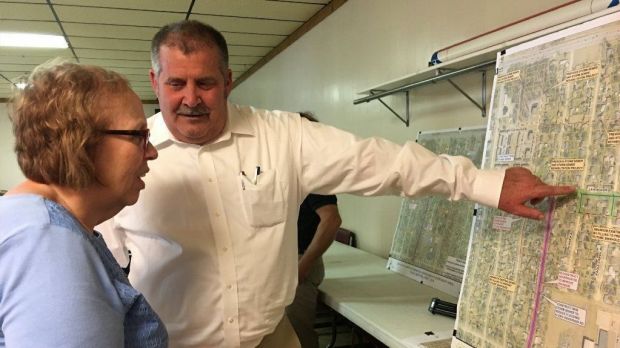

Alberta McCorkle, who lives in the 700 block of Governor Road in South Haven, looked over a map of planned storm water improvements for her neighborhood Thursday.
Mike Jabo, a division manager for DLZ, one of several contractors for different portions of the far-reaching project, assured her it wouldn’t impact her water bill, and her neighborhood would be getting a new storm water system and sidewalks.
McCorkle said she’s lived in her home since 1985 and received information about the meeting, hosted by the Porter County Department of Development and Storm Water Management at American Legion Post 502 in South Haven, in the mail.
“I just wanted to know what was going on in my area,” she said.
In all, more than 50 people, including South Haven and Salt Creek Commons residents, county officials, and representatives from the Twin Creeks Conservancy District attended the open house, meant to inform Twin Creeks customers about being brought into the fold of the county’s $20 million bond issue for storm water improvements.
The meeting grew testy at times, as some residents said Twin Creeks had done little to alleviate flooding and related concerns in their neighborhoods.
“Nothing has ever been done,” said Ron Blatz, director of communications for the Salt Creek Commons Homeowners Association, before wondering why that would be different with the county involved. “How can we put our trust in you guys?”
The conservancy district was formed 20 years ago to serve residents in South Haven, in Portage Township, and in Salt Creek Commons, in Union Township, said David Hollenbeck, the conservancy district’s attorney.
While the district has spent just under $3 million to address storm water problems, that wasn’t enough to cover everything that needed to be done, Hollenbeck said.
A 2012 study of storm water problems throughout unincorporated areas in the county identified the conservancy district “as the worst area in the county, and it was going to take $15 million to $20 million to solve it,” Hollenbeck said.
More than two years ago, county commissioners passed a storm water fee for county residents outside of city limits to raise funds for storm water projects. The fee replaced a previous “ditch tax,” under which the funds had to be used where they were raised. Money from the county’s general fund also was used for storm water projects, but as costs increased, that wasn’t financially sustainable, officials said.
The offshoot of the storm water fee, which is $10 a month, is $3.6 million to $4 million a year in recurring funds, said Commissioners President Jeff Good, R-North, who also serves as chair of the county’s storm water management board.
Those funds are being used to pay for a $20 million bond issue for storm water work, and to put staff and other necessities in place to assess and address storm water problems.
After negotiating with the county, Twin Creeks joined its storm water program a few months ago. Residents in the district pay half of their storm water fee directly to the county and the other half is channeled to the county through the district, said Robert Thompson, director of the development and storm water management department.
Residents had questions about how the county would ensure communication about the many projects, some of which are slated to start in the coming months, especially when that work means road closures and other challenges, and who they could call with storm water complaints, which they said have gone unheeded in the past.
County engineer Michael Novotney assured residents he and other county officials would communicate with them about the project’s many twists and turns, and they could contact him as well.
“Now you call the county storm water department” if there’s a complaint, he said.
County officials urged Twin Creeks customers to focus not on past challenges with the conservancy district, but on the coming projects being undertaken by the county.
“I understand that you’re upset, you’re mad, you’re angry, but we’re going to get this done and get it done right,” Good said. “We’re not going to let this go away.”


