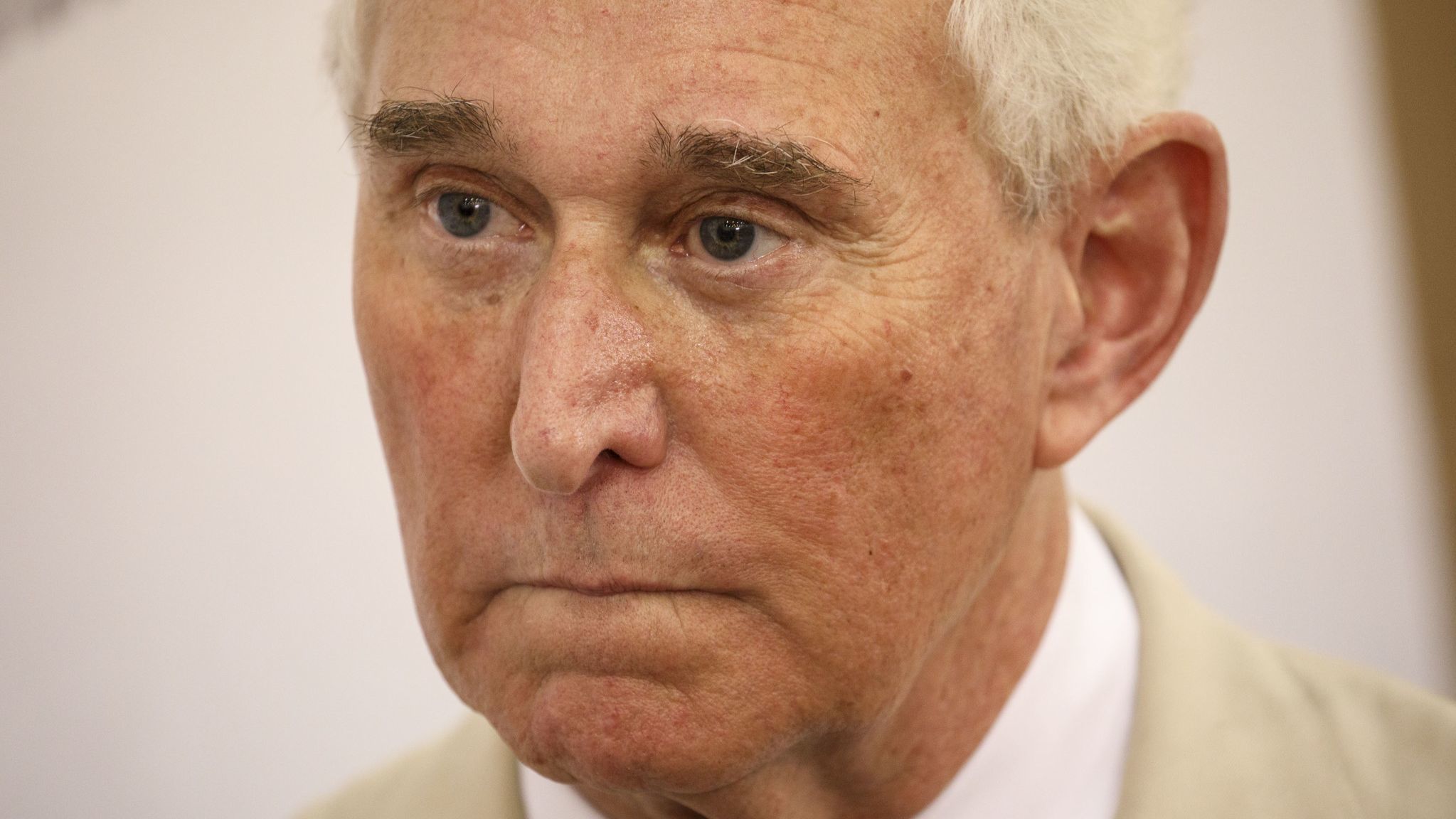

It is no surprise to learn of yet another Russian contact with Donald Trump’s closest advisers in the 2016 presidential campaign, this time with Roger Stone. What is shocking is the way Stone responded to an offer of dirt on Hillary Clinton. Trump’s longtime adviser, Stone, had vehemently denied that he had received any Russian communications. It turns out that was not true. In a meeting arranged by an official with the Trump presidential campaign, Stone was offered Russian intelligence on Trump’s opponent, Hillary Clinton, for $2 million. He turned it down, not because it would be illegal or morally wrong, but because, Donald Trump “doesn’t pay for anything.”
This brings the total to at least 11 Trump associates who had Russian contacts during the 2016 campaign or transition period leading up to the inauguration, including one of the president’s sons, his son-in-law, and two former aides, Michael Flynn and George Papadopoulos, who now are cooperating with federal investigators.
Election interference by the Russians is nothing new. American intelligence officials have known this for many years. In fact, former Director of National Intelligence James R. Clapper reported this openly in his new book, “Facts and Fears: Hard Truths from a Life in Intelligence.” He writes, “The Soviet Union tried to influence every U.S. election during the Cold War.” He gives as an example an effort during the 1960 presidential campaign to get Adlai Stevenson, the Democratic candidate against Republican candidate Dwight D. Eisenhower in 1952 and 1956, to run for a third time as the Democratic candidate, “at least partly because he’d made statements against the escalation of nuclear weapon testing and procurement, particularly of hydrogen bombs, and so was seen as ‘soft’ on the Soviets.”
Stevenson’s biographer, John Bartlow Martin, provided details of the contact by the Soviets, and of Stevenson’s response, based on Stevenson’s own detailed documentation of what he described as a “curious conversation” with Mikhail A. Menshikov, then Soviet ambassador to the United States. Menshikov told Stevenson that Soviet leader Nikita Khrushchev had “voted for you in his heart in 1956” and “will vote for you in his heart again in 1960.”
Stevenson’s notes continue with Menshikov’s message from Khrushchev: “And you Ambassador Menshikov must ask him which way we could be of assistance to those forces in the United States which favor friendly relations. We don’t know how we can help to make relations better and help those to succeed in political life who wish for better relations and more confidence. Could the Soviet press assist Mr. Stevenson’s personal success? How? Should the press praise him, and, if so, for what? Should it criticize him, and, if so, for what?” He also noted, however, their desire not “to interfere in an American election,” while offering to do exactly that.
Stevenson told Menshikov he was not a candidate. “I said to him that even if I was a candidate I could not accept the assistance proffered. I believe I made it clear to him that I considered the offer of such assistance highly improper, indiscreet and dangerous to all concerned,” and later wrote a letter that in diplomatic terms declined any offer of assistance.
That is a sharp contrast to the email sent by Donald Trump Jr. in response to a Russian offer to provide damaging information about former Secretary of State Clinton. “This is obviously very high level and sensitive information but is part of Russia and its government’s support for Mr. Trump,” the offer continued. His response: “If it’s what you say I love it especially later in the summer.”
I worked closely for years with Adlai Stevenson as assistant counsel when he was governor of Illinois, as his presidential campaign staffer, and later law partner. The standard he set of impeccable integrity and statesmanship is one we would do well to strive for today.
The man who did become the Democratic candidate for president in 1960, John F. Kennedy, was elected and appointed Stevenson to be ambassador to the United Nations, where Stevenson famously stood down the Soviet representative on the Cuban missiles. On Oct. 25, 1962, at the U.N. he asked Russian Ambassador Valerian Zorin to confirm that the Russians had secretly placed missiles in Cuba. When Zorin declined to answer, Stevenson said,” I am prepared to wait till hell freezes over — if that is your decision and I’m also prepared to present the evidence in this room.” He then presented the evidence that the Russians had lied to the United States, which then led to the end of the Cuban missile crisis.
Newton N. Minow, senior counsel at the law firm Sidley Austin, was chairman of Public Broadcasting Service from 1978 to 1980 and was appointed to presidential commissions and a Defense Department panel for the George H.W. Bush, Clinton and George W. Bush administrations. He also served as an informal adviser to President Barack Obama, who awarded him the Presidential Medal of Freedom.
MORE COVERAGE: