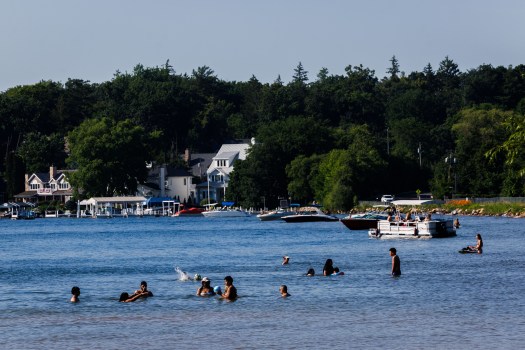


September 2019 has produced more than its share of rainy and even stormy days along the Waukegan lakefront, but Tuesday morning delivered weather fair enough to see the Chicago skyline to the south.
Still, evidence could still be seen of flooding rains from earlier in the month — including a run from Sept. 10-13 with an inch or more of precipitation — as city officials gathered at Municipal Beach to break ground on a small but significant measure to deal with stormwater runoff.
Construction is scheduled to start next week and continue into November on a bioswale that will run in two rows along the entire length of the beach’s north parking lot — a total of 6,000 feet of native vegetation that will catch grimy stormwater before it flows into Lake Michigan.
Mark Kozlowski, a project manager with Chicago-based Infrastructure Engineering, said the end result will deliver “a highly functional beautification project for the lakefront,” one that both provides “a grand entrance” to the beach while also boosting the environment.
“Basically, what’s happening is all of the (water) that’s draining to the roadway and the parking lot now is going to be picked up by the bioswale and treated for pollutants and whatever might be harmful to the water in Lake Michigan,” Kozlowski said. “It’s going to be treated and picked up before it’s discharged there.”
Paid for by a $360,000 grant from the U.S. Environmental Protection Agency that required a local match of $15,000, the work will include installation of 500 yards of “engineered growing medium,” as Kozlowski described the mix of soil and plants that will filter out things like residue from vehicles and waste from shorebirds.
“It improves water quality and reduces beach closures, and the target goal for stormwater quality measures was to capture and filter 1 million gallons of runoff annually,” he said, adding that water flowing across impervious surfaces like asphalt contains “pathogens, sediments and lax nutrient value, and the vegetated swales contain engineered soil with high organic compost content” that will house 900 environmentally appropriate native plants of mixed species.
In its current state, the parking lot stretching parallel to Sea Horse Drive is your basic bland expanse of asphalt that does nothing to promote the natural beauty of Municipal Beach. Anyone looking for a preview of how this project will dress up the lakefront can look to the south end, where a bioswale with a footprint about the size of garage was installed in recent years around a traffic drop-off circle that also houses food trucks during the summer.
According to Pete Campenella of Campenella & Sons, the contractor for the project, asphalt will be carved out of the parking lot in a row that roughly equals the existing painted yellow medians. If you’ve ever tried to park there on a busy afternoon, you know those medians do almost nothing for traffic control, so the bioswale project will also keep vehicles from entering and exiting in pell-mell fashion.

Another modest improvement to Municipal Beach that will also control traffic — in this case, of the pedestrian variety — is taking shape this fall and could be in place next spring. The city is looking to purchase a “nautically themed” system of ropes and wooden posts that will run between the parking lot and the dunes that line the west side of the beach, especially on its north end.
Noelle Kischer-Lepper, the city’s director of planning and economic development, said the rope fencing is designed to ensure that people accessing the beach are “walking on the pathways that we want to them to use instead of through the dune,” which is a quietly critical biosphere housing grasses and birds in need of protection.
Last but not least on the list of current improvements planned for the beach, Kozlowski said designs are being drawn up for improvements to Sea Horse Drive that will include a separate path for pedestrians and bicyclists. Those plans could move closer to execution next spring.
All told, according to Mayor Sam Cunningham, this package of upgrades represents progress toward Municipal Beach becoming “a destination spot” in the regional recreational industry.
“One of the biggest jewels that we have on the North Shore is our three linear miles of beach,” Cunningham said, standing next to the current bioswale. “We’re setting the tone of making (our) beach an attractive place for families to come and enjoy.
“These are small things, these are the basics that we talk about — one step at a time, moving forward to making this a premier place, a destination place for families throughout Lake County to come to Waukegan.”
There are still and will be other challenges toward reaching that goal, not the least of which include the indirect access provided by Sea Horse Drive and the still-undeveloped parcels of neighboring land that bear scars from their former industrial uses.
And, like every other shoreline community, Waukegan will have to deal with the possibility that rising levels on the Great Lakes — and more flooding rainstorms — will remain in the long-range forecast rather than exist for a short interval. Earlier this month, city officials report, public works crews had to use pumps to clear standing water from the south end of the beach, which was flooded up to the Stiner Pavilion.
But as the city inches forward at Municipal Beach, it’s impressive to see that even the small details have the bigger picture in mind — both aesthetically and environmentally.