
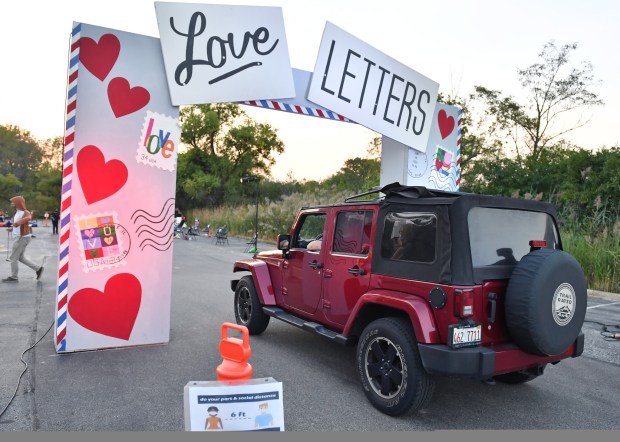


Cars lined up to see Libertyville High School students perform “A Love Letter,” a drive-thru play over the weekend which featured a collection of scenes about love.
Taking place in the school parking lot that looks out at Butler Lake, a production consisting of about 75 LHS students, made up of actors and crew, organized 10 scenes for those in attendance. In order to work within COVID-19 health guidelines, the production took place in a drive-thru format in which attendees followed a line in their cars driving to each scene.
The production itself explored numerous different kinds of relationships that have ties to love. These included friendships, parent and child, sibling, “frenemies” and significant others, officials said.
Those in attendance were required to stay in their cars and wear masks. Students performing also wore masks. The play itself was double-casted, officials said. This meant that students were rotated out for each set of two cars, which provided students a chance to catch their breath in-between each scene. Behind the scenes, technical theater students provided lighting, scenery and props, a release from the production team states.
Kevin Holly, the technical director for LHS, said he found the drive-thru idea online after a community theater in Virginia gave a similar kind of performance in the form of monologues. He said the biggest challenge with the format was performing outside, as it required moving the equipment from inside, and renting a generator. The turnaround for the show was quick as well, Holly said.
The play was approved just after September started, Holly said. Auditions were next, and then two weeks of rehearsal. But rehearsal took place remotely and through video chatting, Holly said. The first time the actors were together physically was Wednesday, which turned out to be the day before their first show, he said.
Originally, Thursday was supposed to be a dress rehearsal. But Holly said the tickets for the Friday and Saturday show sold out faster than expected, which left a lot of parents out. Because of this, they turned their Thursday dress rehearsal into a proper show, which saw 28 cars. Friday brought 42 cars, and Saturday saw 46 cars, Holly said, which means each actor performed their scene almost 30 times for the audience over the course of the weekend.
Other challenges Holly mentioned included the viewing angle of the actors in respect to the cars, and the various noises and occurrences of being outside. But he did say the weather held up nicely, minus one example he gave of the wind catching a few prop bags from one scene, and taking them to another.
“We were so thankful for the weather,” Holly said. “The weather cooperated the entire week.”

“A Love Letter” was a collection of scenes that were taken from three other plays, Holly said. He added Christopher Thomas, the theater director, wanted to do scenes from different plays, but make it a cohesive show to help fit the format.
Some scenes from the show included a throwback to Thornton Wilder’s 1938 play, “Our Town,” where two of the actors stood on ladders and looked out at the moonlight. Another scene, taken from the 2004 production, “Almost, Maine,” features two characters falling for each other.
Looking forward, Holly said this performance took the place of the fall show put on by the theater. The larger production, which is supposed to be a musical this year, has been moved to April for the time being. There are also plays typically put on in the winter, and then at the beginning of the year in January. For winter, Holly said they are looking to do a radio-style performance of “It’s a Wonderful Life.”
“I’m sure at some point, we’ll be able to get back to school and be able to rehearse,” Holly said. “But, can we have an audience like we normally would? And that’s a big question mark.”
He added the most important thing he’s taking away from the production is the fact that the students were able to put on a live production even in the middle of a pandemic. He mentioned some students said this could be a story they tell to their own children.
“The fact that we had the opportunity to perform and keep things alive for theater was the most important thing for us,” Holly said.


