Skip to content
THERMOMETER | Not only is a thermometer good to have on hand during cold and flu season, but it should also be a fixture in your first-aid kit. The Red Cross recommends a non-mercury, non-glass oral thermometer.
ArtistGNDphotography via Getty Images
THERMOMETER | Not only is a thermometer good to have on hand during cold and flu season, but it should also be a fixture in your first-aid kit. The Red Cross recommends a non-mercury, non-glass oral thermometer.
AuthorAuthor
PUBLISHED: | UPDATED:
Getting your Trinity Audio player ready...

THERMOMETER | Not only is a thermometer good to have on hand during cold and flu season, but it should also be a fixture in your first-aid kit. The Red Cross recommends a non-mercury, non-glass oral thermometer.
NON-LATEX GLOVES | The Red Cross recommends having two pairs of non-latex gloves in size large in your kit. These disposable gloves can protect your hands from exposure to germs and bodily fluids and won't trigger a reaction in people with a latex allergy.
NON-LATEX GLOVES | The Red Cross recommends having two pairs of non-latex gloves in size large in your kit. These disposable gloves can protect your hands from exposure to germs and bodily fluids and won’t trigger a reaction in people with a latex allergy.
FLASHLIGHT | You should also keep a small, waterproof flashlight or headlamp as well as some extra batteries in your first-aid kit.
EMERGENCY FIRST-AID GUIDE | The materials in your first-aid kit won't be helpful unless you know how to use them. Your kit should include basic instruction manuals to guide you through CPR and first aid.
EMERGENCY FIRST-AID GUIDE | The materials in your first-aid kit won’t be helpful unless you know how to use them. Your kit should include basic instruction manuals to guide you through CPR and first aid.
INSTANT COLD COMPRESS | Also known as instant ice packs, instant cold compresses are portable and disposable ways to treat minor pain, swelling for sprains, headaches and fevers.
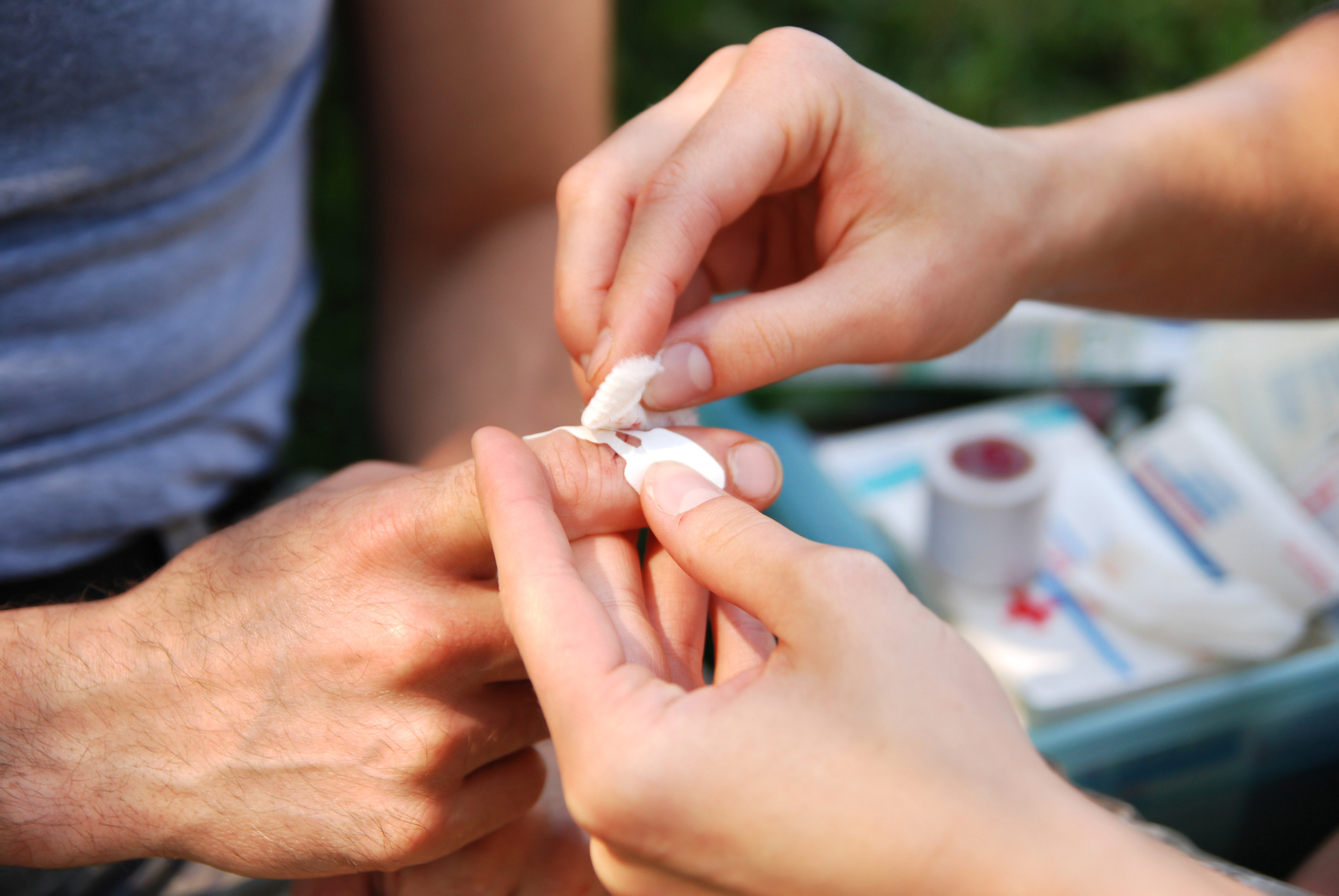
ADHESIVE BANDAGES | A first-aid kit should also have adhesive bandage strips in assorted sizes, including “butterfly” bandages, which can help close small, shallow cuts.
ANTISEPTIC WIPE PACKETS | Individually packaged antiseptic towelettes can be used to help clean and sanitize the skin before dressing a wound.
COMPRESS DRESSINGS | Compress dressings are highly absorbent, sterile pads that help minimize blood loss and keep wounds clean.
ROLLER BANDAGE | A flexible, soft roll of gauze bandages will help hold dressing on wounds while still allowing for flexibility for movement if needed.
GAUZE PADS | Gauze pads are non-stick sterile, all-purpose bandages to help stop bleeding and keep wounds clean. The Red Cross recommends having five 3-by-3-inch and five 4-by-4-inch sterile gauze pads in your kit.
CLOTH TAPE | For injuries that require a dressing besides an adhesive bandage, you'll need cloth tape to hold the bandages in place.
CLOTH TAPE | For injuries that require a dressing besides an adhesive bandage, you’ll need cloth tape to hold the bandages in place.
SAFETY PINS | Safety pins in a variety of sizes are also a first-aid kit staple as they can help secure wraps and bandages.
SCISSORS | A small pair of scissors is handy to help cut gauze, tape, clothing, bandages and more.
TWEEZERS | Used by many as a grooming tool, tweezers are also a first-aid staple that can be used to pick out small particles or foreign objects from the skin.
ANTIBIOTIC OINTMENT | Antibiotic ointment helps protect against infection while promoting fast healing of cuts, scrapes, scratches and burns. The Red Cross recommends having five antibiotic ointment packets of 1 gram each in your kit.
HYDROCORTISONE OINTMENT | Hydrocortisone comes in the form of ointments, creams, lotions and sprays. No matter the form, it helps relieve redness, itching, swelling and other discomfort caused by skin conditions. Include either a tube or a few individual packets in your first-aid kit.
CALAMINE LOTION | Calamine lotion can help soothe the itching and pain of minor skin irritations, such as those caused by poison ivy.
EMERGENCY BLANKET | Emergency blankets are lightweight, metalized plastic sheets that help retain body heat. They are used by first responders and search and rescue teams and can also be used as a ground cloth, gear cover or shelter from the elements in an emergency.
BREATHING BARRIER | A breathing barrier is a tool used to help administer CPR. It is a mask-like face shield with a one-way breathing valve that prevents the spread of disease by preventing direct contact between each person's mouth.
BREATHING BARRIER | A breathing barrier is a tool used to help administer CPR. It is a mask-like face shield with a one-way breathing valve that prevents the spread of disease by preventing direct contact between each person’s mouth.
<img loading="" class="lazyload size-article_feature" data-sizes="auto" alt="ASPIRIN | There are a few basic medications you should have in a first-aid kit. Aspirin is one of them because it can be life-saving for an adult with chest pain or who may be having a heart attack, according to the Mayo Clinic. The Red Cross recommends two packets of aspirin with 81 mg each.” title=”ASPIRIN | There are a few basic medications you should have in a first-aid kit. Aspirin is one of them because it can be life-saving for an adult with chest pain or who may be having a heart attack, according to the Mayo Clinic. The Red Cross recommends two packets of aspirin with 81 mg each.” data-src=”/wp-content/uploads/migration/2020/10/09/XPUDYXAJXK4QQKEG3DMOJMSUKA.jpg”>
ASPIRIN | There are a few basic medications you should have in a first-aid kit. Aspirin is one of them because it can be life-saving for an adult with chest pain or who may be having a heart attack, according to the Mayo Clinic. The Red Cross recommends two packets of aspirin with 81 mg each.
OTHER PAIN RELIEVERS | For treating a variety of other pain, it's smart to have a variety of your preferred pain relievers in your kit, such as acetaminophen and ibuprofen.
OTHER PAIN RELIEVERS | For treating a variety of other pain, it’s smart to have a variety of your preferred pain relievers in your kit, such as acetaminophen and ibuprofen.
PERSONAL MEDICATIONS | You should keep extras of any personal medications you take that don't need refrigeration in your first-aid kit. This includes a prescribed auto-injector of epinephrine to treat severe allergic reactions.
PERSONAL MEDICATIONS | You should keep extras of any personal medications you take that don’t need refrigeration in your first-aid kit. This includes a prescribed auto-injector of epinephrine to treat severe allergic reactions.
<img loading="" class="lazyload size-article_feature" data-sizes="auto" alt="DUCT TAPE | Duct tape is something most DIY homeowners have on hand, and its versatility is why it is great to have during emergencies. It can secure bandages, make a tourniquet, set a splint and more.” title=”DUCT TAPE | Duct tape is something most DIY homeowners have on hand, and its versatility is why it is great to have during emergencies. It can secure bandages, make a tourniquet, set a splint and more.” data-src=”/wp-content/uploads/migration/2020/10/09/B7ZTXF2X363KUCYX4AD3DXSBV4.jpg”>
DUCT TAPE | Duct tape is something most DIY homeowners have on hand, and its versatility is why it is great to have during emergencies. It can secure bandages, make a tourniquet, set a splint and more.
EMERGENCY PHONE NUMBERS | Beyond the tools that could be helpful during an emergency situation, you should also include a list of emergency phone numbers for family members, your family doctor and pediatrician, local emergency services, emergency road service providers and the poison help line.