

A historic piece of Aurora is open to the public once again.
After being closed for more than a year due to the pandemic, the Grand Army of the Republic Memorial Hall and Museum in downtown Aurora reopened over the weekend, appropriately enough on the Fourth of July, which was the 143rd anniversary of the facility opening.
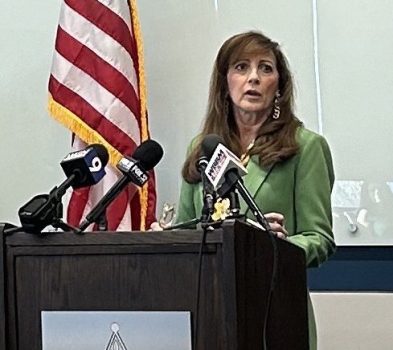
City officials including Aurora Director of Communications Clayton Muhammad and Aurora Director of Public Art Jennifer Evans welcomed the opportunity for the museum to show off its newly redecorated lower level and the new Service and Sacrifice exhibit, which details Aurora’s military contributions since 1917.
“It was intentional that we open this museum on the anniversary of its opening 143 years ago and show off its new exhibits that showcase the service and sacrifice made by others,” Muhammad said. “We’re fortunate to have a curator who knows a lot about our military history and has created a new lower level that speaks for those who have served.”

Evans spoke of the museum’s curator Eric Pry of Aurora, who has been part of the museum’s ongoing renovation and restoration work.
“The previous Public Arts director started this project and Eric (Pry) took over the reins,” Evans said. “The project took a long time as there were some issues with funding.”
Pry began working as curator in 2018 and said grant money from the state’s Department of Natural Resources “was frozen” under former Gov. Bruce Rauner and was released again in 2019 by Gov. J.B. Pritzker.
“One of the reasons this project lasted so long has been the lack of funding. It’s an expensive project and we didn’t want to burden the residents of Aurora with the cost,” Pry said of the renovation. “Unfortunately, the funds from the DNR were frozen but in 2019, Gov. Pritzer announced that all previous DNR grants would be released and we were included in that grant, which was worth $750,000.”
Pry said to date, “our last report shows $525,000 has been spent.”
Pry was happy about meeting the July 4 deadline to reopen.
“COVID restrictions were lifted in June so we didn’t have a whole lot of time and we knew if we didn’t get things open we were going to miss the anniversary,” he said. “This was not just a celebration of our country’s emancipation from the British Empire but also to hopefully what will be an end to the pandemic and our being able to get together again. We didn’t want to miss that.”
The pandemic understandably slowed things down “in a large part because there were limitations on how many people we could have in the building” Pry said, as well as getting approval for contracts and projects.
Muhammad spoke about Pry’s passion for the job as well as his leadership, which the curator said comes from lots of time spent with his father.

“Neither my dad nor I served in the military, but my understanding is that most of my family before him served in various conflicts,” Pry said. “My dad was a construction worker who had to get up early but on the weekends he’d turn on the History Channel or tell me stories about his dad who served (in the military) … and that all sparked my interest.”
Pry said he is currently looking to fill a part-time position and once he does, the museum will be operating three days a week on Thursdays and Fridays from noon until 4 p.m. and on Saturdays from 10 a.m. until 3 p.m.
David Sharos is a freelance reporter for The Beacon-News.