


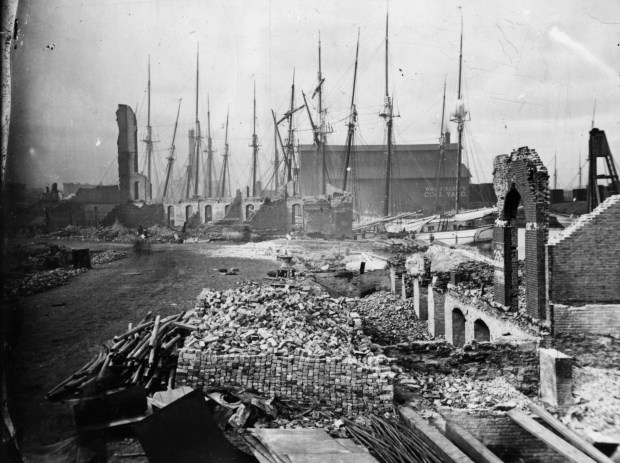


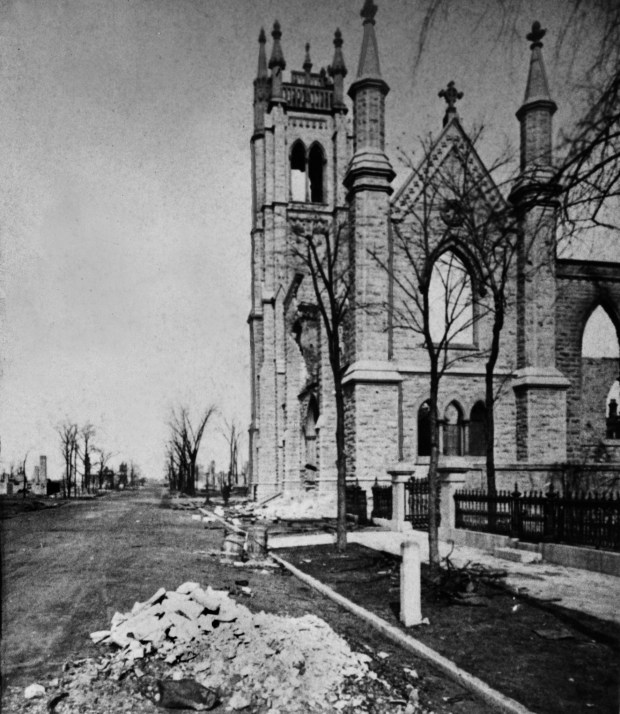


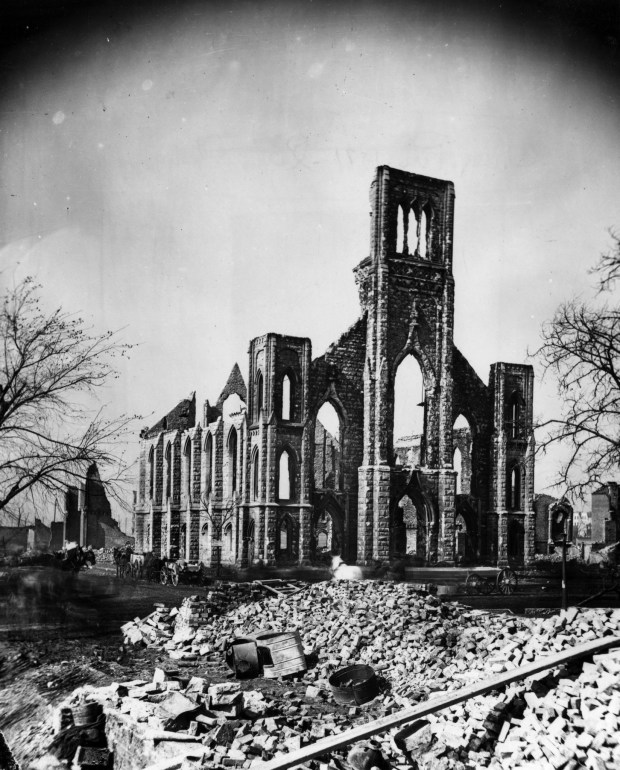
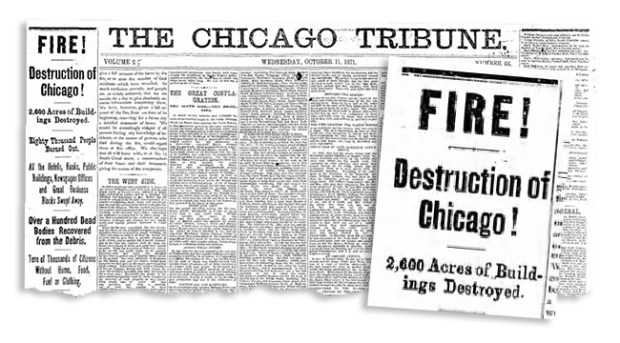




Our family stories about the Great Chicago Fire are like many of Chicago’s stories about itself. They lean heavily on romanticized fragments of memory.
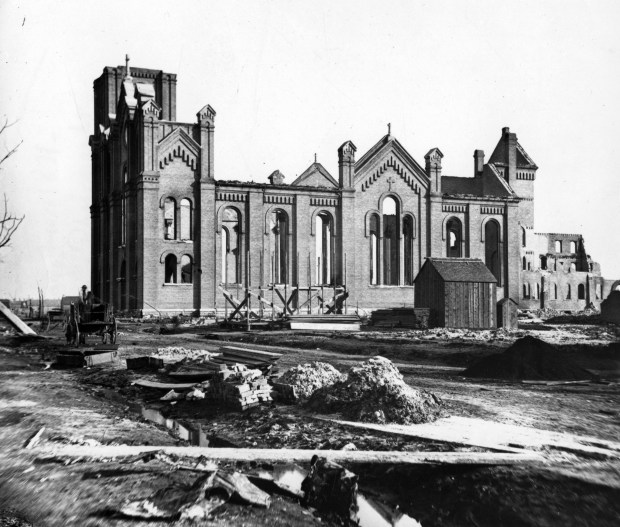
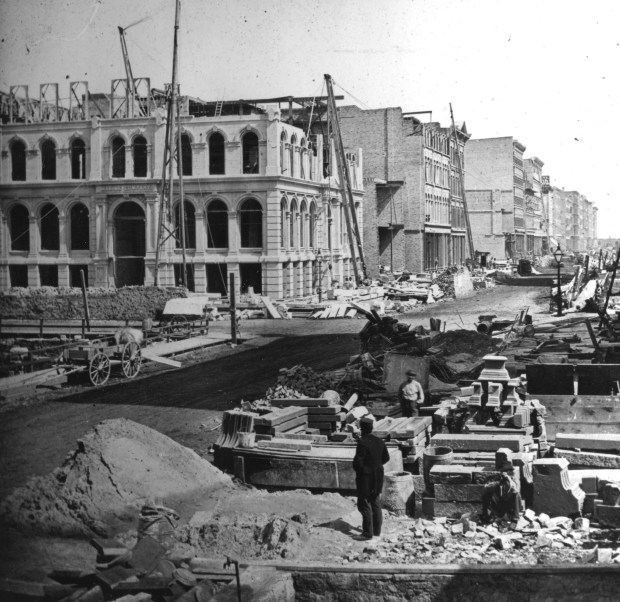
We learned about the fire when we were kids, walking through the Loop in the 1970s, past the buildings constructed just after October 1871 on what’s now Block 37.
My dad told us who Catherine O’Leary was. His mother’s father’s family — or was it someone they knew? — lived near the O’Learys. The fire wasn’t set by a cow kicking over a lantern, he told us; it was some drunken neighbor or tramp, sleeping in the hay, maybe, who lit the blaze with a cigar. Or was it a lantern?
By the time neighbor Daniel “Peg Leg” Sullivan alerted people to the flames, it was too late. So my widowed great-great-grandmother fled the inferno, her children carrying the family’s new cast iron stove and other belongings.
The stove was too heavy. They abandoned it on a Chicago River bridge. I’ve always wondered if the stove is still there, rotting in the riverbed.

Like family lore and Chicago tales, there were exaggerations. It was Bridget O’Connell Cranley’s brother, Daniel O’Connell, a city fireman at the time of the Great Fire, whom records indicate lived on DeKoven Street. My great-grandmother’s family lived on Adams Street in a boardinghouse Bridget ran, doors from where the world’s first skyscraper later rose.
My ancestors lost the boardinghouse to the flames, then rebuilt their lives right along with their knocked-back city.
Our family still tells the stories about the Great Fire 150 years later, stories about the city and how it changed around us. We were bit players: a firefighter here, a Cook County clerk there, laundrymen, a few bookies — and a few bookies who were also laundrymen.
Long before the Fire, our family and our city were both adapting and surviving.
When we arrived, the Irish were the down and out, the papist drunkards raising loose women and brawling men. Great Fire accounts blaming Mrs. O’Leary reflect this narrative. It’s a story told by political leaders about each new generation of Chicago immigrants, to keep the newcomers from challenging entrenched power.
Eventually, the Irish came into their own and became men of industry and engineers of the political machines. Our family rode along with them, trying to move up as we saw Chicago evolve from a collection of coal-ash-covered wooden shacks into the builder of the first skyscraper, the home of the world’s largest mail-order company, the pioneer of department stores. It was a place of wonder that we helped build.
Chicago bragged, and my family boasted with it. The world’s first skyscraper, across the street from where our family lived! The Columbian Exposition. The center of American rail and commerce.

Chicago had great stories to tell. City leaders, among them, Col. Robert R. McCormick, the owner and steward of what he called the World’s Greatest Newspaper, the Chicago Tribune, took pride in the part played by the men of Chicago — to McCormick and so many others, it was always the men — in electing Lincoln, the president who saved the union.
But the stories told by much of official Chicago too often ignored that Lincoln died for the idea of racial equality: John Wilkes Booth heard the president’s last speech and took it to mean Lincoln wanted full citizenship for Black Americans. And the colonel and his contemporaries, even when they decried legal segregation and even racial covenants for real estate, fought against what the city could be at its best, using their grand plans to justify things like leveling Black neighborhoods and busting up communities.
When the O’Connells fled Ireland during the famine, they met the Cranleys, who also had fled a place where a family couldn’t practice their faith, a place where an Irishman couldn’t own a horse worth more than five English pounds.
In Chicago, we escaped that, my dad emphasized. And we should always fight against it.
But many of the Irish politicians used their elevated positions to reinforce their own power, even while marking great achievements that left mixed legacies.
The city reversed the flow of the Chicago River to purify our drinking water, but at the expense of America’s river system ecology. Meanwhile, pols bolstered their clout by requiring water service lines be made of lead, so only their backers in the plumbers’ union could do the work. It’s a multibillion-dollar legacy we’re still struggling to fix today.
Business leaders and politicians backed the 1909 Burnham Plan to remake the city. But the changes they touted also included racial covenants and led to the creation of public housing projects like the Robert Taylor Homes that further segregated our city.
They encouraged the building of single-family homes, but power brokers’ redlining prevented Black Chicagoans from getting home loans.
They let aldermen use zoning to extort contributions from companies.
They built a car-friendly city as they made it illegal for transit companies to raise their fares.
My father told us about the Chicago of his youth, a city of 3.6 million people that was hollowed out by corruption and racism. Instead of preserving post-Fire buildings as monuments to commerce and learning and religion, Chicago sought ways to replace them.
Yet there is so much we have done in the past 150 years. We’re not the city we could be, but we’ve made real progress.
In 1997, a City Council committee declared it wasn’t Mrs. O’Leary or her cow who started the fire, shining a light on historical research that some think puts to rest the calumny of popular accounts.
In the 1990s, the city was rocked by bribery scandals involving illegal dumping and aldermanic corruption. But with each new federal investigation, the range of easy corruption schemes narrows.
The high-rise public housing that isolated so many people of color has been demolished, even as the promise of integrating former residents into Chicago’s communities has largely failed to come true.
It’s harder today for city leaders to ignore the crime plaguing parts of our city than when we last saw murders spike in the 1990s because more people are paying attention now.
Chicago still is one of the most segregated cities in the country, but neighborhoods like once-majority-white Rogers Park and even Bridgeport, now have no racial or ethnic majority.
What can Chicago become in the next 50 years? To find out, we need to keep a bright light on the less-savory legacies of those who rebuilt Chicago after the fire. And as we continue the task of rebuilding, aim to make Chicago a place that welcomes everyone.
Liam Ford is a former Tribune editor and fifth generation Chicagoan.


