Students and faculty at Oak Park and River Forest High School are getting to test out and use a recently completed building addition that replaced a single-floor cafeteria with a three-story structure.
The $35 million project is the first major construction in nearly 60 years at the 149-year-old institution that has graduated luminaries such as author Ernest Hemingway, McDonald’s founder Ray Kroc and actor Dan Castellaneta.
“It’s the first renovation we’ve done at the school since the mid-1960s,” Superintendent Gregory Johnson said. “The motivation and focus was to provide a space that is welcoming and inviting for students, allowing them to be scholars within the school in a relaxed environment. Not your traditional classroom structure, but a slightly less formal environment for them to study, engage and relax.”
“Project 1? is the first part of a 10-year, five-phase Facilities Master Plan that follows recommendations from a 40-person team of community members who identified school needs.
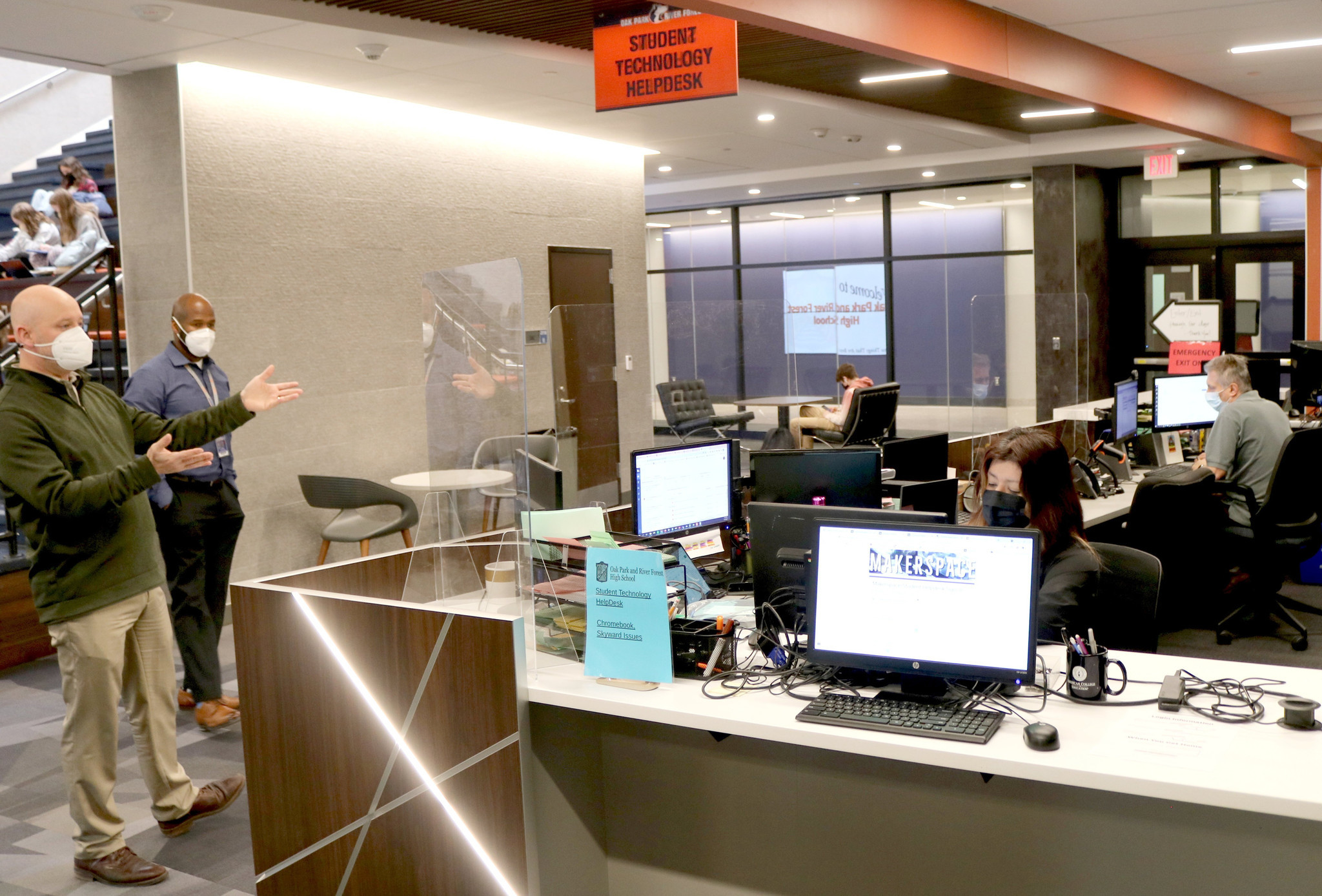
“The newly-added space is right around 20,000 square feet,” OPRF Director of Construction Jeff Bergmann said. “Where there had been a cafeteria on just one ground floor, we’ve now added a new basement for storage and two floors above it. So there are now four levels of space instead of just one.”
The new South Cafeteria features movable tables and chairs and an elevated center section with a gently-sloped handicapped-accessible ramp.
The second floor is the Student Resource Center, which contains multi-use classrooms, a tutoring area, a technology help desk and a tiered, open lecture hall that extends up to the third floor library.
“The new library has more space and a completely different configuration,” Johnson said. “Unfortunately, all the new bookshelves are not yet here, due to supply chain challenges.”
The library features a help desk and a large, central classroom. An expansive reading area near panoramic windows overlooking the west campus was completely filled with masked students studying during a tour last Jan. 19.
In addition to the new three-story building, a number of classrooms were renovated and upgraded with new technology.
With overhead lights dimmed, a driver’s education room was filled with students at the wheels of 28 state-of-the-art simulators.

“This allows us to have more students driving during the school day while using fewer resources,” Johnson said. “It counts as driving hours, but they still have to go on the road into real traffic.”
Another classroom features an entire wall constructed of erasable white board.
“The surfaces of the desks are also whiteboards, so that really helps engage the students,” English teacher Erica Eckart explained.
Just as in the cafeteria and the Student Resource Center, the renovated classrooms use desks and chairs that can be rolled around and adjusted to any height.
“The flexible grouping of the furniture totally changes the feel of the learning environment,” Eckart said. “Instead of everything being all in rows, the students are sitting together. They like it better, it feels more positive and it’s a better space for learning.”
Johnson echoed the positive sentiment in recalling recent student comments.
“We had a mini-ribbon cutting for them and one of the first things we heard when they first came in was ‘wow, this feels like college,'” he said. “And that’s what we wanted –an academic, professional but relaxed environment.”

The main entry to the high school also saw extensive renovation. A large stone tablet sculpture known as the “Book of Knowledge,” set in the facade above the original entryway, was preserved following a remodeling in the 1960s and now rests in a glass display case in the hallway.
The entirety of Project 1 components will not be finished until fall 2023, Johnson said, and construction was completely financed with cash reserves.
An additional $16 million in capital projects and $5.1 million in health and life-safety improvements, such as roofing work, technology upgrades and accessibility for people with disabilities, also are being undertaken. Officials said that work is budgeted and financed out of funds separate from Project 1.
The next phase of the Facilities Master Plan, not yet approved by the Board of Education, will include an addition to the physical education wing, a field house extension and flooring and mechanical upgrades.

According to the school website, the estimated $65.3 million cost of Project 2 is more than twice as much as the original $32.6 estimate for the first phase.
Future elements of the master plan include upgrades to the Performing Arts area, science labs, Special Education classrooms, Administration and Student Services offices, tennis courts and other components. A “green roof” and solar panels for certain areas are planned.
Johnson and Bergmann both praised Project 1 designer FGM Architects.
“What FGM did has been stunning,” Johnson said. “It’s obvious how much time and care they put into everything.”
Johnson said thanks also is due to the community for supporting the Facilities Master Plan.
“At some point, we will have a grand opening event where everyone can come in, tour the new facilities and we can officially welcome them the way we want to,” he said. “Our goal is to just keep improving to make the school the best we can for all the students.”