

Most of the properties along the ravines from Winnetka through Winthrop Harbor, including the one through which the Waukegan River flows into Lake Michigan, are in private hands posing a challenge when needed remediation becomes necessary.
Michael E. Prusila, the planning supervisor for the Lake County Stormwater Commission, said when stream banks in the ravines erode, it causes problems for the ecosystem. Since most of the property consists of private homes, restoration cannot easily be government-mandated.
“Ravines are a pretty distinctive feature in communities around here,” Prusila said. “Some of them have severely eroded stream banks. This causes concerns for the stormwater running through them.”
Remediating ravine erosion is one of the goals of the newly released Lake Michigan Watershed-Based Plan, along with restoring wetlands, curbing flooding, stabilizing stream banks, removing contaminants, developing the best stormwater practices and more.

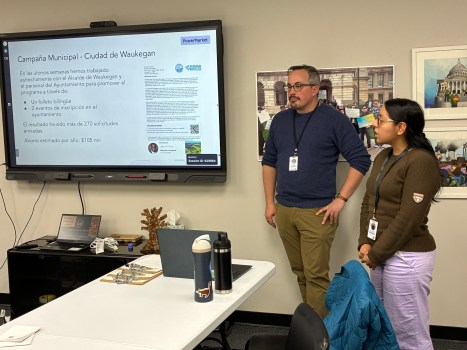
Commission representatives introduced the latest watershed plan at an informational meeting Thursday at the Waukegan Public Library, initiating the process leading to its adoption by the commission, the Lake County Board and local governing bodies.
“It’s a road map for voluntary remediation of water quality, flood damage and other water resource-related issues along Lake Michigan in Lake County,” Prusila said after the meeting.
The Lake Michigan Watershed consists of all land along the lake in Illinois, Wisconsin, Michigan and Indiana from which water flows into it, Prusila said. The plan itself is for the areas east of Green Bay Road, from Winnetka to the south through an area just north of the state line.
Though Green Bay Road goes from Evanston through Highwood, and then starts again at Old Elm Road between Highland Park and Lake Forest continuing into Wisconsin, Prusila said the ridge which causes stormwater to flow east into the lake continues.
Along with the bluffs and ravines which carry stormwater into the lake, Prusila said it also flows there through Kellogg Creek, the Dead River, the Waukegan River and Pettibone Creek. The entire Lake Michigan Basin consists of 67,900 square miles around the entire body of water, including 81 miles of rivers and streams, as well as 3,600 acres of wetlands.
With the plan now introduced, Prusila said there will be a public hearing at 9 a.m. Wednesday at the Lake County Courthouse & Administration Building. Prusila said it will be in the form of an open house where people can talk to officials and make comments. The public comment period ends April 6. First the commission, and then the Lake County Board will vote on it.

Kurt Woolford, the commission’s executive director, said during the meeting the plan is a holistic approach to dealing with the issues surrounding the Lake Michigan Watershed. There will be financial grant opportunities through a variety of agencies to help fund the work.
One woman who lives near the lake in far northern Illinois expressed concern about grant funding since the applications must be filed by an organization rather than an individual. She said she is unable to form a homeowners’ association.
“I don’t have any neighbors,” she said. “Do I need to hire a lawyer and form an organization?”
The plan is intended primarily for municipalities, other taxing bodies like park districts and individuals. Prusila said areas like coastal plain stretching east from the bluff, along Sheridan Road between Waukegan and the state line, are handled differently.
Waukegan Harbor and the areas which once housed factories along the city’s lakefront have long been under remediation controlled by the United States Environmental Protection Agency, including several Superfund sites.
“It’s about a mile wide,” Prusila said. “It’s unique and internationally recognized.”
One goal of the plan is restoring wetlands wherever possible. Prusila said such restoration includes areas which were once wetlands, but are no longer. They can be brought back with remedial treatment.
New with the introduction of the plan is an interactive online component. Jacob Jozefowski, a water resource professional with the commission, said it enables a person to enter a specific address to learn about the area and what remediation can be done.