

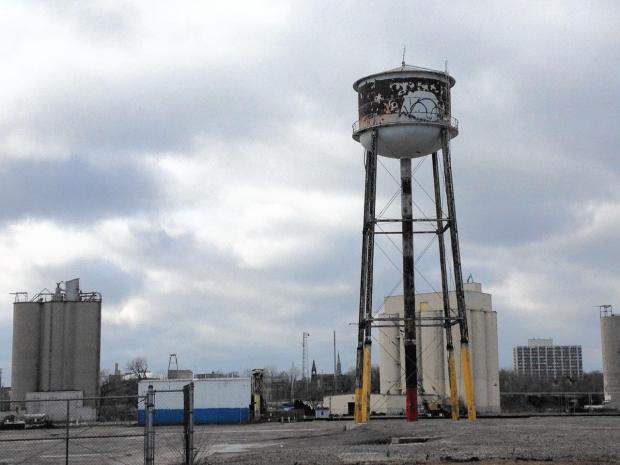


Some Waukegan residents wanted to preserve the nearly century-old water tower at the lakefront once a part of Johnson Motors’ Outboard Marine factory, but city officials determined the cost of saving it was too much.
Once recommended as a historic landmark by the Waukegan Historic Preservation Commission in 2017, Commissioner Michael Hohf described it as a reminder of the lakefront’s industrial past.
“We wanted to honor what happened,” he said at a commission meeting Thursday. “Johnson Motors was an example of the work that was done there. It would be nice to leave a symbol of what was there.”

– Original Credit: News-Sun
Waukegan Mayor Ann Taylor said she remembers the bustling factories which were part of the lakefront when she was a young girl, but both manufacturing in Waukegan and its location are different today.
“It was getting to be ugly,” Taylor said Friday. “People see the lakefront as a place for recreation and enjoyment. There’s still a lot of industry in Waukegan, but the process is different now.”
Built in 1926, the water tower, now on city-owned property, was demolished in a few hours Wednesday near the Waukegan harbor after a unanimous vote of the City Council approved the action on Sept. 18 in a money-saving measure.
When the city demolished the factory buildings and left the water tower standing in 2017, then Mayor Wayne Motley said he hoped it would be, “a monument to the people who spent their entire lives working” there.
About the same time, local preservationist Harry Came submitted an application to the commission to make the water tower a historic landmark. When the recommendation went to the City Council, the request was tabled. No further action was ever taken
Ty Rohrer, the Waukegan Park District’s manager of cultural arts and historian, said Friday the water tower was one of the few things remaining, along with grain silos, of the lakefront’s industrial past. There are other memories, too.
“It is part of what gave Waukegan our wonderful diversity, and helped the city grow and prosper,” Rohrer said. “The water tower also represents a bad part of history, too. Those factories left us with a lot of pollution.”

– Original Credit: News-Sun
Though the commission recommended the City Council make the water tower a landmark, council members never acted. Stewart Weiss, an attorney with Waukegan corporation counsel Elrod Friedman, said council inaction left the city free to demolish it.
“No certification of appropriateness was necessary or required by the Historic Preservation Commission,” Weiss said. “No ordinance was ever passed.”
Economics helped the City Council make its decision about the water tower. Taylor said the cost of maintaining it for the next three to five was approximately $250,000. The price to tear it down was $72,260.
“There was so much rust that you couldn’t save it without a vinyl coating,” Taylor said. “It’s only going to last three years, five at the most, and then you have to do it all over again. The alderpersons didn’t want to spend the money. They said, ‘tear it down.'”

– Original Credit: News-Sun
Hohf said he did not expect the city to pay for the tower’s preservation, but he hoped former Johnson Motors employees or their children would be willing to save a symbol of the place many spent their adult lives working.
“I was hoping that would happen,” he said. “I know of some (Johnson Motors) alums who are still here, who might want to do it for their children.”
Jim Mahnich, a onetime Johnson Motors employee, said at the commission meeting there were still three buildings in town which were once part of the company. They are now used by other businesses. The company is no longer in operation.
Waukegan remains an industrial city, but the factories are located elsewhere, like along Waukegan Road where Medline and The VisualPak companies — two of the city’s largest employers — operate. Taylor said manufacturing is very different today, but remains here.
“There’s still a lot of industry,” she said. “It’s much more automated. It’s more centered around trucks for shipping. There are train tracks there too. We’re seeing more and more of that activity.”