

The complexity of the issues surrounding establishment of a tax increment financing district for the Hollywood Casino resort project were on display Tuesday night in Aurora.
The public hearing for establishment of the Farnsworth-Bilter TIF district on the Northeast Side brought them out, with people arguing for and against the proposed incentive before the Aurora City Council, which will make a decision on establishing the TIF district in January.
The TIF district was contemplated as part of a redevelopment agreement between the city and Penn Entertainment, Hollywood’s parent company, approved by the City Council on Oct. 26, 2022.
Penn Entertainment plans to build a $360 million casino resort, and the city, as an incentive to the company, agreed to pay $50 million toward the project upfront. The money would come from a bond issue, which would be paid back by proceeds from the TIF district increment.
Since that time, the city has taken the myriad steps necessary to establish the TIF district, which would be on several land parcels at Farnsworth Avenue and Bilter Road. The district would cover only the property involved in the Hollywood Casino development.
Since approval of the redevelopment agreement, the City Council also has approved the final plans for the casino development, deeded over three city properties to the casino and hired an engineer to shepherd through road projects necessary to accommodate the development.
It also gave over to the casino options it had to buy three properties in the development – a church, the Alamo Ballroom and Gaslight Manor. The casino has since purchased those properties through its real estate company.
Those properties are part of a key point of contention about whether or not the property should qualify for a TIF district based on whether or not it is actually blighted, and whether the area meets the “but-for” test necessary to establish a TIF district, which means that but for the TIF district, the development would not happen.
Charles Durham, of Ryan, LLC, the company which did the TIF study for the city, says the area does meet both the blighted test and the but-for test.
He said it also meets qualifications for passing the TIF district as a conservation district, which means it is likely to stay or become blighted in the future without the TIF district.
“There are conditions in place that do curtail efforts to redevelop,” Durham said. “The TIF removes some of those impediments. Without the TIF district, in our opinion, the project would not be financially feasible.”
But others at the hearing said the opposite.
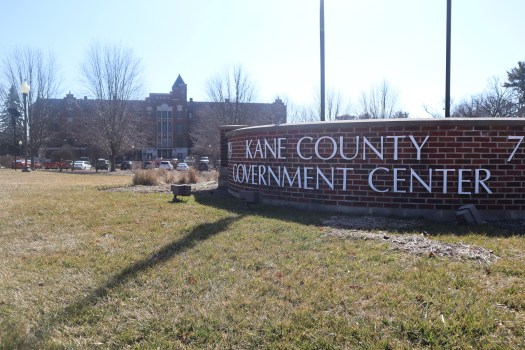
Several relied heavily on the comments made by Mark Armstrong, the Kane County supervisor of assessments, at the Joint Review Board hearing for the TIF district. The review board is made up of all the taxing bodies in the proposed TIF area, which includes Kane County.
Armstrong was the one dissenting vote when six of the seven taxing bodies (with one absent) at the review board voted to support creation of the TIF district.
He said he did not feel the case was made that the area was blighted, and also said the but-for case was not made, because the property in the area recently sold for millions of dollars. He said it appeared to him the redevelopment of the area had already begun, without the TIF being established.
Both Ald. John Laesch, at large, and Chris Lauzen, Kane County treasurer, referred to Armstrong’s comments at the review board and touted his expertise on land assessment and TIF districts. Both Laesch and Lauzen oppose creation of the TIF district.
Lauzen is opposed to the city spending $50 million and getting it paid back “on an installment plan” when he said the casino could afford to do the project on its own. He decried the fact the TIF district ties up tax dollars for the other taxing districts for 23 years.
“I just don’t want the city of Aurora to be taken advantage of,” he said.
He also sided with Armstrong’s assessment that the property is not blighted.
“Just because you call something blighted doesn’t mean it’s blighted,” he said.
Laesch, who has been a consistent critic of the casino plan and the TIF district to support it since it was announced more than a year ago, called the property near the Interstate 88 interchange and across the street from Chicago Premium Outlets mall “prime real estate.”
He touted Armstrong’s “point that the property is already being developed without the TIF.”
“I feel like a lot of this is just a charade where the casino wins, and the taxpayers lose,” he said.
They were backed by several people, such as Sandy Schmidt, who said “in this scenario, blight is not warranted.”
Helen Ratzlow said the TIF district does not meet the but-for clause of the TIF Act.
“The $50 million bond, I still don’t believe Penn Entertainment needs it,” she said.
Many others said they consider using a TIF district as taking money from other taxing bodies, such as the school district, in this case Batavia School District 101.
But Ald. Patty Smith, 8th Ward, called that claim “untrue.” She said that the money involved currently does not exist, and would be created only by the development itself, with the aid of the TIF district. She said the increment money has “never, ever been removed from the school district budget.”
The taxing bodies would continue to receive the tax money they have from the property, and in this case, would receive 10% of the money in the increment through the 23 years of the TIF district, due to a separate intergovernmental agreement between the city and the Batavia School District.
“This is a prime example of some of the untruths that have been passed on,” she said.
Alex Alexandrou, the city’s chief management officer, pointed out that five of the taxing bodies on the review board – the city, the Batavia School District, the Fox Valley Park District, the Aurora Library District and the Waubonsee Community College District – voted in favor of establishing the TIF district.
He also said the reason the redevelopment has started – the millions cited as being spent on the properties in the proposed TIF district – is because of anticipation of the district being established.
He pointed out that redevelopment of the Chicago Premium Outlets mall across the street, as well as the development down Bilter Road to Mitchell Road, took place because of a TIF district – TIF District 2, often considered one of the most successful ever in the state.
Alexandrou also touted the “extra benefits” that have come to Aurora through the more than $300 million in gaming taxes the casino has paid to the city since it opened in 1993.
“We have data and evidence to show the new casino will generate much more,” he said.
Smith also pointed out that the extra benefits – such as funding aldermanic ward funds and the city’s yearly Quality of Life grant program – are paid for with casino funds.
“It needs to be said that without a casino … a lot of those programs go unfunded,” she said.
That was the point made by several agencies that showed up at the hearing, such as the Association for Individual Development, the Fox Valley Girl Scouts and World Relief, which has an office in downtown Aurora.
Bob Gorski, of the Association for Individual Development, said the grant from the Quality of Life program funds the organization’s victim services program, used by 501 of their clients, and representatives from World Relief said their grant funds cover the Children and Youth program, which provides after- and pre-school programs and other services for about 200 kids of immigrant families in Aurora.
“We’re really thankful for this grant we receive each year,” said a World Relief spokesman.