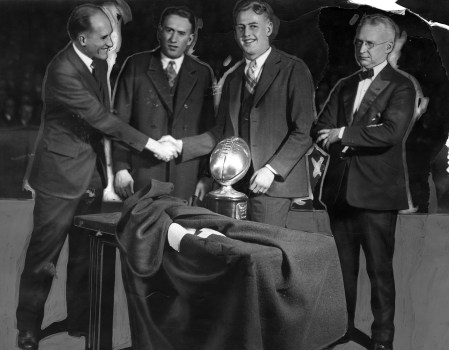
The Chicago Tribune Silver Football — 100 years later —remains one of the highest honors a Big Ten player can receive.
The list of winners includes future Pro Football Hall of Famers and Super Bowl MVPs along with others less remembered in the sport’s annals. The Tribune hoped the annual award, which preceded the Heisman Trophy by 11 years, would “become a much sought honor surpassing any now possible for these hard-working gridiron heroes whose efforts afford pleasure to so many thousand people.”
-
- 1940s: From Tom Harmon to Red Wilson
- 1950s: From Vic Janowicz to Bill Burrell
- 1960s: From Tom Brown to Mike Phipps
- 1970s: From Mike Adamle to Tim Clifford
- 1980s: From Mark Herrmann to Anthony Thompson
- 1990s: From Nick Bell to Ron Dayne
- 2000s: From Drew Brees to Brandon Graham
- 2010-23: From Denard Robinson to Marvin Harrison Jr.
Meet the winners from the first two decades.
1924: Red Grange, Illinois HB

If you love football, there’s a good chance you have Red Grange to thank for it. For Bears fans, and more broadly NFL fans, Grange’s participation in the early days of the league helped legitimize and stabilize it. Perhaps it’s Big Ten football you love. Grange’s game against Michigan is considered one of the best college performances of all time. He accounted for six touchdowns and 402 yards (212 rushing, 126 returning, 64 passing) — and played defense — in a 39-14 win. Even if you love the business of sports and finding out what athletes endorse, you have Grange to thank for that. He was the first professional athlete with an agent, getting a cut of gate receipts in his contract with the Bears and putting his name on everything from candy bars to outboard motors.
1925: Tim Lowry, Northwestern C

Tim Lowry was a true Chicagoan, having attended Eugene Field Grammar School before playing football at Senn High School on the North Side. He stayed close to home for college, choosing Northwestern, where he played football and wrestled. He was Northwestern’s first All-American in college football’s modern era and earned a letter as a heavyweight wrestler. With Lowry at center, Northwestern turned around its fortunes in the Big Ten, going from a 2-6 record (0-6 in the conference) in 1923 to a 5-3 finish (3-1 Big Ten) in 1923. After earning both his bachelor’s and law degree from Northwestern, Lowry served as an alderman in Evanston and on the board for the Illinois Center.
1926: Benny Friedman, Michigan QB

An early prototype for what the position would become, Benny Friedman understood the unique control quarterbacks have over how a play will go. “Every passer has a little computer in his head,” he said after his football career was over. “In a split second he has to determine the direction the receiver is going, the distance he’s away from the passer and the speed he is traveling. With all that data in his mind he must then throw the pass.” After winning the Silver Football, Friedman had an eight-year run in the NFL and is a member of the Pro Football Hall of Fame as well as Michigan’s Hall of Honor.
1927: Ken Rouse, Chicago C

Ken Rouse’s selection as the Silver Football winner for 1927 might appear to most people to be an unusual choice. Rouse was a center on a University of Chicago team that went just 4-4. However, the Lindblom High School graduate made quite an impression on the conference’s coaches and players throughout his career with the Maroons. Read more here.
1928: Chuck Bennett, Indiana HB

Indiana wasn’t exactly a football powerhouse in the 1920s, cycling through four coaches during the decade and finishing nine seasons at fifth or below in the Big Ten. The team’s struggles make Chuck Bennett’s accomplishments that much more impressive. Despite the Hoosiers going 4-4 in 1928, he was an All-American and Indiana’s first Silver Football winner. He went on to play in the NFL for the Portsmouth Spartans — who moved to Detroit in 1934 to become the Lions — and Chicago Cardinals. Bennett’s post-football life kept him close to the sport. He coached high school football in Indiana and Minnesota before finding a home in Chicago’s suburbs. He coached for 21 years at Lyons in LaGrange, winning 11 West Suburban Conference championships and also working as the school’s athletic director. The best student-athletes at the school receive the Chuck Bennett Award.
1929: Bill Glassgow, Iowa HB

On a team known more for its defensive prowess, Bill Glassgow scored the first touchdown at the newly opened Iowa Stadium — later renamed Kinnick Stadium — and the only Hawkeyes touchdown two weeks later in the stadium dedication game against Illinois, a 7-7 tie. The Tribune wrote this about him: “No halfback ever revealed himself in a brighter light. He ran off the tackles, he ripped into the line and he passed. He literally carried almost the entire Purdue team with him at times. When tougher and more willing backs are built, they will have to make the model from the stocky lad from Shenandoah, Iowa.” A shoulder injury affected Glassgow’s ability to play major-league baseball. He played in the NFL for a few years while also attending law school and then worked as an attorney in Iowa, serving as the Linn County Attorney in the early 1950s.
1930: Wes Fesler, Ohio State TE

Wes Fesler made the most of his time at Ohio State, playing football, basketball and baseball, not to mention being a member of Phi Beta Kappa. As a guard in basketball, Fesler was a first-team All-American, but it was football where he truly made his mark. He was a versatile player who could line up at tight end or halfback, depending on what his team needed. After graduation, Fesler had interest from the NFL, but coaching was calling his name. He coached basketball and football at Harvard, working with the Crimson backfield, and was head coach at Wesleyan and Pittsburgh before eventually getting the chance to coach his alma mater. Fesler led the Buckeyes to a Rose Bowl win in the 1949 season, and his star halfback Vic Janowicz won the Heisman Trophy in 1950. But his teams went 0-3-1 against Michigan and Fesler was replaced by Woody Hayes, who had a pretty good run with the Buckeyes.
1931: Clarence “Biggie” Munn, Minnesota G/FB

Given his nickname because of his short stature, Clarence “Biggie” Munn played guard and fullback and was one of the best punters of his era for the Golden Gophers. His contributions to football, however, are much bigger than that. Munn became Michigan State’s head coach in 1947 and turned what had been a middling program into a national power. Munn’s Spartans won two national championships in 1951 and ’52 and won the Rose Bowl in the 1953 season, the school’s first as a Big Ten member. He wrote the first textbook dedicated to football, focused on Michigan State’s offense. After the 1953 season he moved into administration, and as Michigan State athletic director, Munn had a hand in getting arenas and stadiums built that are still in use today at the East Lansing campus. His coaching tree was impressive, as well, as Missouri and Notre Dame coach Dan Devine and Nebraska’s Bob Devaney worked for Munn.
1932: Harry Newman, Michigan QB

While in high school in Detroit, Harry Newman attended a summer camp where he happened to meet another Silver Football winner: Benny Friedman. The former Michigan QB took Newman under his wing and helped him learn a new skill. ”It was Benny who taught me how to pass,” Newman remembered. ”I think I may have thrown two passes in high school. Benny felt if I was going to make it to the top in college, I needed to be a good passer as well as a runner.” Friedman’s work with Newman paid off. With Newman under center, Michigan won three straight Big Ten championships with only one loss. He went on to play for the New York Giants, playing in the fabled 1933 title game at Wrigley Field that the Bears won 23-21 under George Halas and winning an NFL championship in 1934.
1933: Joe Laws, Iowa QB

Iowa was expelled from the Big Ten for the 1929 season, likely over suspected player compensation, and the years after the school’s reinstatement in February 1930 were bleak: no Big Ten wins from 1930-32. Joe Laws was one of the few bright spots to cheer up Hawkeyes fans. He was an electric punt returner and had two memorable touchdown runs at Purdue his senior year. Laws played 12 years for Curly Lambeau’s Green Bay Packers, winning three NFL titles. He played both ways and had 18 interceptions from 1940-45 plus another 21 unofficial picks before it became an official statistic.
1934: Francis “Pug” Lund, Minnesota HB

Minnesota owned the Big Ten in the ’30s, and Francis “Pug” Lund was a big reason. He was known for his speed and refusal to go down easy when tackled. He could kick, pass and throw. In 1933 Lund had more yards from scrimmage than all of Minnesota’s opponents combined. By 1934 he was a phenomenon and led the Golden Gophers to an undefeated record and the first of three consecutive national championships. He left Minnesota before he graduated to take care of his sick father, then passed on several offers to play professional football. Nearly 60 years later, after serving in World War II, raising a family and working in insurance, Lund graduated with his degree in education in 1993.
1935: Jay Berwanger, Chicago HB

Jay Berwanger’s name is attached to two important football rituals that survive to this day: the Heisman Trophy and the NFL draft. After a sparkling run for the Maroons as a halfback, punter and linebacker, Berwanger was awarded the first Heisman Trophy by New York’s Downtown Athletic Club, then was the first person picked in the first NFL draft, chosen by the Philadelphia Eagles, who traded his rights to George Halas’ Bears. Berwanger never did play for the Bears, though, as he and Halas couldn’t come to terms on the contract. He was more than a football player. He wrestled and did the decathlon in track and field. And he has one other distinction unlikely to be repeated: When the Maroons played Michigan in 1934, future U.S. President Gerald Ford tackled Berwanger. Ford later said Berwanger left his face bloody and scarred.
1936: Vern Huffman, Indiana HB/QB

Before enrolling at Indiana, Vern Huffman had already earned acclaim by winning an Indiana state basketball championship at New Castle High School. In Bloomington he distinguished himself as both a football and basketball player. He was named an All-American in both sports and won the Silver Football as he led the Hoosiers to a 3-1-1 Big Ten record (5-2-1 overall). One of his biggest wins came at Stagg Field as he scored two touchdowns in a 20-7 victory over the University of Chicago. He was also on the 1935-36 Hoosiers basketball team that went 18-2 overall and won the Big Ten. After college, Huffman played briefly in the NFL for the Detroit Lions before managing a dairy and working for the FBI.
1937: Corby Davis, Indiana FB

The second of back-to-back Silver Football winners at Indiana, Corby Davis was part of the Hoosiers team that took third in the Big Ten in 1937. He scored the only touchdown in the most thrilling win of the season, a 10-0 victory at Ohio State. After his senior year, the Cleveland Rams chose Davis with the No. 1 pick in the NFL draft. He played four seasons in the NFL before serving during World War II as a rifleman in the Second Infantry in France. Davis was wounded in action in 1944, and when he returned to the United States, he went back to football, this time as an official for the Big Ten. Davis officiated the 1957 Rose Bowl, an Iowa win over Oregon State, and continued to officiate football until 1961.
1938: Howie Weiss, Wisconsin FB

Playing under Harry Stuhldreher in Madison, Howie Weiss became the Badgers’ first Silver Football winner. He was a two-time team MVP, with a memorable 40-yard run against Northwestern still ranking among the best in program history, and also played linebacker. In 1938 his hometown of Fort Atkinson, Wis., proclaimed “Howie Weiss Day,” and 1,000 people showed up on Feb. 12 to celebrate. He was just 20 years old and addressed the crowd, saying: “You’ve made me the happiest boy in the world tonight, and you’ve made my mother the happiest mother in the world.” Weiss played for the Detroit Lions and served in the Navy during World War II before settling down to a life in business in the Milwaukee area.
1939: Nile Kinnick, Iowa HB

Few athletes have made as big an impact in such a short life as Iowa legend Nile Kinnick did. Coming from Adel, Iowa, Kinnick stayed in his home state for college. The Hawkeyes struggled early in his career, but by 1939 they looked like a brand-new team, going 6-1-1 and finishing ninth in the Associated Press poll. Kinnick flourished, throwing for 638 yards and 11 touchdowns and running for an additional 374 yards and five scores. He won the Heisman, the Silver Football and the AP Male Athlete of the Year, and sports writers of the day gushed over how the world needed more men like Kinnick. He went to law school after college but left to join the Naval Reserve, training to be a fighter pilot. While training near Venezuela, Kinnick’s plane crashed and his body was never recovered. In 1945 Iowa students voted to name the football stadium in Kinnick’s honor.
Maggie Hendricks is a freelance reporter for the Chicago Tribune.