

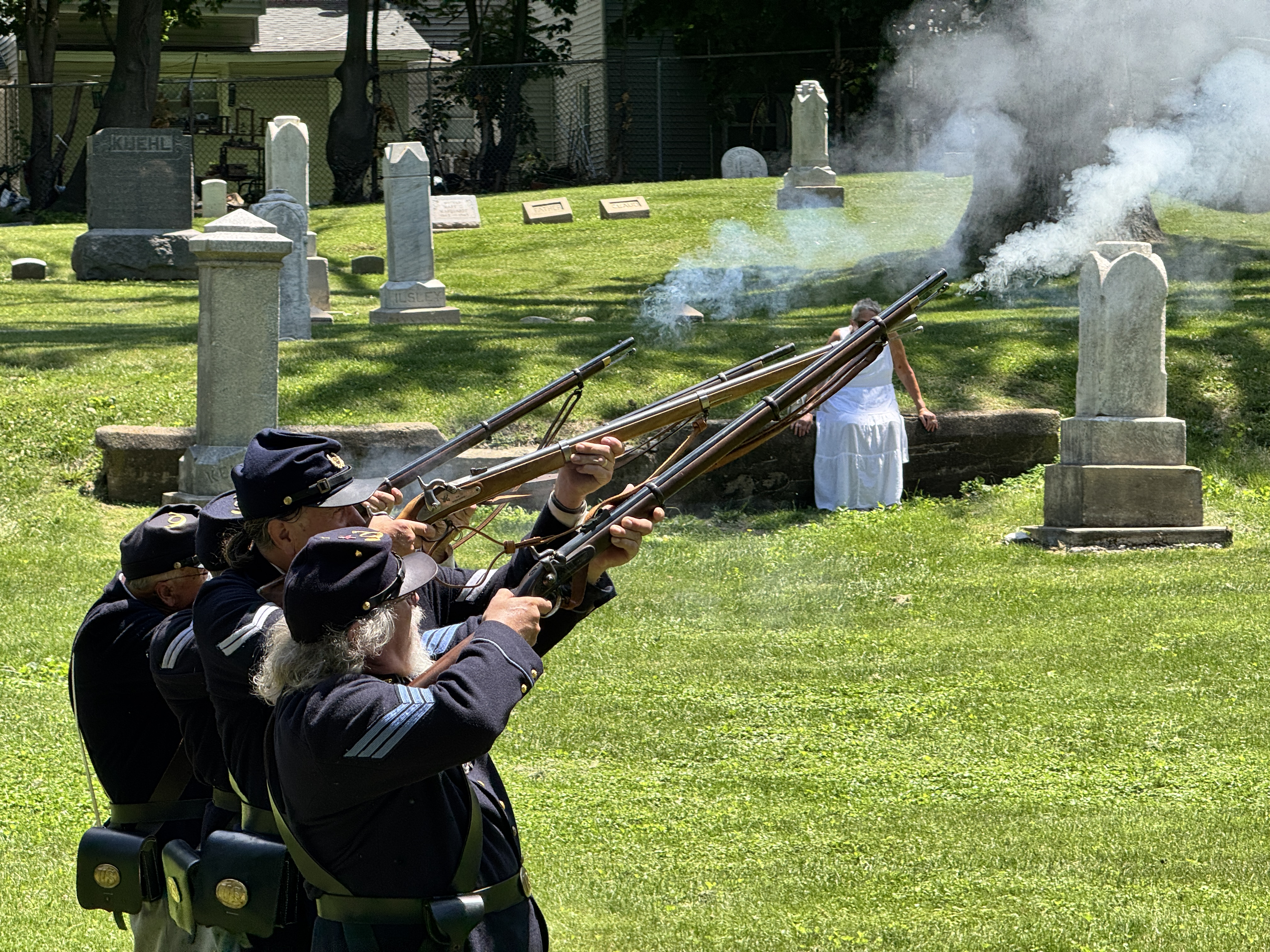

After resting in an unmarked grave for decades, Porter County’s first female physician now has not only a tombstone on her grave but also an Indiana Historical Bureau marker in downtown Valparaiso.
During twin ceremonies in the grueling heat Saturday, Dr. Almira Fifield received one accolade after another, giving her long-deserved recognition for her accomplishments and dedication.
Fifield died March 8, 1863, at the hospital in Paducah, Kentucky, where she tended sick and wounded soldiers during the Civil War for 11 months. She had received her doctor of medicine degree just a decade after Elizabeth Blackwell, the nation’s first female physician, received hers.

“We gather to restore her place in history in recognition of her service and her sacrifice,” said Diane Schweitzer, who organized the commemoration and worked with researcher Barbara Fifield Brandt to dig up more information about the Fifield family. Schweitzer is regent with the William Henry Harrison Chapter of the Daughters of the American Revolution.
Jane Schultz, author of “Women at the Front: Hospital Workers in Civil War America,” said Fifield was part of “a small circle of women who managed despite raised eyebrows and occasional harassment.”
“To pursue a career in medicine was tantamount to denunciation of marriage or motherhood,” Schultz said.
Dr. Fifield might have set up a medical practice in Valparaiso, but that hasn’t been determined yet, she said.
“Women were neither invited nor imagined as potential members of the AMA (American Medical Association),” but at New England Female Medical College in Boston, Fifield was accepted.
When the Civil War broke out, the small number of female doctors couldn’t join the Union Army as physicians. “The best they could do was to seek appointments as nurses or matrons, those who managed other female nurses,” Schultz said.
“Despite this official ban on youth, however, persistent young women managed to find their way into hospital service. This was certainly the case for Dr. Fifield,” she said.

Fifield had hoped to join the 9th Indiana Infantry Regiment, in which her brother Zacheus served, but was denied. Instead, she was posted at the Union Army hospital in Paducah, Kentucky.
The bloody battle at Shiloh greatly increased demand for medical workers, which allowed her services to be accepted. Fifield died of what Brandt, a medical researcher, believes was meningitis.
“Under 18 women who received their MDs before 1861, including Southerners, ultimately served in one capacity or another during the Civil War,” Schultz said.
“The women who came into the service with medical degrees were rare and remarkable,” she said. They were officially listed as nurses, but nothing prevented them from using their medical knowledge, Schultz said.
The female physicians’ experiences “were filled with medically and racially complex interactions with people she would not otherwise have met or otherwise treated in civilian life,” Schultz said.

The war offered doctors “an unprecedented opportunity to address bodily debilities of every kind, not only wounds and amputations, but undiagnosed diseases and chronic illnesses in the era before the germ theory was widely embraced by the medical community,” she said.
The war saw 750,000 deaths and millions of casualties, offering “a bloody banquet of clinical experience,” Schultz said.
Two-thirds of the deaths were the result of “the withering effect of disease, when bodies were undernourished and taxed to their physical limits,” she said.
Many of the relief workers were convalescing soldiers, but patients often said they preferred being tended by women, who reminded them of their mothers and sisters. “Women would listen to their stories, acknowledge their humanity and sympathize,” Schultz said.
Fifield’s day would have begun about 6 a.m., organizing delivery of breakfast to inmates. If the hospital was understaffed, she would empty night jars, wash faces and torsos and tidy up bedding, Schultz said. Her main job was assisting the surgeon in charge during rounds, taking notes of patients’ conditions and any progress.
“Women who impressed their surgical peers as especially proficient were to help debride, irrigate or dress wounds, hold appendages during procedures and even do stitch and scalpel work, and that was all before lunch,” Schultz said.
Fifield’s typical day would have been 16 hours, but could be as long as 18 to 20 during busy times.

“We can only hope the surgeons who directed work at the Paducah hospital saw her talent and maturity and sought her assistance,” Schultz said.
“Twenty-first century hospitals still make use of the military system or organization that is a legacy of Civil War medicine at the temporary hospitals, some of them in tents, that dotted the landscape,” Schultz said.
Casey Pfeiffer, of the Indiana Historical Bureau, led the unveiling of the historical marker south of the Porter County Museum on Franklin Street.
“Markers are snapshots, continuing to remind us of our past,” she said.
“History teaches us lessons about our past while informing us about our present,” Pfeiffer said.
City Council President Ellen Kapitan read a proclamation by Mayor Jon Costas proclaiming Saturday Dr. Almira Fifield Day, honoring the doctor who gave her life in service to her country and encouraging citizens to reflect on the privilege, rights and responsibilities of being an American.
At Union Street Cemetery, where the new marker on Fifield’s grave was joined by one honoring the Fifields as a pioneer family, the accolades continued.

Terri Lehman, president of the Society of Indiana Pioneers, announced “this extraordinary Hoosier” was honored May 31 as one of less than 10 Distinguished Hoosiers in the society’s 109-year history. Overall, the society has honored 10,020 Hoosier ancestors.
Brandt, whose research into Fifield stemmed from just a few sentences about her in a notebook on the Fifield family history from Brandt’s late father, laid two wreaths, one on Dr. Fifield’s grave and one for the entire family.
More than 60 members of the Fifield family from the East Coast, West Coast and points in between gathered to honor Dr. Fifield, Brandt said. Dr. Fifield died at age 29, unmarried and childless.
Six siblings descended from Dr. Fifield’s brother Zacheus, their great-great-grandfather, attended.
“It’s cool to walk the land that our ancestors walked,” said Ann Fifield of Dartmouth, Massachusetts.
“This is really wonderful,” said Lisa Fifield Snadderly, of Portland, Oregon. She is a nurse whose father is a physician.
Scott Fifield, of Duluth, Minnesota, where he and his siblings grew up, said he and a brother visited the cemetery two years ago and were impressed by how much the DAR did to clean it up since then.
“Beautiful cemetery, lovely people, hot day,” said Doug Fifield, of Duluth.
Doug Ross is a freelance reporter for the Post-Tribune.


