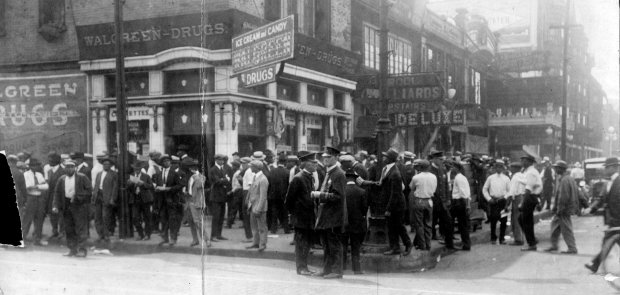
Here’s a look back at what happened in the Chicago area on July 20, according to the Tribune’s archives.
Is an important event missing from this date? Email us.
Flashback: Apollo 11’s voyage to the moon kept Chicagoans spellbound in a time of tumult
Weather records (from the National Weather Service, Chicago)
- High temperature: 101 degrees (1980)
- Low temperature: 53 degrees (1970)
- Precipitation: 3.03 inches (1978)
- Snowfall: None

1924: Sybil Bauer, a Chicago native and Northwestern sophomore, won the gold medal in the 100-meter backstroke in the 1924 Paris Olympics. Her time was a world-record 1:23.20 seconds.
Vintage Chicago Tribune: Summer Olympians from the area who won gold
Bauer didn’t start competing in events until she was a teenager at Schurz High School. Soon thereafter, however, she became the first great female swimmer of the backstroke. Bauer set 23 world records — holding at one point all existing records for women in backstroke from 50 to 440 yards, according to the International Swimming Hall of Fame — and won six consecutive AAU 100-yard backstroke championships, according to the Olympic Games.
Her greatest feat may have taken place in Bermuda on Oct. 8, 1922, when Bauer became the first woman to beat a world record held by a man. She completed a 440-yard backstroke race in 6 minutes, 24 seconds — almost four seconds faster than the old record held by Harold Krueger of Honolulu.
She was engaged to Edward Sullivan, then sports editor of the New York Evening Graphic and future television show host, but was stricken with cancer and died in 1927. Bauer was just 23 years old.

Also in 1924: Johnny Weissmuller — the Austrian born, Chicago raised future “Tarzan” actor — won gold at the Paris Olympics in swimming. He won five gold medals in the 1924 and 1928 Olympic Games.

1944: In a speech broadcast to the delegates inside Chicago Stadium from a train car at a naval base on the Pacific Ocean, President Franklin D. Roosevelt accepted the nomination for a fourth term during the Democratic National Convention at Chicago Stadium. Roosevelt was en route to Hawaii to join military brass debating strategies for the Pacific theater during World War II.
Vintage Chicago Tribune: Tradition of acceptance speeches at political conventions began in Chicago
“You in this convention are aware of what I have sought to gain for the nation, and you have asked me to continue,” FDR said in accepting its nomination.
Roosevelt was reelected Nov. 7, 1944, but died April 12, 1945.

1968: About 1,000 children with intellectual disabilities ranging in age from 8 to 18 competed in the first Special Olympics, which took place at Soldier Field.
Responding to a written proposal from Chicago Park District employee Anne Burke, a $25,000 check from the Joseph P. Kennedy Jr. Foundation was forwarded here to help start the games, courtesy of the foundation’s executive vice president, Eunice Kennedy Shriver.
Vintage Chicago Tribune: The first Special Olympics at Soldier Field — 55 years ago
The initial one-day outing included participants from more than 20 states and Canada. Admission was free, but with little publicity and a basic lack of understanding, not many showed up besides friends and relatives of the youngsters.
Still, the spirit was the same as if the stadium was packed, and the event was considered a huge success by those in attendance.

1992: Jeff Erickson escaped from the Dirksen U.S. Courthouse. The con man was convicted of robbing a string of Chicago-area banks with his wife, Jill Erickson.
When the Hanover Park duo was caught in 1991, she was mortally wounded in a chase with FBI officers and he was arrested and taken to the Metropolitan Correctional Center. But as he was being led from the Dirksen U.S. Courthouse on July 20, 1992, Erickson uncuffed his hands with a handcuff key, disarmed a guard and fatally shot Deputy U.S. Marshal Roy “Bill” Frakes and court security Officer Harry Belluomini, a retired Chicago police officer.
Want more vintage Chicago?
Subscribe to the free Vintage Chicago Tribune newsletter, join our Chicagoland history Facebook group, stay current with Today in Chicago History and follow us on Instagram for more from Chicago’s past.
Have an idea for Vintage Chicago Tribune? Share it with Kori Rumore and Marianne Mather at krumore@chicagotribune.com and mmather@chicagotribune.com