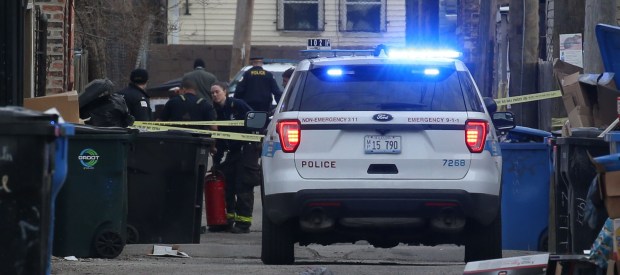
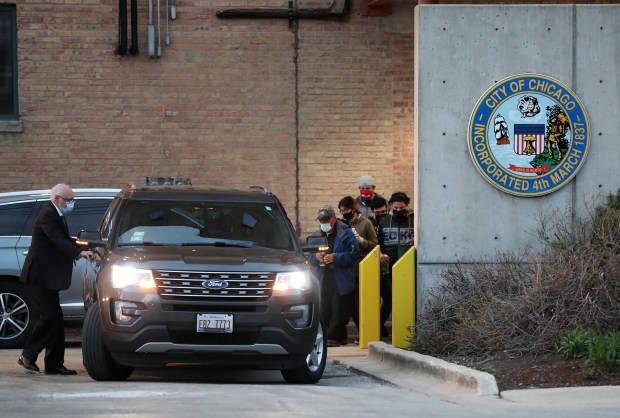
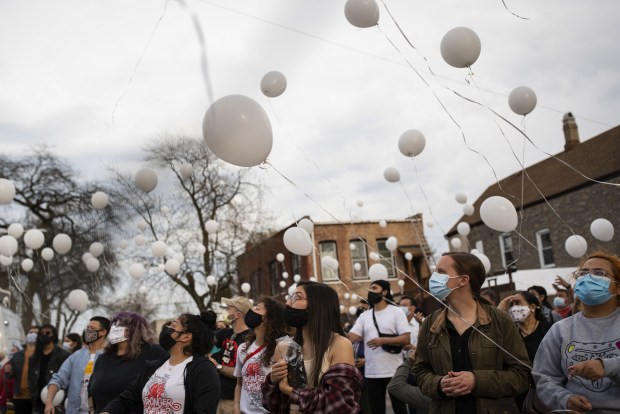
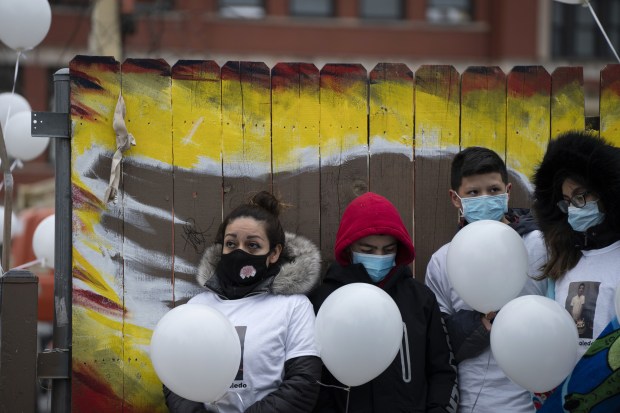
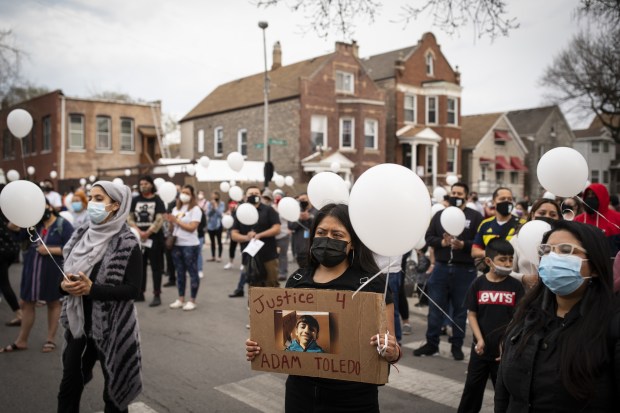
A memorial to Adam Toledo on April 20, 2021, at the site where the teen was shot and killed by Chicago police Officer Eric Stillman in an alley near West 24th Street and South Sawyer Avenue in Little Village. (Brian Cassella/Chicago Tribune)
The family of Adam Toledo is challenging a recent court order that increased disability payments to the former Chicago police officer who fatally shot the 13-year-old in Little Village in 2021.
Cook County Judge Sophia Hall last month ordered that the Policemen’s Annuity and Benefit Fund of Chicago increase the monthly payments to ex-officer Eric Stillman from 50% of his former salary to 75% until he reaches the Police Department’s mandatory retirement age, 63. Stillman is now 39.
Hall’s order came after she found the pension board erred in its determination that Stillman’s post-traumatic stress disorder was not entirely caused by the Toledo shooting. The ex-officer is a veteran who served in Afghanistan.
“There is no competent evidence that Stillman’s PTSD was due in part to a preexisting injury,” Hall wrote in July.
Last week, though, an attorney for Toledo’s family filed a motion to intervene in the case, filed by Stillman last year, and another asking the judge to reconsider.
In court filings, Toledo’s family argues that the pension board got it right in its decision to award Stillman 50% of his salary because there was “preexisting stress” identified in the record, namely a diagnosis that Stillman struggled with anxiety.
The next hearing is scheduled for early September. Stillman’s attorney didn’t respond to a request for comment.
Stillman joined CPD in 2015, though a department spokesperson told the Tribune on Friday that he’s currently inactive. In March 2021, Stillman shot and killed Toledo during a foot pursuit in Little Village.
In body-worn camera footage previously released by the Civilian Office of Police Accountability, Toledo could be seen tossing a gun and raising his hands in the moments before Stillman fired the fatal round.
In September 2024, Stillman testified to the police pension board that the shooting and its aftermath caused him to develop PTSD and made it impossible for him to work as a police officer, according to a transcript of the hearing filed in Cook County Circuit Court. He received the diagnosis in November 2022.
“Prior to the incident on March 29, 2021, I was a proud police officer,” Stillman said. “I served my country as a Marine and that made me resilient. The events on March 29, 2021 changed everything. The situation I was put in changed everything. My address was leaked. Threats were made. A 24-hour guard by the Department was put on my house for months. I left my home for months for security reasons.”
“The ability to move on is near impossible,” he added. “I did not choose this, nor do I want to live with PTSD. I served proudly and I hope to serve as a police officer again.”
The pension board initially awarded Stillman 50% of his CPD salary after he testified that, upon his return to the United States from Afghanistan, he was diagnosed with anxiety. Soon after, Stillman filed an administrative review complaint, asking a judge to increase those payments to 75% because the diagnosis was directly related to his performance of official police duties.
E. Jason Wambsgans / Chicago Tribune
People gather April 5, 2021, in Little Village, including Micaela Cruz, center, for a rally for Adam Toledo, 13, shot and killed by police.
E. Jason Wambsgans / Chicago Tribune
Family and community members release balloons on March 29, 2022, at the site where Adam Toledo, 13, was fatally shot by a Chicago police officer in Little Village one year earlier.
John J. Kim / Chicago Tribune
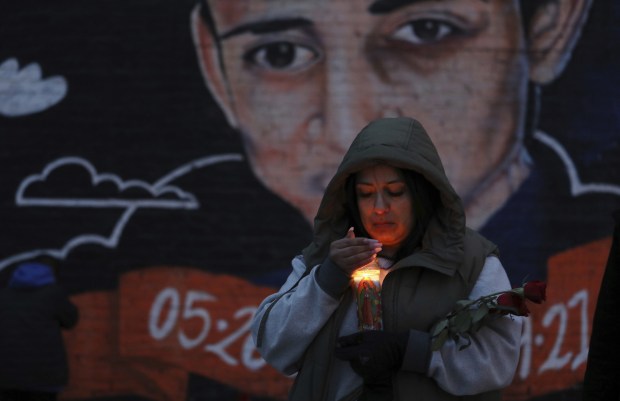
Friends and relatives of 13-year-old Adam Toledo light candles during a gathering at a mural in his memory, in the 3600 block of West Ogden Avenue on March 29, 2022, in Chicago.
Antonio Perez / Chicago Tribune
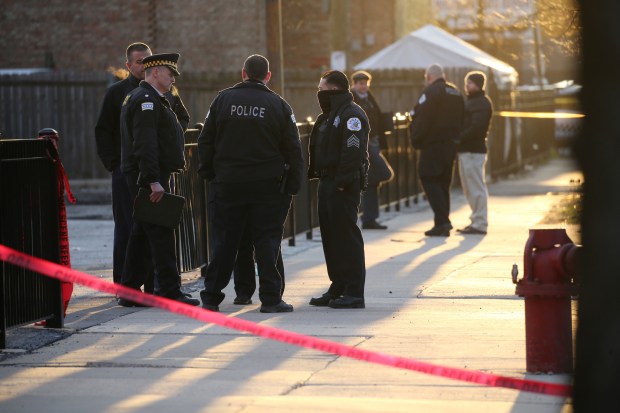
Police work at the scene where a Chicago police officer fatally shot a person March 29, 2021, near the corner of 2400 S. Sawyer Ave., behind Farragut Career Academy High School.
Antonio Perez / Chicago Tribune
The sun rises as police work at the scene where a Chicago police officer fatally shot a person March 29, 2021, near the corner of 2400 S. Sawyer Ave., behind Farragut Career Academy High School.
Antonio Perez / Chicago Tribune
Firefighters clean up as police work at the scene where a Chicago police officer fatally shot a person March 29, 2021, near the corner of 2400 S. Sawyer Ave., behind Farragut Career Academy High School.
Chris Sweda / Chicago Tribune
A person walks through an alley at 24th Street and Sawyer Avenue in Chicago's Little Village neighborhood on April 1, 2021. Thirteen-year-old Adam Toledo was shot and killed at that location by a Chicago police officer on March 29, 2021.
John J. Kim / Chicago Tribune
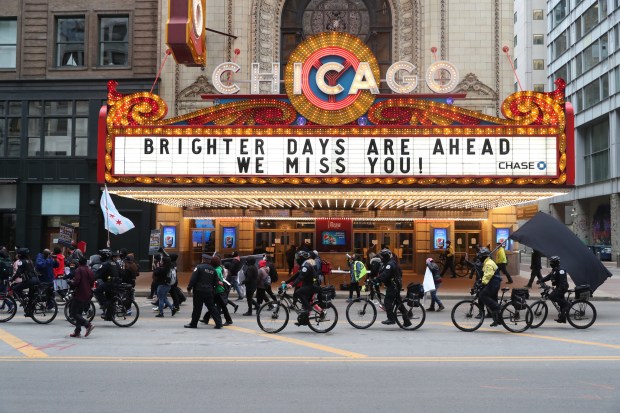
People march on State Street after a justice for Adam Toledo rally in Chicago's Federal Plaza on April 14, 2021.
Armando L. Sanchez / Chicago Tribune
A community march attendee wears a Mexican flag during a peace walk for 13-year-old Adam Toledo.
Chris Sweda / Chicago Tribune
People protest in solidarity for Adam Toledo at the corner of North Wabash Avenue and East Chestnut Street in Chicago's Gold Coast neighborhood after traveling in a car caravan from Chicago's Lawndale neighborhood on April 9, 2021.
Armando L. Sanchez / Chicago Tribune
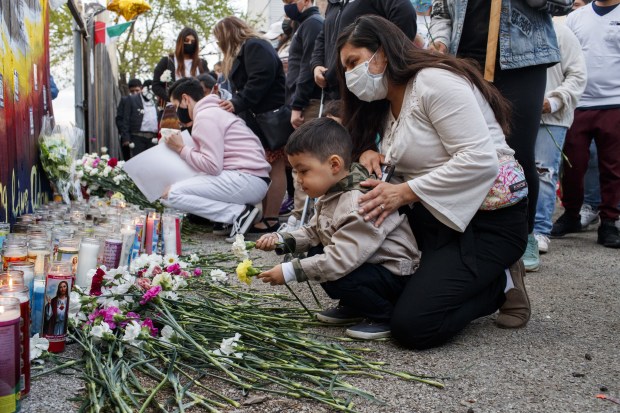
A woman and child place flowers near a memorial where 13-year-old Adam Toledo was fatally shot.
Armando L. Sanchez / Chicago Tribune
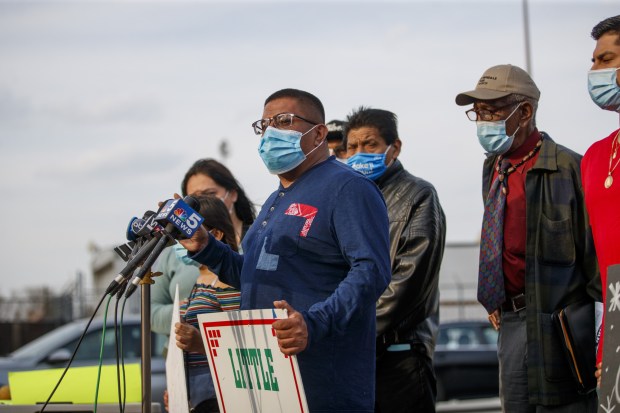
Community activist Baltazar Enriquez, center, speaks with members of the media during a peace rally in honor of 13-year-old Adam Toledo.
Armando L. Sanchez / Chicago Tribune
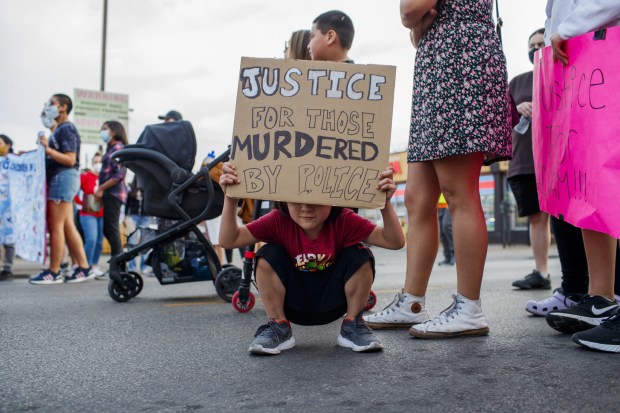
Balthazar Lopez, 4, holds a sign during a peace rally in honor of 13-year-old Adam Toledo who was shot and killed by police.
Antonio Perez / Chicago Tribune
Police work at the scene where a Chicago police officer fatally shot a person near the corner of West 24th Street and South Sawyer Avenue, behind Farragut Career Academy High School, on March 29, 2021.
Chris Sweda / Chicago Tribune
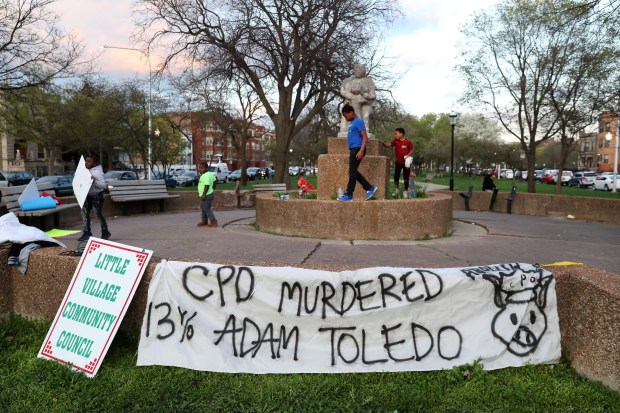
Children walk around a statue at protest of the fatal police shooting of Adam Toledo.
Brian Cassella / Chicago Tribune
Protesters shout at Mayor Lori Lightfoot on April 5, 2021, as she departs a news conference about the police shooting death of 13-year-old Adam Toledo.
E. Jason Wambsgans / Chicago Tribune
Elizabeth Toledo stands at the site where her son Adam Toledo, 13, was killed in a shooting by Chicago police one year earlier.
Armando L. Sanchez / Chicago Tribune
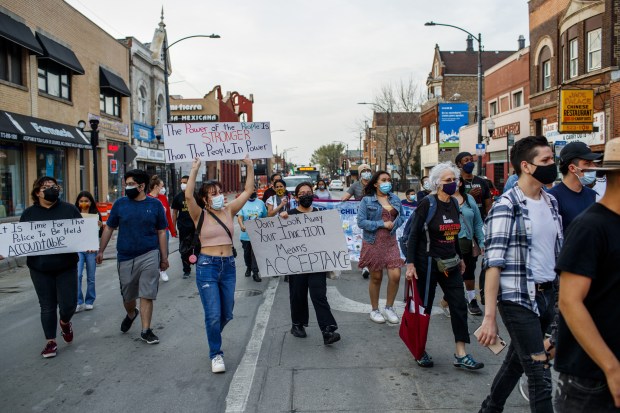
Members of the community, supporters and activists march through Little Village during a peace rally in honor of Adam Toledo, 13, who was shot and killed by police.
John J. Kim / Chicago Tribune
Two-year-old Moises Toledo holds a red rose and wears a T-shirt depicting his 13-year-old uncle, Adam Toledo, during a gathering at a mural in his memory. Adam Toledo was fatally shot in March 2021.
Antonio Perez / Chicago Tribune
Police work at the scene where a Chicago police officer fatally shot a person March 29, 2021, near the corner of 2400 S. Sawyer Ave., behind Farragut Career Academy High School.
Armando L. Sanchez / Chicago Tribune
Jacob Perea, 7, and his brother Juan Perea, 9, hold signs April 6, 2021, during a peace rally in honor of 13-year-old Adam Toledo, who was shot and killed by police.
Armando L. Sanchez / Chicago Tribune
Relatives, supporters, and members of the community march during a peace walk on April 18, 2021, for 13-year-old Adam Toledo.
E. Jason Wambsgans / Chicago Tribune
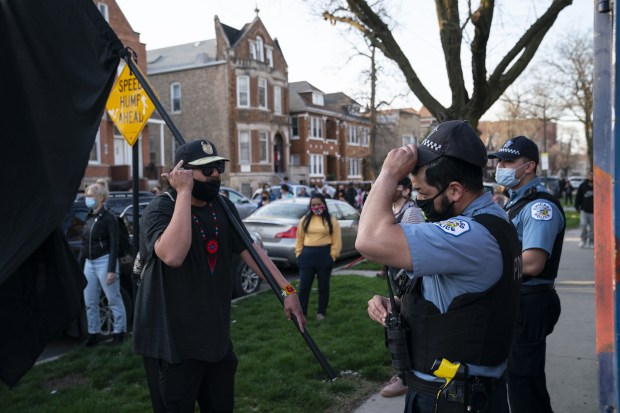
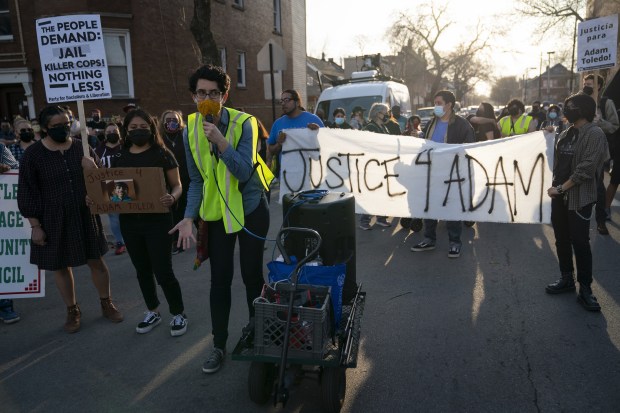
Residents confront police officers during the second of two rallies April 5, 2021, for Adam Toledo, 13, shot and killed by police in Little Village.
Antonio Perez / Chicago Tribune
Elizabeth Toledo is comforted by her father, Francisco Garcia, during a news conference April 2, 2021, over the circumstances of the shooting death of her son, 13-year-old Adam Toledo, by Chicago police.
John J. Kim / Chicago Tribune
Delilah Martinez holds a candle during a gathering to remember 13-year-old Adam Toledo at a mural in his memory.
E. Jason Wambsgans / Chicago Tribune
Family and community members attend a prayer vigil March 29, 2022, at the site where Adam Toledo, 13, was fatally shot by Chicago police a year earlier after a chase in the Little Village neighborhood.
Chris Sweda / Chicago Tribune
A sign remembering Anthony Alvarez and Adam Toledo is held up as people protest against the police during a rally in Federal Plaza in downtown Chicago on April 3, 2021.
E. Jason Wambsgans / Chicago Tribune
Residents watch a rally April 5, 2021, for Adam Toledo, 13, shot and killed by police in Little Village.
Armando L. Sanchez / Chicago Tribune
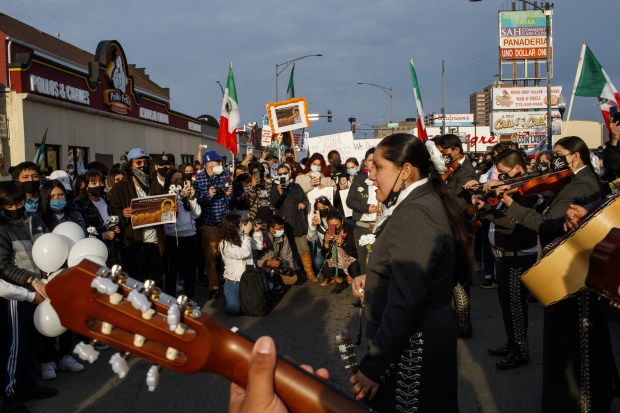
Musicians perform for the Toledo family on April 18, 2021, during a peace walk for 13-year-old Adam Toledo who was shot and killed by a Chicago police officer during a foot pursuit.
Chris Sweda / Chicago Tribune
The family of Adam Toledo and their attorneys exit the COPA offices after viewing the body camera footage on April 13, 2021.
E. Jason Wambsgans / Chicago Tribune
Outreach worker Aaron Rivas gives an impassioned speech April 5, 2021, during a vigil for Adam Toledo, 13, shot and killed by police in Little Village.
E. Jason Wambsgans / Chicago Tribune
Residents and activists attend a vigil April 5, 2021, for Adam Toledo, 13, shot and killed by police in Little Village.
E. Jason Wambsgans / Chicago Tribune
Elizabeth Toledo, left, attends a prayer vigil on March 29, 2022, at the site where her son Adam Toledo, 13, was killed in a shooting by Chicago police one year earlier, after a chase in the Little Village neighborhood.
Armando L. Sanchez / Chicago Tribune
Relatives, supporters, and members of the community march on April 18, 2021, during a peace walk for 13-year-old Adam Toledo who was shot and killed by a Chicago police officer during a foot pursuit.
E. Jason Wambsgans / Chicago Tribune
Residents and activists attend a vigil April 5, 2021, for Adam Toledo, 13, shot and killed by police in Little Village.
Armando L. Sanchez / Chicago Tribune
Musicians perform for the Toledo family during a peace walk for 13-year-old Adam Toledo.
Chris Sweda / Chicago Tribune
Marilyn Rodriguez gets ready April 9, 2021, to drive in a caravan to protest the fatal police shooting of Adam Toledo. The small group traveled from Chicago's Lawndale neighborhood to the Gold Coast neighborhood.
John J. Kim / Chicago Tribune
"Hands up, don't shoot" is shouted during a rally for Adam Toledo in Chicago's Federal Plaza on April 14, 2021.
E. Jason Wambsgans / Chicago Tribune
Maria Gardner Lara gives a speech April 5, 2021, at a rally for Adam Toledo, 13, in Little Village.
Brian Cassella / Chicago Tribune
Mayor Lori Lightfoot and Chicago police Superintendent David Brown speak April 5, 2021, at New Life Church in Little Village about the police shooting death of 13-year-old Adam Toledo.
Armando L. Sanchez / Chicago Tribune
People march past a memorial for 13-year-old Adam Toledo during a peace rally in honor of the teen who was shot and killed by police last week.
Chris Sweda / Chicago Tribune
Chicago police stand in a line as people protest at the corner of North Wabash Avenue and East Chestnut Street in Chicago's Gold Coast neighborhood after traveling in a car caravan from Chicago's Lawndale neighborhood on April 9, 2021.
Chris Sweda / Chicago Tribune
People protest for Adam Toledo at the corner of North Wabash Avenue and East Chestnut Street in Chicago's Gold Coast neighborhood.
Chris Sweda / Chicago Tribune
Marilyn Barnes holds a sign reading "Justice for Adam Toledo!" while participating in a protest against the police at Federal Plaza in downtown Chicago on April 3, 2021.
E. Jason Wambsgans / Chicago Tribune
1 of 44
People gather April 5, 2021, in Little Village, including Micaela Cruz, center, for a rally for Adam Toledo, 13, shot and killed by police.
After the shooting, the Civilian Office of Police Accountability found Stillman violated three CPD rules during the pursuit and shooting and recommended the department fire him. Initially, CPD largely rejected COPA’s assessment and instead said Stillman should face a five-day suspension for failing to activate his body-worn camera in a timely way, records show.
“The recommended penalty of separation for Officer Stillman’s use of force — were the allegation to be sustained, which it should not — is excessive and inconsistent with previous administered penalties for excessive force,” former CPD Superintendent David Brown wrote in 2022. “According to the consent decree, discipline is to be consistently applied.”
That impasse triggered a process by which a single member of the Chicago Police Board would decide if Stillman would face an evidentiary hearing on the disciplinary charges. In 2022, former board President Ghian Foreman approved the evidentiary hearing.
Since then, though, CPD’s public-facing disciplinary proceedings have been largely curtailed by an ongoing legal fight between the city and Fraternal Order of Police. Stillman was one of the CPD officers who, amid the slowdown, opted to have his case decided out of public view by a third-party arbitrator. Those cases remain on hold for the foreseeable future.