

Around the time the U.S. Department of Homeland Security (DHS) expanded its Chicago-area “Midway Blitz” effort to find and deport undocumented residents in Lake County, local governmental entities used social media to let residents know about available resources.
A week ago, 20 people were apprehended in a three-day stretch primarily in Waukegan and North Chicago by officers of the U.S. Border Patrol and the U.S. Immigration and Customs Enforcement (ICE) — both of which are part of DHS.
Dulce Ortiz, the executive director of Mano a Mano Family Resource and a Waukegan Township trustee, is part of a group sending rapid response teams to the activity to offer what assistance it can. She said there were 16 apprehensions on Friday, primarily in western Lake County.
Border Patrol agents apprehended allegedly undocumented people at places like gas stations, grocery stores, car washes and nurseries in the Round Lake area, Wauconda, Lake Villa, Lakemoor, Grayslake, Fox Lake and Gurnee.
“They’re going to places where Latinos congregate or work,” Ortiz said. “They were asking people for their immigration documents. They are targeting areas where there is a large percentage of Latinos.”
Ortiz said she has confirmation that six people, mostly men, were apprehended at a car wash in Wauconda. Two men were taken at a Home Depot, one at a restaurant and another at a grocery store in the Round Lake area.
A pair of men were apprehended at a Walmart in Fox Lake, one at a grocery store in Lakemoor, one at a nursery in Lake Villa, another at a greenhouse in Grayslake and one more at a Gurnee restaurant.
“This is increasing the terror and fear in our community because it’s not safe to go outside the home,” she said. “They can’t go to work. They can’t go to the grocery store. They take the risk of being kidnapped.”
Ortiz said she used the term “kidnapped” because the agents’ faces are covered, they do not have badges and they do not tell those arrested about their rights, as law enforcement officers are required to do.
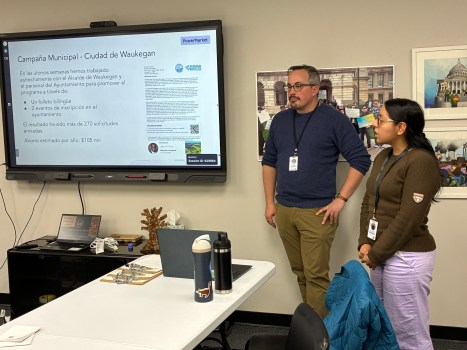
When the arrests started to accelerate, the city of Waukegan, Waukegan Community Unit School District 60, Waukegan Township and the Waukegan Park District all put posts on their respective Facebook pages giving the public information that they deemed useful.
Waukegan Mayor Sam Cunningham said people need to know their rights — the city website has a resource center for legal rights — and need support in a time when many are afraid. Businesses have fewer customers because people are not venturing out.
“We want to show people we are sympathetic to their situation,” Cunningham said. “We’re losing our people in a way that’s not normal. This is an affront to our city, and the way we live. We want people to feel calm, safe and fearless.”
District 60 Superintendent Theres Plascencia said in an email that she is regularly communicating with people online and via social media.
“A very real concern we’ve heard from many of our families and staff relates to how enforcement actions are being carried out and who is being approached, which has added to the uncertainty and stress many are feeling,” she said in the email.
Plascencia said regularly communicating with district families is important at all times, and especially now. It is one of the ways they feel supported. Social media is one of the ways to communicate.
Jay Lerner, the Park District’s executive director, said a message was put on social media because it is important to communicate with patrons since some buildings are public and law enforcement can enter those when a patron does not need to be buzzed in.
Waukegan Township Supervisor Marc Jones said a message went on social media because, like the Park District, certain buildings, such as the Patricia Jones Center, are open to the public. Others, like the township office, the Eddie Washington Center and Staben House, are not.
Attempts to reach representatives of DHS, ICE and the Border Patrol were unsuccessful.