
SEATTLE — When the Big Ten added former Pac-12 schools Oregon, Washington, UCLA and USC to the conference last fall, there was a belief those programs would struggle to adjust their styles of play.
For years, Pac-12 schools that preferred aerial attacks and Big Ten teams that opted to run the ball clashed in Rose Bowl matchups.
The Pac-12 style meant more plays were being run in their conference play — something Washington coach Jedd Fisch said he has noted.
Fisch, who previously coached in the Pac-12 at Arizona and as a UCLA assistant, said he expected to run 76 plays per game in that conference.
Last year, the Huskies averaged 64.7 plays per game.
“The Big Ten,” Fisch said in October, “is certainly a different league when it comes to the amount of plays being run.”
The former Pac-12 schools finished toward the middle and bottom of the conference in rushing yards per game last season. This year, however, the Big Ten’s bellwether programs have not demonstrated themselves to have superior rushing attacks.
Oregon leads the conference in both average yards per rush (6.4) and rushing yards per game (239.7). USC is fourth in rushing yards per game (200.2), while Washington and UCLA are seventh and eighth, respectively.
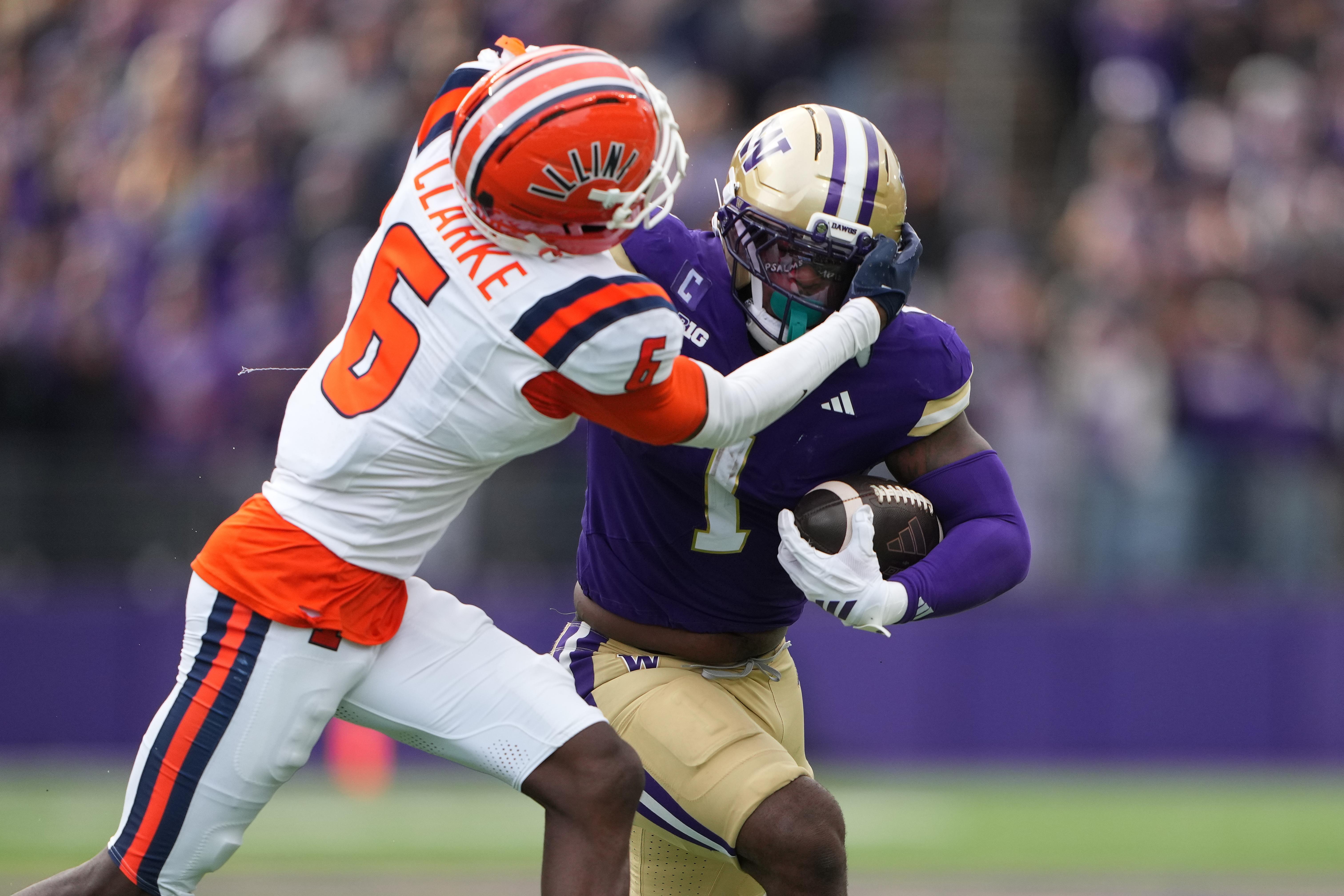
Huskies running back Jonah Coleman, recently named one of six finalists for the Hornung Award that honors the nation’s most versatile player, leads the Big Ten in rushing touchdowns (13) and is tied for third in the nation behind Mississippi running back Kewan Lacy (16) and Georgia Tech quarterback Haynes King (14).
“Jonah’s a great short-yardage runner,” Fisch said. “So when you have short-yard opportunities and you have a chance for Jonah, that usually works out well.”
Seven of the Big Ten’s top 20 rushers are from former Pac-12 schools, including USC’s dynamic duo of Waymond Jordan and King Miller and Oregon’s Noah Whittington and Jordon Davison. Players from the traditional Big Ten schools make up the top eight rushers, but those from former Pac-12 schools are making strides.
In terms of total rushing attempts, Oregon ranks fifth in the conference with 37.7 per game. Washington and USC slot in at eighth and 11th, respectively, while UCLA is 14th.
The Big Ten’s top rushing quarterback is the Huskies’ Demond Williams Jr., whose versatility has allowed him to have the third-highest completion percentage in the conference behind Ohio State’s Julian Sayin and Nebraska’s Dylan Raiola. UCLA quarterback Nico Iamaleava has the second-most rushing yards of any Big Ten quarterback.

Williams became the 16th quarterback in FBS history to accumulate at least 400 passing yards and 100 rushing yards in a game when the Huskies beat Rutgers 38-19 on Oct. 10.
“Demond Williams Jr. is a superstar,” Fisch said after the game.
Such an assessment could be extended for many quarterbacks at former Pac-12 schools. Williams, USC’s Jayden Maiava and Oregon’s Dante Moore are three of the Big Ten’s top six quarterbacks in passer rating. Fernando Mendoza, who played at another former Pac-12 school, Cal, before transferring to No. 2 Indiana, has the second-best passer rating (178.6) in the Big Ten, trailing only Sayin (192.6).
“He continues to improve,” Indiana coach Curt Cignetti said of Mendoza in October. “He continues to prepare like nobody I’ve ever been around. He’s getting better and better.”
Though quarterback play from former Pac-12 teams has been as advertised two years into the four schools’ Big Ten tenures, it’s their ability to run the ball that has come as a bit of a surprise. And with only a few weeks remaining in the regular season, it’s possible that at least one former Pac-12 team (Oregon) will qualify for this year’s College Football Playoff.