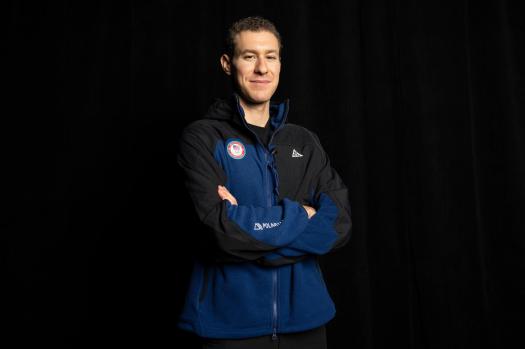
It won’t exactly be a full-circle moment when Jason Brown steps onto the ice this weekend for Skate America, the penultimate stop in figure skating’s premier series and where he made his Grand Prix debut as an up-and-comer some 12 years ago.
Brown’s path has been far too complex to call it that.
Rather the arc of his career has been full of twists and turns, highs and lows. There was the joy in winning eight medals at the U.S. championships and the team bronze the Americans won at the 2014 Sochi Olympics. And the disappointment in missing out on the Olympic team four years later, along with all those top-five finishes without a medal at the world championships.
Yet in a sport often unyielding to age, the 30-year-old Brown — who grew up in Highland Park — has pressed on, supported by one of the most fervent fan bases in the sport, one that seems intent on carrying him to another appearance at the Winter Games in February.
“You know,” Brown said, reflecting on his career during an interview with The Associated Press, “when I look back at, like, videos or pictures, it feels like a lifetime ago. But I don’t feel it.
“But when I look at, like, memories from Sochi or Skate America or when I was just starting out, I’m like, ‘Whoa.’ I feel like I’ve lived a lifetime since then.”
Brown is gregarious almost to a fault. Schedule a 30-minute chat with him and it turns into an hourlong discussion touching on just about every subject imaginable. He is unflinchingly positive, whether talking about himself or anyone else, though dwell too long on Brown’s own career and he will attempt to cover his face, blushing in bashfulness.
Like those early years at the senior level, back when he was the next big thing in American figure skating. He was called up to make his Skate America debut in 2013, when Naperville’s Evan Lysacek had to withdraw because of an injury, and Brown finished fifth.
He returned six weeks later at the Grand Prix event in France and won the bronze medal.
The following January at the national championships, Brown was third in the short program before winning the free skate with a “Riverdance” program that went viral — and still is considered must-see stuff to this day. It was enough to earn him a spot at his first Olympics, and “Riverdance” made a return in Sochi, helping the Americans land on the podium.
Four years later, Brown was left off the U.S. Olympic team for the Pyeongchang Games in South Korea.
He admits to thinking about calling it a career at that point. Most figure skaters do in their early 20s, especially given that Brown never has been able to consistently land the high-flying quadruple jumps that started to take over the men’s competition.
But he stuck it out, earning a spot on the team for the COVID-affected Beijing Olympics in 2022, then decided to continue skating on a reduced schedule. He dabbled in choreography, worked with other skaters but all along continued to compete.

Now he’s poised to perform at Skate America on Friday-Sunday in Lake Placid, N.Y. — with a return of “Riverdance,” albeit slightly modified for his short program — before competing at the Finlandia Trophy the following week. The goal: win, of course, but also show the U.S. Figure Skating officials who ultimately will select the Olympic team that he deserves a place on it.
“I’m a different skater. I’m a different person than I was a decade ago,” Brown said. “I’m still in the sport because I love it so much, and I’m so grateful for the support of the fans and just love from the skating community.
“So take ‘Riverdance.’ That’s my way of, like, saying thank you. Like, ‘Thank you for all your support all these years, sticking by me through thick and thin.’ I feel kind of like everybody has been on this roller coaster with me since I was a teenager.”
Brown figures to have a good chance at the podium at Skate America. World champion Ilia Malinin, his U.S. teammate, already has won both of his Grand Prix assignments and won’t be in the field, nor will Olympic contenders Adam Siao Him Fa of France and the Japanese duo of Shun Sato and Yuma Kagiyama.
His biggest competition likely will come from Mikhail Shaidorov, the rising 21-year-old star from Kazakhstan, who wasn’t even a teen when Brown was competing at the Winter Olympics for the first time.
“There was always this feeling of this could be the end,” Brown said. “That said, I thought I was going to retire eight years ago, then again four years ago.
“We don’t know what the future holds and how the sport will continue to evolve. I just know that I want to bring two programs this year that feel like they embody my career and are really important to me.”