
Some Northwest Indiana communities with transit development districts are already looking to expand the boundaries to generate additional transit-oriented development opportunities.
“That’s a conversation we’re starting to have with several communities,” consultant Aaron Kowalksi, with MKSK, told the Northwest Indiana Regional Development Authority’s Transit Development District Steering Committee on Wednesday.
Under state law, each district is set up with boundaries a half mile surrounding a South Shore Line station. Each district can expand up to double the original size, but only once. The districts expire in 2045.
A TDD works like a tax increment financing district, except the TDD adds the sweetener of capturing the increase in income taxes as well as property taxes generated in the district to fund things like infrastructure.
“There is quite a bit of activity occurring within the TDD boundaries,” he said. Eleven have been established, with the one serving Beverly Shores and The Pines established just this year.
The South Bend airport and downtown Valparaiso are still eligible, even though Valparaiso doesn’t have a train station. All the other districts are established around South Shore Line stations.
“We established these boundaries, and we’ve been working incrementally with the communities to offer support” on the RDA’s behalf, Kowalski said.
Some communities are being proactive and reviewing various plans to update them, including comprehensive planning as well as zoning, to be more prepared for developers to come in.
“We want to continue to work with the communities that have not completed those,” Kowalski said, to get this step toward development done.
Having these plans in place will not only make it easier to apply for grants but also to hold conversations with developers and investors. The RDA is available to assist, he said.
Kowalski gave a shout-out to Portage for announcing recently that it will start updating its comprehensive plan after the first of the year. The city’s Redevelopment Commission has been active in planning for economic development surrounding the Portage/Ogden Dunes train station.
Hammond has two transit development districts for the new Gateway Station that connects the historic east-west route with the new West Lake Corridor route expected to begin operating next year. The RDA is working closely with the city to help attract the development the city wants within the TDDs, Kowalski said.
The Banc, a recently completed housing development in the former Bank Calumet building downtown, is a Hammond TDD success story.
Munster has two districts, one for the new station at Ridge Road and another at the station serving both Munster and Dyer at the end of the new West Lake Corridor route. Among the considerations is using the “complete street” principles to make Sheffield Avenue conducive to pedestrian and bicycle use as well as vehicles.
The RDA is working with East Chicago to potentially expand that TDD, Kowalski said.
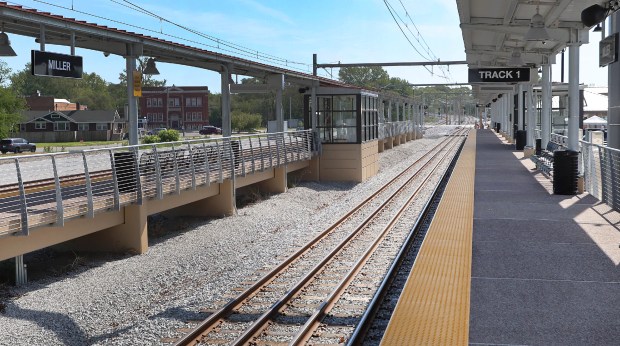
“There’s a lot of working happening in Gary,” which has TDDs for Gary Metro Station downtown and Miller, Kowalski said.
Porter’s Dune Park Station TDD is focused on designating a portion of U.S. 12 as a scenic byway, diverting truck traffic onto U.S. 20. That byway designation would extend east into Michigan City.

The Beverly Shores/Pines TDD is in its infancy. Beverly Shores Councilman Geof Benson said the towns are working with the Indiana Department of Transportation and Indiana Department of Environmental Management as well as the RDA to see what the next steps should be.
“The lynchpin in getting transit-oriented development here is the sewer from Michigan City,” Kowalski said. Developers would prefer to use sewers rather than septic systems.
Michigan City is the poster child for TDDs, with the new 11th Street Station being conjoined with a massive multi-use development that covers an entire city block, as well as other large projects popping up because of the Double Track NWI project that has reduced travel times between Michigan City and Chicago.
RDA Director of Economic Development AJ Bytnar gave the TDD Steering Committee a sense of what to expect from the new nonprofit local development entity being created by the RDA.
“We know that along both the West Lake and the double track corridors, every community has a different flavor” for redevelopment and infill development, Bytnar said.
The local development entity will help identify stumbling blocks to development, what tools communities have in their economic development toolbox and how to overcome these hurdles. “We’re leaving no stone unturned,” he said.
The new nonprofit should be established in the first quarter of 2026 to start addressing properties that present challenges to developers, perhaps because of ownership issues or environmental concerns, Bytnar said.
“We know some of the land speculation that occurs here in Lake County and how it can be a stumbling block to development,” he said.
“Some communities may only have a couple of properties. Some communities might have copious amounts of parcels that have accumulated over the years,” he said.
Rather than establishing a template, the new entity will examine these on a case-by-case basis, he said.
Doug Ross is a freelance reporter for the Post-Tribune.