To kick off 2026, the Tribune food team takes a look at three notable restaurants that opened last year in these unstarred reviews: Buttercup in the South Loop, Kanin in Ravenswood and Nadu in Lincoln Park.
Buttercup
While on a run through the South Loop last summer, I made a surprising discovery. Now shuttered was my longtime happy hour spot, 16th Street Bar & Coffee Lounge, the cozy cafe tucked away off Michigan Avenue. Peering through the window, gray walls were painted cream and green and gone were the plush black booths. Lettering on the windows read, “Cafe by light. Amaro at night.”
Replacing the beloved neighborhood bar was Buttercup, Chicago’s latest entry into the all-day cafe category. Owner Israel Idonije partnered with the team behind Oliver’s to rejuvenate a third space with attention to detail, inspired by Italian aperitivo culture. Most Chicagoans may be familiar with amaro through Aperol spritzes and negronis, but Buttercup shows there’s more to explore — with over 250 bottles of amari, possibly Chicago’s largest collection, to boot.“I know there was a lot of hesitance, especially with Buttercup initially, but a lot of the 16th Street Bar patrons that have come in, they keep coming back,” Idonije said.
The former Chicago Bear and South Loop resident has an ambitious mission to revamp the South Loop, or “SoLo,” as he calls it, into a comprehensive hospitality corridor through his Pangea Restaurant Group. The restaurant, which opened in September, is Idonije’s newest opening, preceded by Signature Steak and The Staley nearby, as well as his breakfast sandwich stall, Egg Bunni, at Sterling Hall in the Loop.
It’s a gorgeous space designed by Nathan Michael Design Co. and seats 40 in 1,100 square feet, Idonije tells me. At nighttime service on a busy weekend, it’s a tight squeeze, but the smaller footprint means it’s hard to be overlooked by staff. During the day, the space is designed for the work-from-cafe crowd, with ample outlets for computers. I found my servers attentive and smartly dressed in neat white shirts with red ascots, and food and drinks came out quickly. After just a few months, the menu has seen a couple of versions, drawing from seasonal flavors.

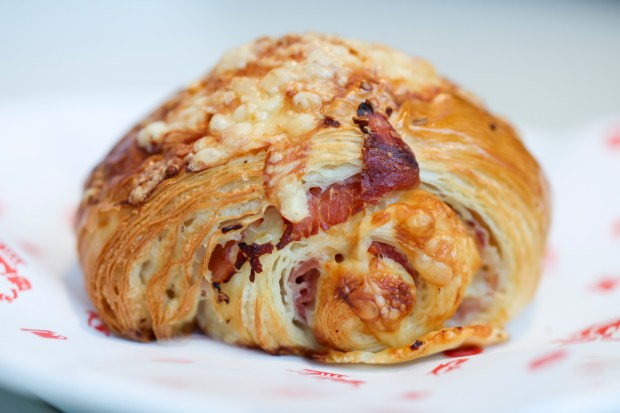
From its dayside menu of pastries from Naperville’s Sparrow Coffee, I was most impressed with the ham and cheese croissant ($9). Catalpa Grove ham and Gruyere cheese are enclosed by layers of crispy flaky dough and garlic, onion, and Maldon flaky salt top a delightful cheese crust. Definitely get it warmed up, and come early before they sell out.
From their fall latte menu, a maple sea salt chai with oat milk was light, foamy ($7), perfect for sipping but very delicate. A Mexican hot chocolate was made with Abuelita and ancho chile, but the heat didn’t jump out ($7). I liked the pistachio mocha ($7) the most, nutty and balanced with the sweetness of smooth chocolatey milk.
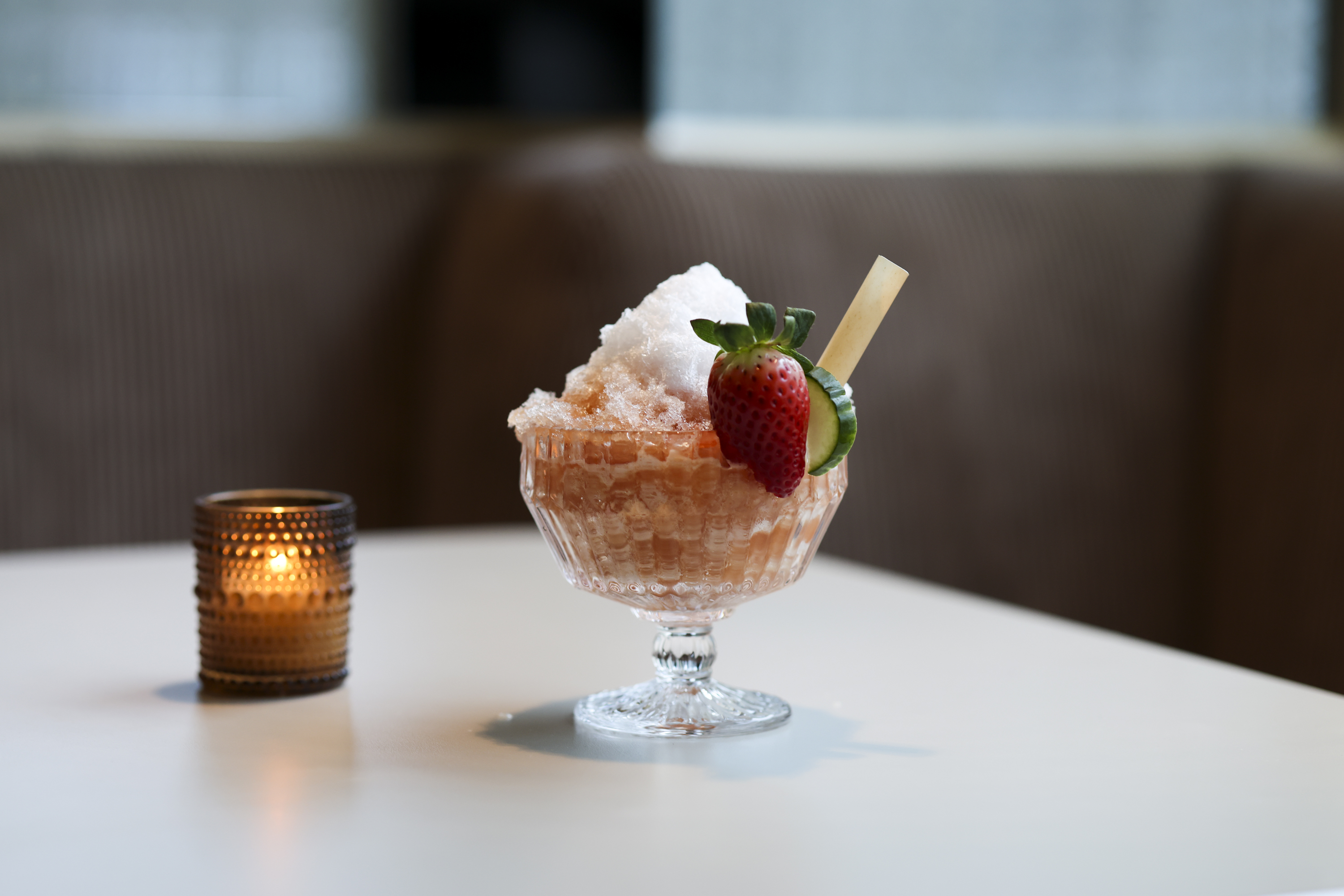
Their namesake Buttercup cocktail ($16), made with Meletti amaro, gin, lemon, passion fruit and buttermilk, wasn’t bitter or sour as the ingredients might imply, and served with a wedge of cucumber and strawberry over a snowball of shaved ice. Beverage director Luke DeYoung uses a Japanese kakigori shaved ice machine to create the effect. The same ice is used for their classic Roman-style grattachecca ($14), which has a choose-your-own-adventure aperitif and fruit syrup pairing — I ordered spiced apple with Gratta Blockhaus amaro. It came out in a plastic cup, which is how it’s prepared in Italian street kiosks on steamy summer days, with a fun drink umbrella. Both drinks can be made with a nonalcoholic amaro.



Roasted pork collars ($24) came slathered in a tangy, crunchy topping of golden raisin gremolata and fennel pollen. The 8-inch truffle pizzetta ($20), baked with luscious fresh dough and topped with parmesan and comte, was a bit salty for my taste, and we opted out of an optional $12 truffle shaving. I also wondered why our server brought out very sharp pizza scissors when it meant nearly elbowing the table next to us in such narrow confines to make the cuts. Next time, I’ll ask for the pizza to come out pre-cut.
With the bevy of sweet cocktails, it could be tempting to skip dessert — don’t. The pistachio olive oil cake ($12) was one of the outstanding desserts I’ve had at a Chicago restaurant in recent memory. Each bite was supple and rich, interwoven with the crackled salty-sweet praline topping that globbed the center, and dusted with powdered sugar. I dream about this cake constantly.
Cocktails here are playful, and while a few lattes and pastries leave a bit to be desired, it’s an experiential, attractive space worth trying. Certain dishes I wasn’t anticipating to stun me because it seemed like the menu was more beverage-focused, absolutely did.

As for Idonije’s Pangea, he says to expect Happy’s Classic Ice Cream to open three doors down, as well as a martini bar taking over the former M Lounge around the corner, and a Japanese cocktail bar in 2026.
“We want to get better with each one and, and we want people to know that when they come to a Pangea venue, they’re going to be in for a great experience,” Idonije said.
— Lauryn Azu
75 E. 16th St., 312-888-3156, sipbuttercup.com
Kanin
Kanin, a Filipino Hawaiian bodega, opened in March to a line that stretched for blocks in Ravenswood as customers waited for a chance to snap up their signature offering: musubis.
The shop is small. There are just three tables with six chairs. The menu too is small, there are a handful of musubis, bento boxes, a few sides and some desserts. But small and simple doesn’t mean the food can’t be extraordinary.
One of Kanin’s bestsellers is the longanisa and egg musubi ($6). It takes the iconic Hawaiian snack that is typically a rice block topped with grilled Spam and wrapped in nori (dried seaweed), and instead uses the slightly sweeter Filipino longanisa sausage paired with a slice of tamagoyaki, or Japanese rolled omelette.

It’s the perfect balance of sweet and savory, reminding me of breakfasts with family around steaming platters of longsilog, a popular Filipino breakfast of longanisa, sinangag (fried rice) and itlog (fried egg).
The musubi options range from classic spam and egg ($4.50) to more inventive takes such as the Grand Slam ($6), which features a sweet egg omelette, miso bacon jam and a hash brown that I wish was just a little more crisp.
Another popular offering is the ube banana pudding ($5.50). Sold by the quart, it’s perfect for banana lovers, though I would have liked a stronger ube flavor.
Where Kanin truly shines is when their chefs find magic in their experimentation, creating delicious culinary mashups. The recently added adobo loco moco ($15) was a clear standout. The dish features a burger patty, fried egg and garlic furikake rice, covered in a beef gravy with bay leaf, toasted peppercorn, garlic and a little hint of acidity. Chef and co-owner Julius Tacadena said they put all of their creative focus into the gravy, and it shows. The dish is wonderfully balanced with its rich umami gravy and creamy egg, all without being too complicated.
“What’s important to me is that fine line between creativity and novelty,” he said. “Whatever we put out, I want it to be something that doesn’t just feel like someone took rice and put a bunch of things on it and put it on nori and it’s good to go. I do think it needs to have a little more soul behind it.”

Of course, you can’t talk about Kanin, which means rice in Tagalog, without talking about the rice. Tacadena said he checked out around 20 brands of rice to find one that cooks well at a large scale, since they go through 150 pounds of it a day. It was perfectly fluffy and well-seasoned in every item, acting as a solid base to let the other flavors shine through.
“Attention to the details that do matter, where we can, is really the name of the game,” he said.
My favorite item was the shrimp musubi ($5), which draws inspiration from sinigang, a Filipino sour soup. The bright tamarind brought a fresh layer of flavor to the musubi, and the shrimp was crisp and delicious.
“The sinigang shrimp was more accidental than anything,” Tacadena explained.
He knew they wanted a pescatarian musubi on the menu. Inspired by a memorable panko-breaded shrimp dish from a now-closed restaurant in Hawaii, he began to experiment with air frying shrimp in their small kitchen. Inspiration struck one day as he was cooking sinigang for his siblings, and he rolled the fried shrimp in the sinigang seasoning.
Lucky coincidences are a bit of a theme for Kanin.
“This venture was a series of very fortunate and lucky events, where one thing led to another,” Tacadena said.
He’d always dreamed of owning his own restaurant, but it was a dream he thought would come true later in life, perhaps in retirement. What began as a breakfast pop-up at Novel Pizza, where he met partner Francis Almeda, has now become a business that’s been featured on various “Best of 2025” lists and has become a part of a flourishing Filipino food scene in Chicago. The success has been humbling and surreal for Tacadena.
“We sort of burst onto this culinary scene,” he said. “Even when people refer to me as chef, it feels a bit strange to me.”
More is yet to come from Kanin. Tacadena is teeming with ideas for dishes, from tocino or bistek tagalog to kare kare or corned beef. He hopes to eventually open a second location, a counterpart to Kanin, where they could experiment even more. At the very least, he hopes to increase production in 2026, perhaps through commissary kitchens.
“Now that we have our feet under us,” he said. “I feel like there’s no limit to what we can and can’t do.”
The Ravenswood bodega feels homey and welcoming, with colorful and eclectic artwork hung across the walls, some from the restaurant’s partners, others from local artists.
Tacadena sees Kanin as not just a bodega, but a place of community, calling back to the mom and pop shops he grew up with in Hawaii, where everyone knew your name and where you always knew you could eat. Despite the rising cost of ingredients and occasional availability issues, Tacadena said he’s fought hard not to pass the cost on to his customers.
“At the end of the day, food is sustenance and everybody deserves to eat,” Tacadena said.
— Kayla Samoy
5131 N. Damen Ave., eatkanin.com
Nadu
Nadu opened its doors in April, the latest from chef Sujan Sarkar, who’s also behind the lauded, Michelin-starred Indienne. Upon entering the Lincoln Park restaurant, diners are graced with a whimsical and weirdly wonderful painting that merges Chicago’s culture with Indian influence: Mughals on stairs and an Air Jordan high-top, a tiger climbing the curtains of what appears to be the Chicago Theatre, a statue draped in yellow marigolds. The interior is cozy, as if a warm-toned filter was swiped over the space.
Nadu’s focus is on contemporary, regional Indian and each menu item has a region listed next to it — an intentional and tangible point of reference for people unfamiliar with the cuisine, or with how diverse and vast the country is.
“Nadu” means land, country or place in Tamil and other Dravidian languages. Sarkar uses the definition of homeland.
Bengali-born Sarkar, partnered with his longtime friend and collaborator, Sanchit Sahu, who is from the eastern Indian state Odisha, to conceptualize the menu based on their collective experience of what authentic Indian food across the country’s many regions should be, not what it’s become in modern reprise.
“We don’t want to fool people by putting avocado into this dish or that and you’re not going to see any truffles,” Sarkar laughed. “(Our food) is very realistic to what you’ll find across India, but we will never achieve the exact flavors from there because the water is different, the lentils are different, the soil is different — India is 70% coastal.”
Sarkar insists Nadu’s food is simple, with frills limited to the meticulous use of traditional ingredients and techniques.
“Indian food is complex, but it is not complicated,” Sarkar said.
I went with a group of four so we could try several dishes, opting for the $55 tasting menu and a few additions a la carte. We were enthralled each time our server Matt brought out an iteration of a dish we’ve had before. (Note: The menu says which dishes are halal. All the meat except the beef was halal the day we went, so be sure to ask your server if you follow halal guidelines.)
The first taste was a sharing portion of papad and chutneys. Papad is a thin, super crispy cracker typically made from lentil or chickpea flour. At Nadu, the papad was fried to crackly perfection without a trace of residual oil. There were two varieties served alongside a green, minty chutney and a bright orange mango chutney. Both sublime, and even better swooped together with an edge of the papad. Immediately, the tone was set. We’ve never had Indian food like this.

As I finished the papad, Matt brought dahi bhalla, pronounced differently across India. These soft lentil dumplings are soaked in sweet-and-sour yogurt. My family makes dahi bhalla weekly during Ramadan, so I’ve had it at least a hundred times. Nadu’s version felt nostalgic but added a refreshing zip — layered with tamarind and mint-cilantro chutneys, topped with pomegranate and crispy potato thins.
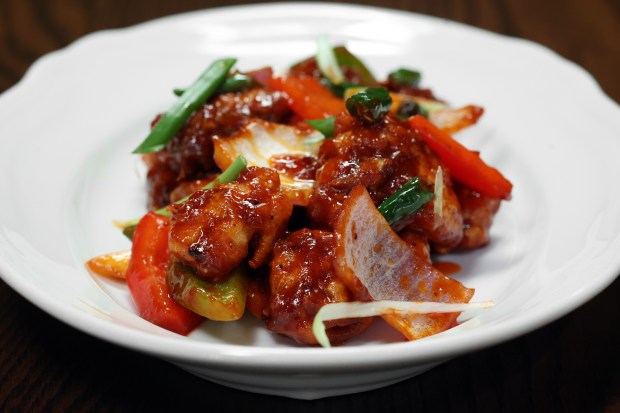
For the second course, I chose Tangra chili fish: crispy barramundi in a tangy sauce, which Sarkar calls an ode to the Indo-Chinese staple from Kolkata’s Chinese community.
Afterward, benne masala dosa. The South Indian staple was leveled up a few notches: crisp and golden-brown on the outside with a soft, airy inside, generously smothered with white cultured butter and stuffed with a potato filling. The chutneys were to a tee.



The real sleeper surprise was the paneer ghotala, which we had a la carte. It was a true “you had to be there” bite — difficult to capture in words how buttery, cheesy, warm, spoonable, spreadable, magical it was. But this is what the menu says: “Crumbled paneer cooked with tomato, onion and young garlic. Layered with creamy Amul cheese, served alongside buttery ladi pav.” Amul cheese is the Indian version of American cheese, with the same devilishly delicious melting capabilities.
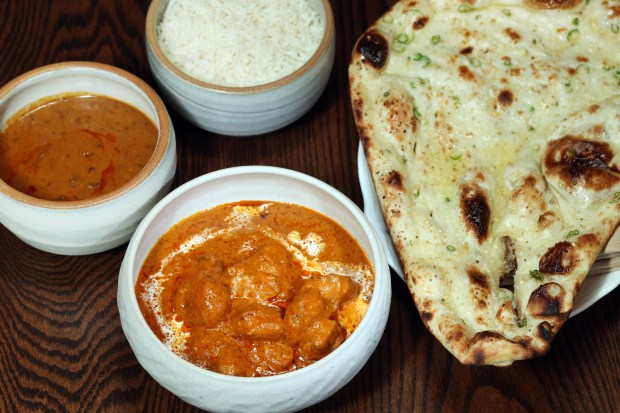
For the main course, most of us chose the Delhi-born murgh makhani. I think butter chicken, as it’s more commonly called, is the one quintessential Indian dish everyone knows, even if their experience with the cuisine is limited. It was solid; better than the many versions I’ve had. But other items were just more striking to me.
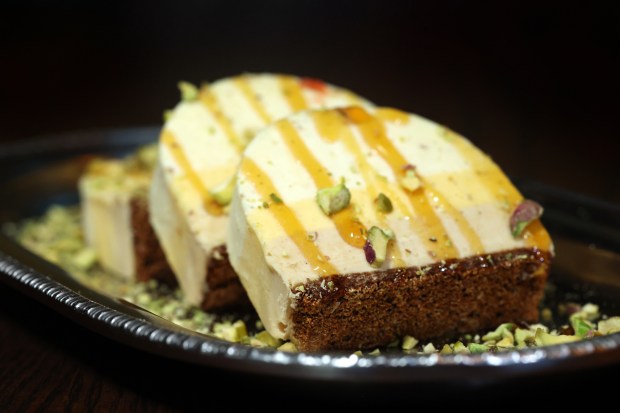
For desserts, the apricot delight reminded me of something served at Indian weddings in small steel saucers. Sahu said that actually was the idea, to emulate specifically the sweet served at Hyderabadi weddings. His take is similar to a milky tres leches, but the cake is lighter and spongier. There was a mango sorbet with a tamarind sauce drizzled over; a “tutti frutti cassata,” an ode to a classic Indian ice cream flavor with small, colorful cubes of candied raw papaya. Nadu’s layered version of vanilla sponge, mango and coffee ice cream and toasted pistachio nougatine crumble was easy to love and plated beautifully.

At first, I was caught comparing the cook of the fish to how an American restaurant would do it, or the lack of a proper dosa elsewhere. But heavier-handed spices don’t belong in every restaurant, just like mango and tamarind ice cream don’t either. In this age of over-saturation of everything from TV shows to movies to good food, it’s hard not to compare things that shouldn’t be compared.
But Sarkar and Sahu, too humble for their own good, undersell how perfectly they’ve emulated India in their food. Nadu rekindled in me an endless love and excitement for the flavors of India, a place that’s also my homeland.
— Zareen Syed
2518 N. Lincoln Ave., 312-590-5676, naduchicago.com
Big screen or home stream, takeout or dine-in, Tribune writers are here to steer you toward your next great experience. Sign up for your free weekly Eat. Watch. Do. newsletter here.