
CORTINA D’AMPEZZO, Italy — In any other Olympic sport, a tie game with the result hanging in the balance would create tension between teams. Not in curling.
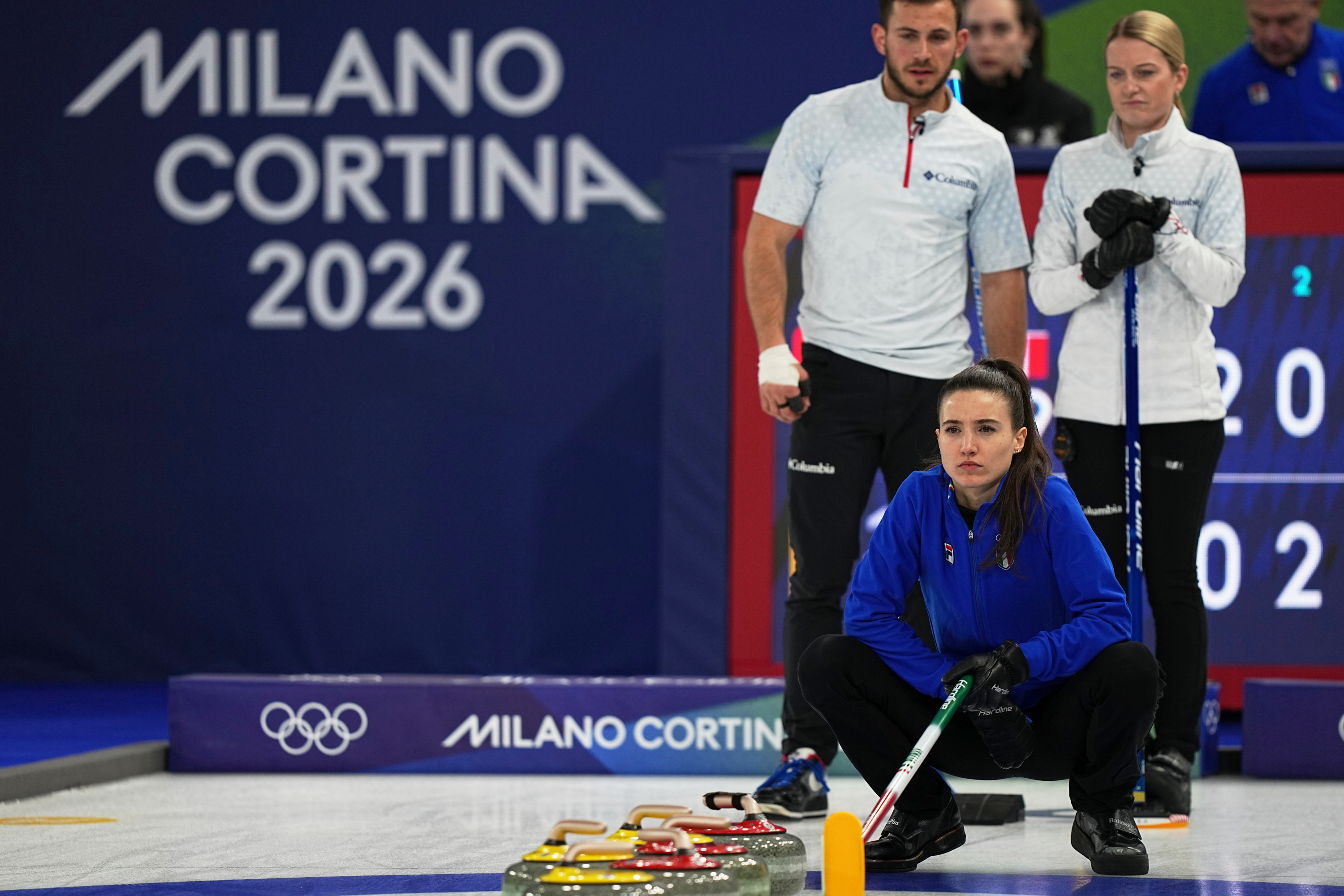
When U.S. mixed doubles curler Korey Dropkin accidentally kicked his stone off the center line Monday, in the middle of a decisive match against Italy in the Winter Games, the Italian duo laughed and waved it off, trusting the American to return it to its original position.
There were no debates involved, no refs called in, no bad-mouthing.
“For us it was really fine,” said Stefania Constantini, the curling belle from Cortina, glowing after the match, which her team won 7-6. “We just had a laugh together because they are really nice people.”
The moment highlighted one of the many reasons the niche sport of curling has such a dedicated fanbase — teams are easygoing and friendly to each other on the ice, even in the most heated moments. Monday’s game decided who would play whom in the semifinals, and the U.S. had been hoping for a win to avoid having to play Italy again.
Though that wish did not come true, it was clear there were no hard feelings. Dropkin said after the match that he and his mixed doubles partner and Minnesota native, Cory Thiesse, would focus on “being a little sharper here and there and just trying to be a little more precise” when playing Italy again Monday night.
“We’re a tough team to beat twice,” he said. “They’re going to have to bring their A game.”
Despite the Italian team’s easygoing approach, Dropkin, who hails from Massachusetts, couldn’t fully escape a chide from his friend Thiesse. In this Olympiad’s mixed doubles field, in which many of the teams are married, siblings or best friends, it often seems there has been more tension between partners than between competing teams.
“You’re lucky you didn’t fall!” she quipped.
“Thanks Cor,” he said, grimacing.
The semifinals will be played Monday evening. Along with the repeat between the U.S. and Italy, Sweden’s curling siblings Isabella and Rasmus Wrana will play Britain’s best friends, Bruce Mouat and Jennifer Dodds, the top-ranked team in the field.
Recounting the moment he stumbled, Dropkin said he had kicked the stone because he’d forgotten it was there.
He’d placed it originally as a “high guard,” or a stone meant to shield those behind it — one that forces opponents into making angled shots.
“You don’t see too many high guards in the game of mixed doubles,” Dropkin said after the game. “I kind of completely forgot about it, even though I’m the one who tossed it up there. They were gracious enough to not really sweat it.
“I think everyone’s got good spirits out there. There’s no hard feelings from one team to another.”
In a curling match, two teams compete to see which can get the most granite stones closest to a bull’s-eye target called the tee by sliding them along a narrow sheet of ice.
The distance between where a player must release the stone and the tee at the other end is about 93 feet. The sheet is only 16.4 feet wide and both teams’ stones accumulate every round, so it gets crowded.
Each round, for up to 10 rounds, teams have eight chances to slide the specialized 44-pound stones toward the tee. They can aim directly for the center, try to knock their opponents’ stones away or nudge their own stones closer to the target. Strategies include blocking and take-outs.