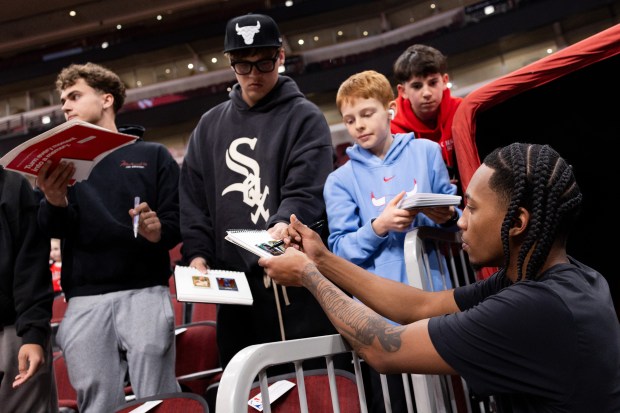

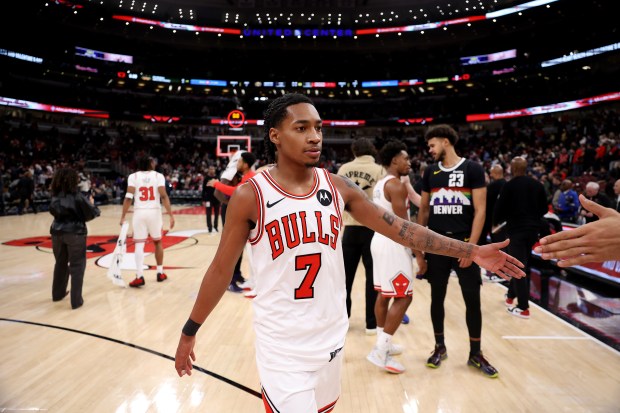


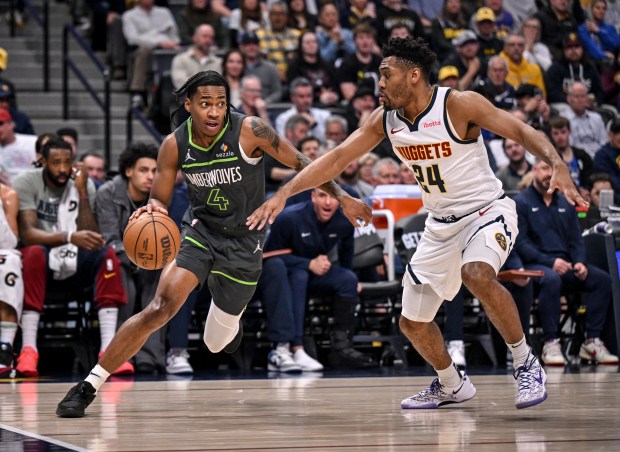
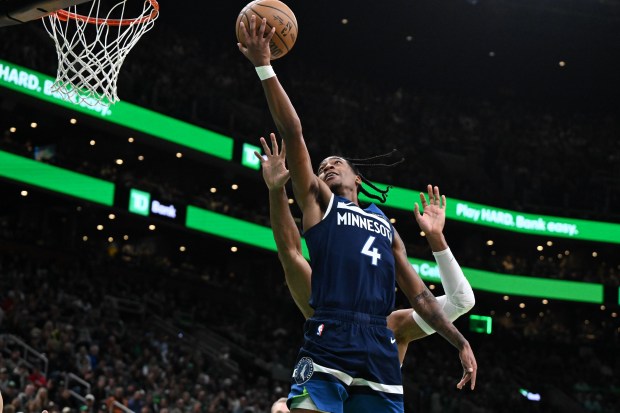

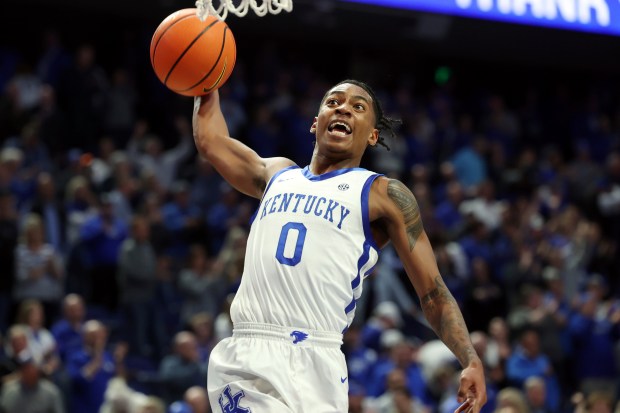

Rob Dillingham knows how to wait.
He learned in Minnesota. Patience was a skill like any other, something to be carefully honed over time. He tried to cling to it through long nights spent mostly on the Timberwolves bench, through weeks without playing in a game at all.
Patience was always the answer to the questions. Why aren’t you playing? Are you actually good enough? What’s wrong with Rob?
Things are different in Chicago. Dillingham, 21, is the only guard the Bulls acquired at the trade deadline who’s under contract for the 2026-27 season. He could be a piece of the future here. He knows it. But the last two years made it hard for him to trust that kind of promising outlook.
The future takes too long to appear. If he wants to find his place in the NBA, Dillingham knows to keep his focus on the now — and the next 24 games — with the Bulls.
“I’ve got an opportunity here,” he told the Tribune. “At least here I’m getting on the floor, you know? It’s up to me to perform to the best of my opportunity, and then from there it’ll keep growing and growing.”
***
Dillingham slept through every call.
In his defense, he didn’t even know it was coming. The Timberwolves had just edged the Toronto Raptors 128-126 in a tight road game Feb. 4. Dillingham didn’t get a second of playing time.
On the bus ride to the airport, he leaned into the comfort of his seat and drifted off to sleep. He woke up to a panicked phone screen flashing bright with missed messages. His agent. Timberwolves general manager Matt Lloyd. His family.
The trade came as a shock. Dillingham stomached his sadness on the tarmac at the Toronto airport, where he gave an awkward goodbye to his teammates of two years before returning to the team hotel.
The Bulls were set to fly into Toronto later that night. The next day would be filled with the awkward minutiae of joining a new team, but the rest of that night was set aside for something akin to mourning.
In moments of sadness, Dillingham prefers silence. He didn’t want to talk to anyone. He didn’t want to hear any apologies or curse the team that gave him his shot in the league. A smaller part of him worried about what he might say in those early hours after the trade. A frustration to be later regretted. A fear that someday could come true.
So that night, Dillingham kept to himself at the half-empty hotel, wishing — as always — for a little more time.
“I just felt like I could’ve played there,” he said. “I felt like I could’ve helped us win.”
Dillingham believed in Minnesota. More than that, he believed in himself in Minnesota. At least at first.

The Timberwolves were perennial contenders, a dynamic Western Conference power fueled by the rising star of Anthony Edwards. When they selected Dillingham with the No. 8 draft pick in 2024, they believed they had secured a future franchise point guard to anchor the backcourt and facilitate the offense around Edwards.
It didn’t work out.
Even with his lottery-pick status, Dillingham had plenty to prove when he first landed in Minneapolis. Coach Chris Finch was readying his team for a season that ended in the Western Conference finals for the second year in a row. He couldn’t hand out minutes for a rookie’s development. If Dillingham wanted time on the court, he had to earn it.
Dillingham wanted to embrace this challenge, but it was easier in his head than on the court. He is listed at 6-foot-2 and carries a noticeably slender frame, a physical deficiency that immediately became a target as a defender. His speed meant less against the sprawling wingspans of NBA rim protectors. His moves became pedestrian even against rotation defenders.
As a rookie, Dillingham played in only 49 games and averaged 10.5 minutes. He assured himself that he learned plenty from the bench, that all he needed was a long summer of work and a better training camp. But when the pattern continued into Year 2, he began to lose his belief.
“It made me anxious,” Dillingham said. “I’d be more anxious to play. I was always used to just playing basketball, every night knowing I’m going to play this many minutes or even if I didn’t play well, I’d have another game.”
Anxiety isn’t a natural state for Dillingham. He considers himself a relaxed person, confident even in his quiet moments. He knows this version of himself well, the one who can be a good teammate and a better friend, the one who was seen as a locker-room leader in college at Kentucky.
“Whenever I’m around things that make me comfortable or give me reassurance, I feel like I can be more of a regular person — be me, be happy, bring joy,” he said.
But Dillingham also is susceptible to doubt. Mistakes stuck doggedly in his memory. Criticism rang louder in his ears than praise. With each passing week of his second season, he developed an inner monologue that questioned every move on the court.
“When you’re nervous, you’re not confident,” Dillingham said. “You start thinking: ‘What if this happens? What if that happens?’ That’s not healthy. That’s not something you can do. But I feel like that was the state I was in playing. I just wanted to help the team win.”

The more Dillingham cared, the more he spun his wheels. He didn’t play in 11 of his final 18 games with the Timberwolves. His scant minutes always were dealt cautiously and rescinded quickly. Finch’s tolerance for mistakes tightened.
It didn’t take much to get benched. Pulling up for a transition 3. Lunging for a rebound rather than following the ball with his body. Taking too long to initiate the action of a set play. Charging directly into a defender at the rim rather than relocating the ball to the perimeter.
And Dillingham became accustomed to watching. Waiting. Wishing for a second chance to redeem his mistakes.
“In that situation, it was either make it or die,” Dillingham said. “I just wanted to do good so bad. That’s pressure. It was always more pressure.”
***
With 2 minutes, 54 seconds left in the first quarter of the Bulls’ loss to the New York Knicks on Sunday, Dillingham took the bait.
Jalen Brunson is simply too good at this. He drove Dillingham down to the low block, then pulled back, sticking his chin up to pantomime the early motions of a shot. The younger guard left his feet before there was even time to think, his body crashing down onto Brunson’s braced shoulders for a foul call.
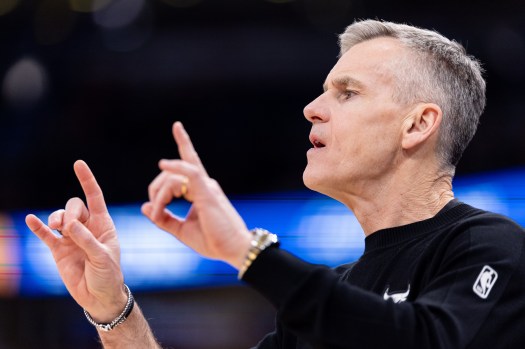
On the other end of the court, Bulls coach Billy Donovan motioned for a timeout the moment the whistle blew. Before Dillingham even could cross midcourt, Donovan was in his ear. The coach strode out to meet him, one hand lofted to emphasize his point, the other on his hip. Dillingham ducked his head in response — maybe in contrition, maybe just in exhaustion — as he trudged to the bench.
This is a familiar scene for Dillingham — a coach calling a timeout on his behalf, a mistake thrust under a microscope. But one key detail differentiated this moment from any in Minnesota. When the whistle blew again two minutes later, he jogged back out onto the court to try again.

Dillingham played 24 minutes in the 105-99 loss. It was a small victory, born mostly out of desperation.
The Bulls have too many guards after the trade deadline. Dillingham is one of six ballhandlers alongside fellow newcomers Collin Sexton, Jaden Ivey and Anfernee Simons and holdovers Josh Giddey and Tre Jones. Donovan described it as a “logjam” and recognized he won’t be able to “fairly” distribute minutes.
But injuries have sorted out the issue in the short term. Ivey is sidelined for two weeks with knee soreness. Simons suffered a wrist injury in Saturday’s loss to the Detroit Pistons. Jones and Giddey are operating under a 24-minute restriction because of hamstring injuries. That has forced Donovan to lean on Dillingham to fill in the gaps.
This necessity balanced out Donovan’s natural inclination to play Dillingham under stricter expectations. He logged less than 10 minutes in the first two games after the All-Star break when the Bulls were working with their full slate of guards. When asked about Dillingham’s reduced minutes, Donovan was blunt — he wanted to see more from him.
Dillingham offers something unique on the Bulls roster with his shifty ability to shake defenders and soft-shoe his way to the rim. The Bulls have plenty of guards, but none of them can create a downhill threat quite like Dillingham. What Donovan is worried about, however, is what happens when Dillingham arrives at the rim.
In his second year, he still tends to jump first before thinking. Freestyling doesn’t cut it in the NBA. Dillingham isn’t long enough to finish over defenders — he had more shots blocked than made at the rim against the Pistons — and often misses passing outlets because of his frenzied approach. Sometimes he dribbles too much. Other times not enough.
For Donovan, the key is bringing calm to this chaos without limiting Dillingham’s creativity.
“I want him to be aggressive,” Donovan said. “I don’t want him to get to a place where he’s like a traffic cop, where he’s just worried about making a mistake, worried about doing anything and it takes away his greatest strength.”
Teaching this lesson may limit Dillingham’s time on the court. Donovan is keen to emphasize accountability in his young players, especially when mistakes occur on the defensive end.

Donovan can fall into a pattern of preference when enforcing these values. He holds some players — the ones he believes in and truly wants to elevate — to a different standard than others. This is why he often yanks Matas Buzelis in and out of the rotation for mistakes while allowing players such as Patrick Williams to play through their errors. Donovan is hardest on the players he sees the most in.
Other guards have weathered this rugged coaching and emerged for the better — most notably Ayo Dosunmu, who was benched early and often in his second season with the Bulls before developing into an elite two-way shooting guard over the last two years. If Dillingham wants to follow Dosunmu, he’ll have to shake a few habits.
“What gets you here doesn’t keep you here,” Donovan said. “And what gets you here doesn’t necessarily take you to the next step. As the talent gap shrinks, you have to make adjustments and changes.
“This is going to be the evolution for him as a player because with his size, there’s certain things he can’t do at the basket. What he can do by getting there is make everyone around him better.”
***
There’s a version of Dillingham who plays free. He just can’t picture it yet.
There were times in college when Dillingham felt he could fly. He spun through defenders and slung passes with his head turned the other way and floated weightless in the air on his way to the rim. But if he’s honest, he hasn’t felt that way since he reached the NBA.
Even his best moments felt like a fluke, a high point he couldn’t repeat on a nightly basis.

“I’ve had moments in my life where I played amazing,” Dillingham said. “Maybe not amazing, but at least really good or close to my potential. Those have been my best times. But they haven’t happened in an NBA setting.”
The longer he plays in the NBA, the harder it is to envision this future. Still, Dillingham knows it can happen. He knows how it will feel — to be the type of player to give confidence to his teammates, to his coach. To be the type of person everyone else can count on.
“In my head, I know what I feel like I can be,” Dillingham said. “I feel like I can be one of the greatest players and win championships and do whatever you would think of one of the greats. I feel like that. But sometimes — it’s hard to see how, you know? Like how do you get there?”
He’s not free. Not yet. But in Chicago, at least, there’s a little more room to breathe.