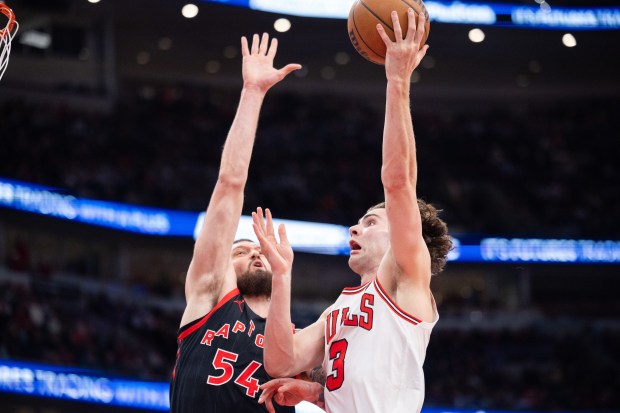


Early in the fourth quarter of Tuesday’s loss to the Oklahoma City Thunder, Josh Giddey stood at the scorer’s table with a resistance band and a towel tucked into one hand, his eyes tracking every movement on the court.
Barely 15 minutes earlier, the Chicago Bulls guard barely could hobble off the court. Giddey turned his ankle on an offensive play, then limped his way through the half court and lined up a 3-point attempt before gingerly exiting. But even with the Bulls trailing by double digits, he insisted on returning for the final quarter.
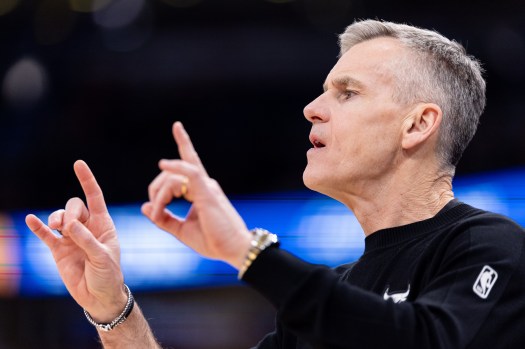
Coach Billy Donovan cited Giddey’s extensive record with ankle tweaks and strains — including a notable one at the end of last season — as a source of confidence for the medical team in Giddey’s discretion regarding his injuries. The Bulls feel that Giddey knows his limits when he rolls an ankle. If he says he’s OK to go back into a game, they believe him.
“Sometimes the initial shock is worse than it actually is,” Giddey said after the loss. “The initial pain always feels bad, but when I got up and started moving around, I realized it wasn’t as bad as I originally thought.”
Still, the moment felt pointless. Giddey subbed back in and muscled his way through 5 minutes, 28 seconds of play. He assisted on a pair of baskets, turned the ball over once and scored three points despite missing a free throw before Donovan finally pulled him again out of concern for a lingering hamstring injury, which is supposed to limit him to about 30 minutes per game (a guideline the coach only loosely follows).
The Bulls were trailing by 16 when Giddey checked in. That deficit was 15 when he exited. It was a short stint in a throwaway game. Yet this brief passage in the fourth quarter raised the kind of questions the Bulls are used to facing this season:
Why is he playing? What’s the point of risking another injury? What is the point of any of this?
The season is ending on a whimper for the Bulls, who are exactly where they want to be, sitting six games out of the play-in tournament and ninth in the draft lottery standings. Still, they prioritize playing Giddey over giving runway to players such as Rob Dillingham, who is ostensibly a crucial piece to analyze as they begin to rethink their long-term roster construction. And when Anfernee Simons and Jaden Ivey return to the rotation, Giddey still is expected to dominate minutes as the primary ballhandler.
This stubborn insistence upon playing Giddey reflects the confusion of the team’s outlook on its starting point guard. The Bulls clearly believe he is valuable enough to prioritize as a centerpiece for their roster rebuild. Yet the front office never has been fully sold on his star power — or whether it plans to truly build around Giddey in future seasons.
Column: Chicago Bulls were late to the tanking trend. That’s nothing new for this front office.
As the Bulls weigh this dynamic, Tuesday’s game was a fitting encapsulation of the franchise’s present and future. Like many of his teammates, Giddey cited the reigning champions as a “benchmark” for the rest of the league to test themselves against. But games against the Thunder also provide moments of reflection and comparison of Giddey’s growth in the two years since the Bulls acquired him from Oklahoma City.
That final season in Oklahoma City defined how Giddey was seen throughout the league — and not in the way he wanted. For most of that year, he felt like a nonfactor on offense and a liability on defense.
When he caught a ball on the perimeter, defenders backed up as if daring him to shoot. Teams clearly schemed to exploit him in the pick-and-roll. And every weakness in his game was picked apart even more shrewdly in the postseason, when he ultimately was benched because of poor shooting and weak defense.
“It was a lot of learning that year, a lot of looking in the mirror and self-reflecting about how I needed to get better as a player,” Giddey said. “That year, my confidence just kept getting lower and lower and I was trying to dig myself out of a hole that was getting deeper every game.”
Giddey clearly has taken an astronomic step forward in the two years since he left Oklahoma City. He is averaging roughly five points and four assists per game more for the Bulls. Most noticeably, his 3-point shooting accuracy has risen above 37% in Chicago, a crucial improvement to establish his credibility as a true backcourt threat.
He credits this area of improvement to regained confidence. That still doesn’t guarantee the most aesthetic shooting. Giddey was the first to admit he missed badly twice in Tuesday’s game, with one 3-point attempt avoiding the rim entirely and falling into Chet Holmgren’s hands as if Giddey momentarily forgot that the big man wasn’t still his teammate. But those types of mistakes don’t hang on Giddey with the same weight as when he was floundering with the Thunder.
“I feel like I’ve gotten to a point now where I let it fly with confidence,” Giddey said. “Whether I go 0-for-11 or 11-for-11, I’m shooting the next one like they’ve all gone in.”
When Giddey looks at the Thunder, he said he doesn’t feel animosity or resentment. Those are his friends, his brothers, the people who saw him through the hardest year of his career, who watched him develop from a rookie to a starter. He always wanted the Thunder to win. He just wanted to do it with them.
But now Oklahoma City also represents something bigger to Giddey. This is a team that laid the framework for how any struggling franchise can rebuild its roster from the bottom up. It’s not an easy formula — not every team can draft talent quite like the Thunder did — but it does provide hope to teams like the Bulls.
Yet herein lies the main problem with this stage of Giddey’s career. Even amid great personal growth, he is back on the first rung of a lengthy ladder as yet another team tries to build with him. There isn’t much winning ahead for the Bulls. It could be years before he sees another opportunity to redeem himself in the postseason.
Giddey understands this reality. He knows his place in the Bulls’ future. That doesn’t make it any easier to find patience in the short term. But he is willing to try regardless.
“They’ve got a winning culture and they build winning habits,” Giddey said. “Being at both ends of the scale when I was there, being where we’re at now — we’re on the outside looking in — it’s the little things that help you get back to that point.
“It doesn’t happen overnight. These things take time to build, and I believe in the guys in this locker room and the coaches and the people in this building that we have the ability to get there.”