
Toni Preckwinkle is chasing history, trying to match the record tenure as leader of the Cook County Board. Her opponent in the Democratic primary is trying to make that longevity her biggest weakness.
In overwhelmingly blue Cook County, Preckwinkle or Ald. Brendan Reilly will be the prohibitive favorite to win in the November general election, too, overseeing the budgets of the county’s sprawling criminal justice system and property tax offices, plus its hospitals and clinics, land bank and forest preserves. The winner will lead the 17-member board but also take on the unofficial role as convener and sometimes referee of the county’s fractious elected officials.
The result may come down to whether voters want a steady hand or something new. Preckwinkle is running for her fifth term. If she’s ultimately successful, she would equal former President George Dunne as the board’s longest-serving leader.
But for the first time in years, she’s had to mount a real campaign against longtime political fighter Reilly, the downtown alderman who believes voters are ready for a change.
Neither Democrat is a neophyte by any stretch. While Preckwinkle has been a candidate on Chicagoans’ ballots since 1983 and won her first City Council race in 1991, Reilly also worked behind the scenes in politics since 1995 before unseating the incumbent downtown alderman in 2007.
Reilly, 54, has avoided directly referencing Preckwinkle’s age (she will turn 79 on primary day) but has talked about her “complacency” and suggested voter sentiment about older politicians overstaying their welcome is playing in his favor.
Preckwinkle, a former history teacher, typically defends her record like the head of a classroom, emphasizing context, flipping through prepared statements, and often tersely making her case or deferring to deputies with expertise. But Reilly’s attacks have revived her progressive political combat instincts.
She forcefully punched back at him in a recent debate, including attacking his ties to President Donald Trump. She’s meanwhile rounded up endorsements from the state’s top leaders, Illinois’ congressional delegation, suburban village officials and faith leaders while crisscrossing the county to tout new transportation projects, the success of community violence intervention investments, county health programs for new moms and raising alarms about federal SNAP and Medicaid changes.
Asked whether matching Dunne’s tenure is weighing on her, Preckwinkle said “no.”
“I feel like we’ve done a lot of good work in the last 16 years, we’ve got good work ahead of us. I’m proud of the fiscal stewardship that we’ve brought to the county, especially given the mess that I inherited,” she said, ticking off the broader offerings at Cook County Health, the county’s drop in violence that exceeds the national rate and strategic economic development.
But Reilly has used Preckwinkle’s lengthy history against her. He’s hammered her management of a decade-long property tax upgrade that resulted in late bills last year, sideswiped her early political support of Mayor Brandon Johnson and former State’s Attorney Kim Foxx, and rehashed her moves to raise sales and pop taxes years ago. He dismisses the Trump flak as a deflection from those criticisms.
Preckwinkle argues she successfully steered the county’s finances into the black without new taxes or fees in recent years, championed equitable criminal justice reforms while seeing drops in crime and that she is the tougher fighter against Trump’s attacks on blue jurisdictions.
Leslie Hairston, a former City Council colleague of Preckwinkle’s whose South Side ward abutted hers, said Preckwinkle’s scholarly disposition shouldn’t be mistaken for indifference.
“Toni’s personality is Toni’s personality, but you should never mistake her kindness for weakness,” Hairston told the Tribune. “If you go at her, she’s going to respond. She’s not the quiet silent type. If you punch, she’s going to punch back.”
And indeed, Preckwinkle’s ascent to the top of the Cook County Democratic Party is proof that she’s a keen political tactician, though campaigning is admittedly not her favorite part of the job.
“Elections, campaigns are a grind. It’s not just that the days are long but you have to be up all the time — smiling and confident and warm — it gets annoying,” she told a City Club crowd in late January, with a laugh.
Preckwinkle has not only her party’s support in the race, but also major public sector unions and progressive advocacy groups like Personal PAC, Equality Illinois and immigrant rights organization ICIRR Action.
Reilly is running to Preckwinkle’s right, arguing she has made the county more expensive and less safe, highlighting the case of a woman critically injured in an immolation on the CTA Blue Line as a symbol of problems with the county’s electronic monitoring program. His endorsers have been limited to a handful of more moderate or conservative members of the Chicago City Council, the local firefighters union and businessman Willie Wilson.
To make up for his relative lack of name recognition outside the Loop, Reilly has turned to prodigious fundraising to pay for a slew of TV ads introducing himself and blasting Preckwinkle. In the final weeks of his campaign, he told the Tribune he’s been attending roughly a dozen events a day.
“It’s incredibly energizing. People are seeing the ads. They get it. They’re upset about the property tax fiasco, they’re not happy with the taxes they’re getting in their mailbox when they do show up, and they believe that Toni’s stayed too long and it’s time to try someone new,” Reilly told the Tribune last week, noting he used a similar message when he toppled longtime downtown Ald. Burt Naratus nearly two decades ago. “He’d done some good things in his career, but he stayed on one term too long and the voters agreed and we beat him resoundingly. So here we are again.”
A reliable business ally on the City Council, often railing against taxes or policies that would stifle development, Reilly raised roughly $3.5 million in the last year from Loop-based business leaders — investors, hoteliers, real estate developers and restaurateurs. His top contributors include Matt Bayer, CEO of the trading card and game company MJ Holding Company; Jim Perry, co-founder of the private equity firm Madison Dearborn Partners; Howard Labkon of the scrap metal family that operated General Iron; and members of the Melman family that lead the restaurant group Lettuce Entertain You.
Preckwinkle raised $2.6 million in the same span. Top donors over the past year include SEIU Illinois, a longtime ally whose political action committee has given nearly $350,000; Gov. JB Pritzker, who gave $250,000 via his trust; and Senate President Don Harmon and the Operating Engineers union, who each gave $100,000. Other major contributors include real estate investors Quintin Primo and Elzie Higginbottom, CRED Chicago policy director Leo Smith, and the personal injury firm Clifford Law.
Reilly has worked to undercut Preckwinkle’s reputation as a competent administrator and fiscal steward, repeatedly hitting her management of the Tyler Technologies upgrade of the county’s property tax system — which has cost tens of millions across several contracts at the county and nearly $122 million in borrowing and lost investment costs to other taxing bodies.
Preckwinkle has said Tyler problems have been shared across offices and that the county had few alternatives, repeatedly emphasizing that this year’s bills came out on time and the project was drawing to a close.
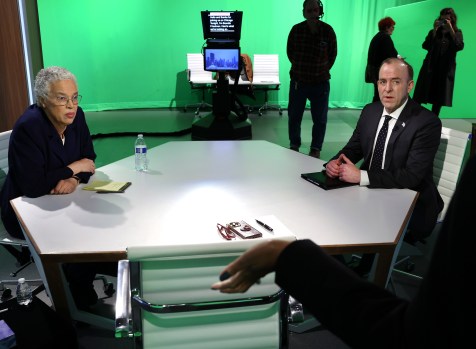
“We started out 30 years not getting the bills out on time and no one willing to take on the challenge of fixing the system, which I did,” she said at a recent WTTW forum with Reilly.
“Local school boards and local municipalities are really good at getting the word out to their constituents,” Reilly told the Tribune last week, adding that Preckwinkle’s failure to take accountability for problems salted the wound. “They know in a lot of cases, they’re probably looking at another property tax bill going up in the next couple of years to offset that.”
Preckwinkle has pointed to the county’s bigger picture: balanced budgets without fines, fees or property tax hikes in recent years, except for a voter-approved one at the Forest Preserve District. The county has earned four bond rating upgrades in four years, increased pension payments that brought county funds from the brink of insolvency to having enough assets to meet 66% of future liabilities, and amassed $1.8 billion in reserves by the end of 2024, including $842 million set aside for a range of emergencies.
The most recent Chicago budget Reilly voted for, Preckwinkle noted, included a host of new taxes and fees (Reilly voted against the property tax increase for the city’s libraries, but for the overall budget). He said it was “imperfect,” but only because of Mayor Johnson’s failure to lead.
In ads and debates, Reilly has tried to rehash Preckwinkle’s support for the 2015 sales tax hike and the short-lived 2017 sweetened beverage tax.
The soda tax was only in effect for four months before an industry-led constituent revolt forced Preckwinkle and county board members to roll it back. Though she ran on unwinding the county’s sales tax during her 2010 campaign, Preckwinkle reinstated it in 2015. She has repeatedly noted the sales tax hike paid for what she promised it would: boosting county pensions and paying for new infrastructure.
Asked whether he would have done the same to rescue county pensions, Reilly would not say. “I think the bigger offense is that she lied to people about what she was going to do with the sales tax,” he said.
Reilly also argued Preckwinkle failed to insulate Cook County Health from federal funding cuts and to turn around enough vacant properties held by the county land bank.
Preckwinkle should have set aside more money from its reserves or federal COVID relief money to make up for Medicaid changes and a rising number of patients seeking care they can’t pay for, Reilly said. If elected, he said he would refinance old debt and request more state money to bridge the gap.
Preckwinkle countered that the county had to allocate all of its federal pandemic money by the end of 2024, before a Trump victory was assured. And those dollars were not meant to be socked away in reserves, but spent.
She set aside millions of those COVID dollars to build up Cook County Health’s mental health offerings and purchase and erase $1.5 billion in medical debt for more than 600,000 county residents, in partnership with the state. In the county’s most recent budget, Preckwinkle also set aside $65 million from existing reserves for emergency health care programs. And she’s defended the work of the land bank, saying it brought 2,400 properties back on the rolls over the last decade and helped support a cadre of Black and brown real estate developers.
Preckwinkle has tried her best to tie Reilly to Trump, with ads showing pictures of the alderman with the then-hotelier a decade ago and saying Reilly had been silent during the worst of Trump’s crackdown on the city and the state. Reilly denied any relationship and noted he’d participated in the “No Kings” rally protesting Trump’s actions last year.
While Preckwinkle instituted a policy to bar immigration agents from county property and counter-sued the administration over threatened funding cuts, Reilly previously voted to soften the city’s sanctuary policies ahead of Trump’s second inauguration. The failed measure would have allowed Chicago police to cooperate with immigration authorities when apprehending accused murderers, rapists and child sex offenders.
Though Reilly said it would have helped address crime and likely reduced the severity of Operation Midway Blitz, Preckwinkle said had it passed, it would have starved immigrants of the same due process rights afforded other Americans.
Preckwinkle said she planned to “run through the tape” with fundraisers, events and canvassing in the last few weeks of the race. Though averse to always being “on,” she said she still found door-knocking fascinating. “For one thing, you never know what you’re going to get. People are surprised that candidates actually show up at their door.”