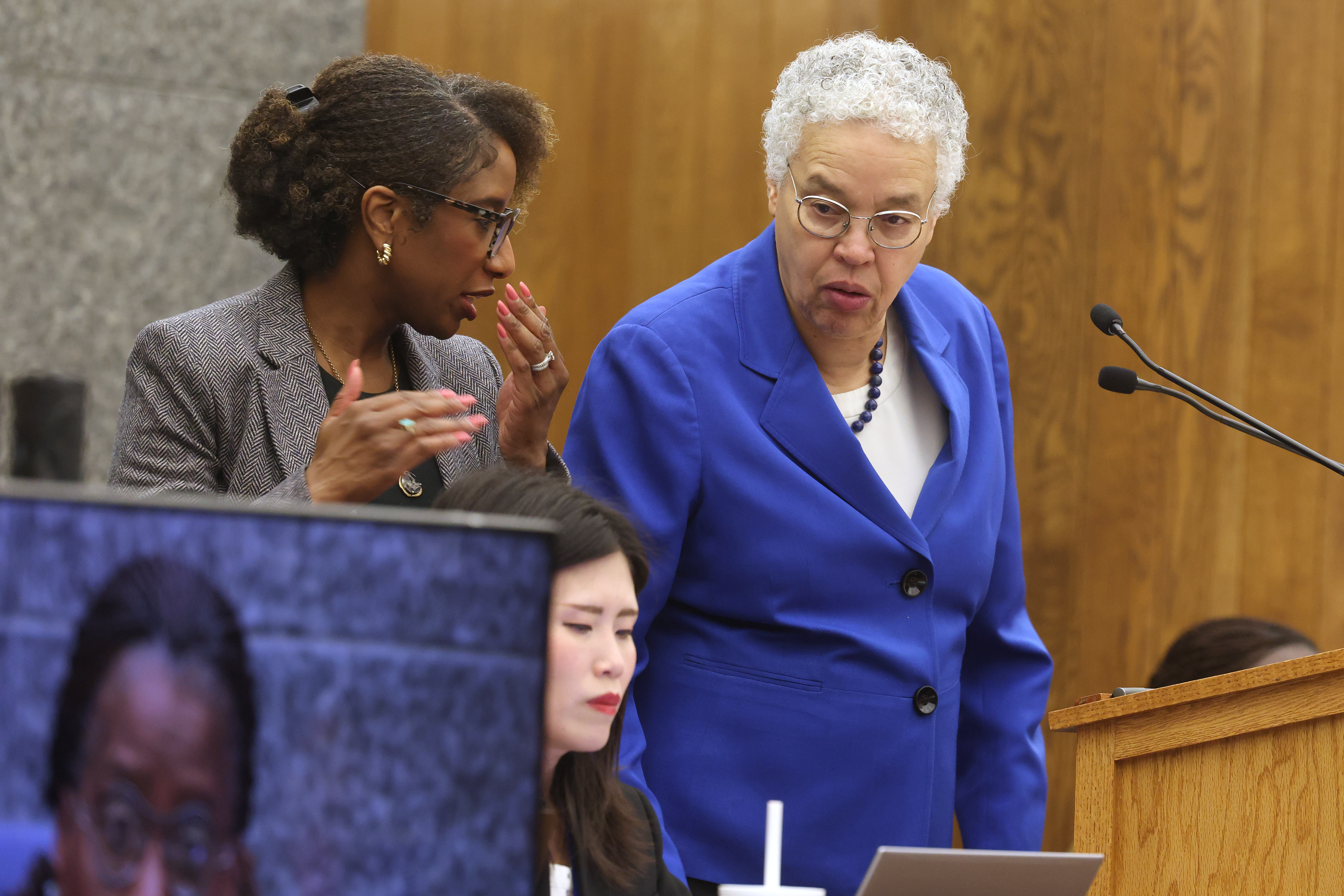

Cook County Board President Toni Preckwinkle won swift approval of her $10.12 billion 2026 budget on Thursday, calling its passage a protection against President Donald Trump’s cuts.
“The Trump administration is threatening our communities and targeting the very investments that keep families stable and safe,” Preckwinkle said at a post-board news conference with allies, pledging to protect essential services like the county’s flagship health system, which “faces an enormous financial crisis at a time when (the Affordable Care Act) and public health itself are under threat.”
The budget “includes more than $320 million to shore up our strategic reserves, ensuring the county can weather whatever comes next,” Preckwinkle said.
Preckwinkle made special note of the fact there is money in the budget to expand county Public Defender Sharone Mitchell Jr.’s immigration unit, which will get seven more positions next year, bringing it to 15.
By adding more lawyers, county officials expect to be able to represent more clients who are in the midst of the immigration process or facing criminal prosecution and deportation. The unit, Mitchell said Wednesday, has so far represented 190 clients.
Like the last several years, the 2026 budget does not include any layoffs or new taxes, fines or fees. The county has not raised its base property tax levy in nearly three decades. Avoiding those unpopular budget balancers is a political boost for Preckwinkle and board members who are facing primary elections in March.
In another election year move, applicants chosen by lottery to get rebates from the county’s homeowner property tax relief fund for low-income individuals with significant bill increases began receiving checks this week, officials said.
The budget remains largely unchanged from Preckwinkle’s initial proposal in October. Commissioners will give themselves pay raises — to $102,170 per year from $99,194 —the latest such increase tied to inflation that they voted to enact starting in 2022. Finance Chairman John Daley’s salary goes up from about $105,000 to $108,198.
Recent tweaks include roughly two dozen new positions at State’s Attorney Eileen O’Neill Burke’s office and new mental health and domestic violence programs. And thanks to the city’s planned record surplus of special taxing district funding, there will be nearly $20 million in new spending on homelessness, food benefits, and help for renters.
Its easy passage and the “collegiality” board members celebrated stood in stark contrast to the budget struggles swirling on the other side of the City Hall-County Building, which several commissioners alluded to after quickly approving a series of amendments in the Finance Committee.
Preckwinkle declined to offer any advice to Mayor Brandon Johnson or the City Council as they continue to negotiate. “I’ve always thought it’s important to stay in our lane,” she said.
Even Sean Morrison, the board’s lone Republican, supported the budget, estimating the county was in the “best fiscal position” in the state thanks to difficult pension fixes funded by a sales tax hike approved in 2015, the decision to refinance hundreds of millions in debt, and a flood of federal dollars hitting Cook County Health. The county has received a ratings upgrade every year for the last four years.
Morrison announced later Thursday that he would not seek re-election, saying he had come to “recognize the limits of what one voice can realistically achieve in a system so overwhelmingly weighted to one side.”
But many expect the following budget to be more difficult. The 2026 spending plan will tap reserves to weather what county officials think will be stormy conditions in 2027 and beyond. Health officials predict state and federal changes could result in an estimated $400 million “negative impact” on Cook County Health.
Reductions in federal Affordable Care Act tax credits could lead to more uninsured patients with limited ability to pay their bills coming to county facilities for care. New Medicaid work requirements that kick in starting in 2027 could lead to an estimated 10% of current enrollees losing coverage.
Eligibility checks for Medicaid patients will also happen twice a year instead of annually, which could lead to another 5% to 12% drop in coverage. Other stresses to the safety net hospital system could also bring in more uninsured patients, leaders have warned.
The county expects to lose nearly 29,000 members in its Medicaid managed care program, CountyCare, next year.
To prepare for that and other looming cuts, the board agreed to move some of the nearly $1 billion sitting in the county’s “unassigned” reserves; $65 million will go into a “grant risk mitigation fund” in case the Trump administration scales back federal grants and $55 million would go to a pension reserve.
Nearly $200 million will help make up for money the county expects to lose thanks to a lawsuit first brought by the Illinois Roadbuilders in 2018. A judge is scheduled to rule in early December about whether the county improperly spent money that should have been used on transportation projects. The county spent some of that money on public safety offices they argued helped enforce traffic laws.

Elsewhere in the budget, State’s Attorney Eileen O’Neill Burke won budget tweaks to add 10 positions to an “in-house digital forensics unit” she argued was sorely needed for attorneys to skim through reams of video evidence. That is paid for with a reroute of money set aside for capital projects. Six other new technology positions and eight victim witness specialists assigned to domestic violence cases in the office were also added in amendments.
In a statement, O’Neill Burke said the budget “is a positive step” in efforts to reduce violent crime. The extra positions “will allow us to build on that progress, modernize our capabilities and improve our effectiveness in the courtroom on behalf of the victims of crime.”
“It will take time, diligence, and persistence to fully restore this office, but we are moving in the right direction,” the statement said.
Mayor Brandon Johnson’s plans to sweep roughly $1 billion from the city’s tax increment financing districts would deliver an additional $19.9 million windfall to the county. If that money comes through, commissioners voted to spend $5.8 million on help for renters in court, $4.1 million on homeless services and $10 million on food access. Another half a million dollars from Stroger Hospital’s budget will go to hosting community mental health forums for young people in suburban districts.