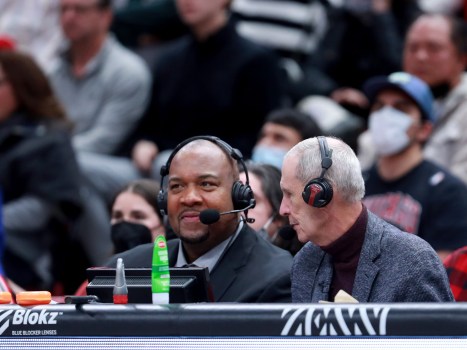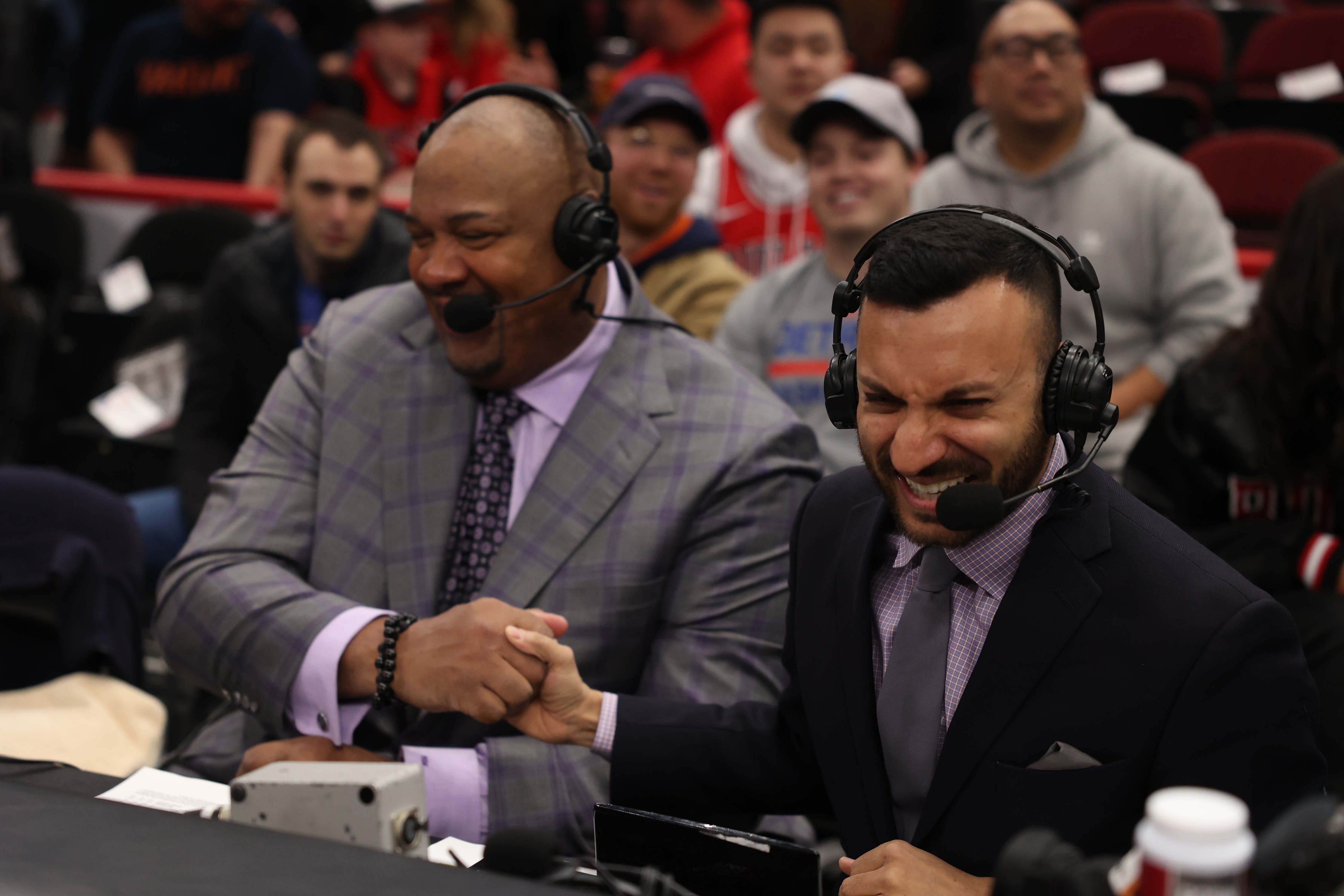
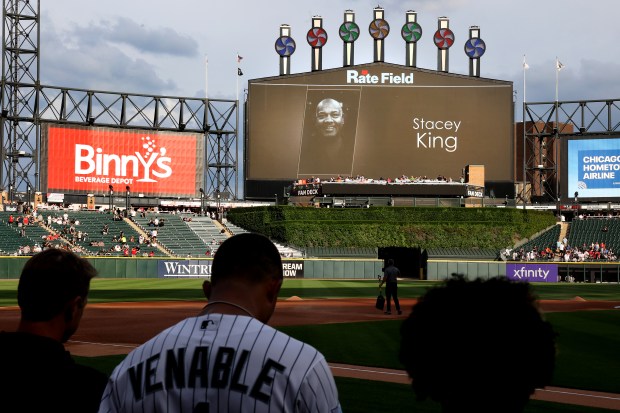
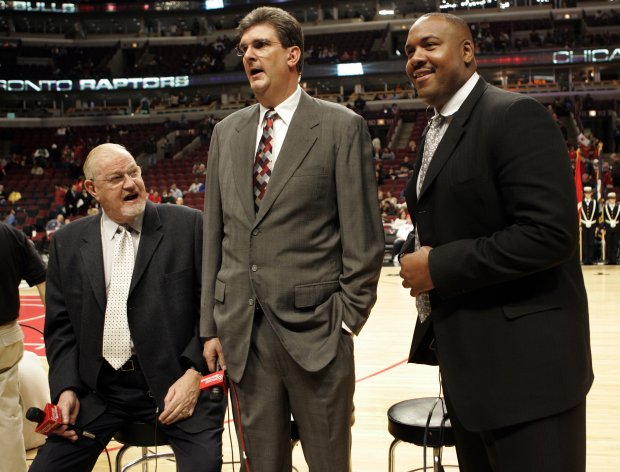



As a broadcaster, Stacey King always took his time on game day.
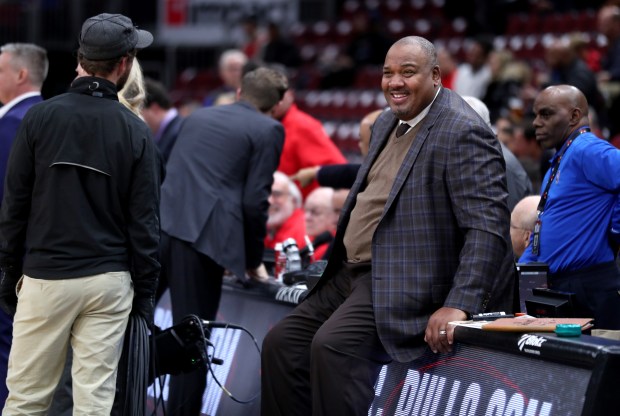
If a game tipped off at 7 p.m., King typically walked through the doors of the United Center at 6:45. Once, longtime Chicago Sports Network and NBC Sports Chicago producer Marc Brady swears, King cut it so close that he didn’t make it to the sideline until three minutes before the show went live on the air.
This could be maddening for a producer. But Brady learned there were two guarantees when it came to King: He was never late, and he was never off.
“I finally got to the point where I wouldn’t sit there and sweat and worry,” Brady told the Tribune. “After a while I realized that we only needed one take to get it done because he was going to nail it every darn time.”
If King started his game days a little later, however, it was only because he was on a different timeline. For him, the second half of any worknight began the moment the final horn sounded.
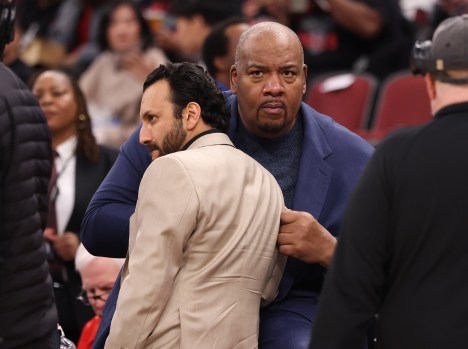
When King took off his headset, he would turn to greet the nearest fan. A line often formed, Bulls fans extending hands wrapped around jerseys and miniature basketballs to be signed, craning their necks to fit into selfies with the former NBA big man.
Security personnel at the United Center knew the drill, letting fans get a little closer to center court than normal. On the road, King often had to wave off a guard to let an eager fan through. Sometimes he wouldn’t wrap up with the final fan until the hardwood had been peeled away behind him, revealing the ice for an impending Blackhawks game.
In the wake of King’s death Sunday at age 59, these long postgame hours became a common thread among a fandom that spans generations and decades. Every Bulls fan in the city, it seemed, had a picture with King. It wasn’t hard to acquire. He spent two careers — as a player and a broadcaster — attempting to connect with every person who walked through the doors of the United Center.
King didn’t mind spending an extra minute or two on any interaction. When it came to Bulls fans, his patience and eagerness were rooted in a simple belief: It wasn’t his time — it was theirs. He was just there to share it.
It wasn’t hard for King to make a first impression on Horace Grant, the power forward whose spot King was hoping to contend for even as a rookie.
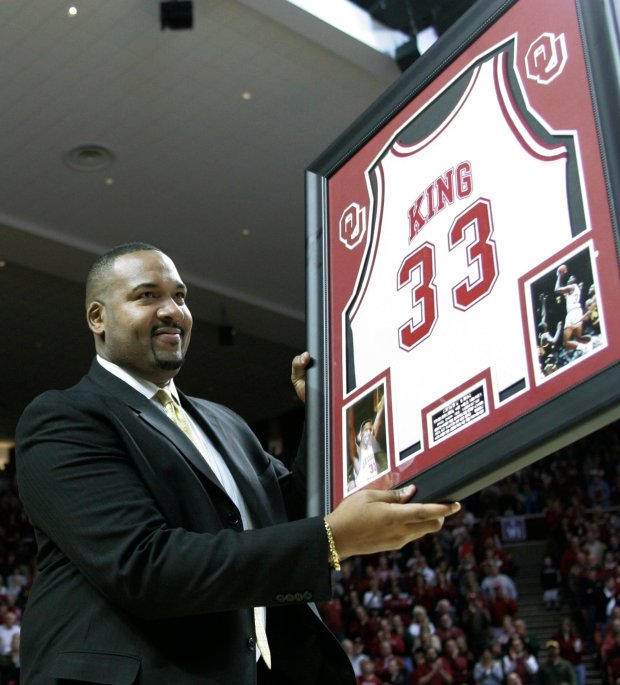
Before he met King, Grant thought he knew what to expect. Grant’s twin brother, Harvey, played alongside King at Oklahoma. Those were the strongest years of King’s playing career, a four-year span during which he dominated the Big Eight while leading the Sooners to the program’s first NCAA championship game.

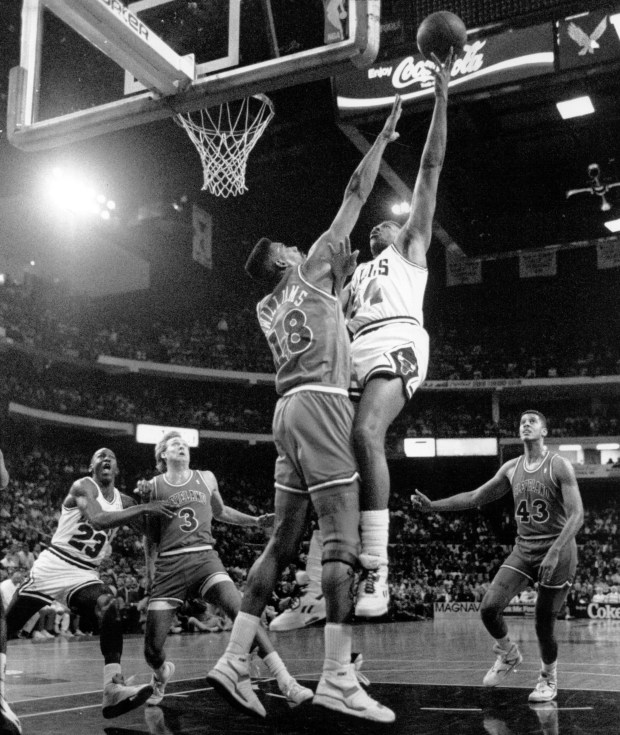
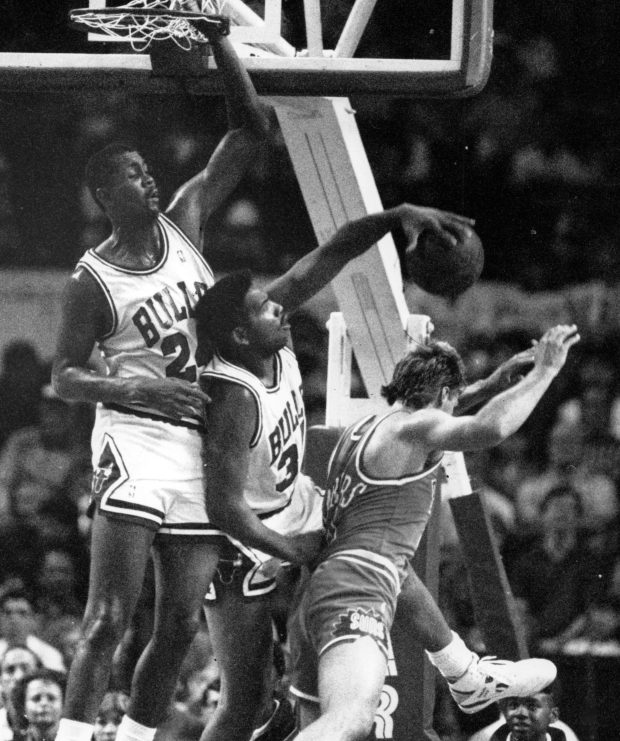
And King was never soft-spoken. CHSN analyst and longtime Tribune reporter K.C. Johnson remembers his first impression of the rookie when King first arrived in Chicago as the No. 6 pick in the 1989 draft. Colorful. Confident. Borderline cocky.
But it was one thing to know of King and another to meet him in person. After their first workout together at the Deerfield Multiplex, Grant said he had to give himself a pep talk: Horace, you’ve met the guy. He’s coming after your job. You’ve got to put the work in.
That dynamic defined their years as teammates. King was a hard worker. He didn’t shy away from the fact he was fighting to usurp Grant from his starting position. The two clashed fiercely in practice.
But off the court, the now-familiar version of King emerged. He was quick with an invitation to grab a meal after practice, always wanting his teammates to stick together rather than drift apart in their downtime.
“Those type of people don’t come very often,” Grant told the Tribune. “That’s rare.”
It’s hard to remember now, but King wasn’t always a favorite among Bulls fans. Chicago sports historian Jack Silverstein noted in a column this week that King actually received a chorus of boos when he was announced at the Grant Park rally celebrating the 1991 championship, a slight that the big man absorbed with his trademark grin and a simple response: “Let’s go out there and have a party tonight.”

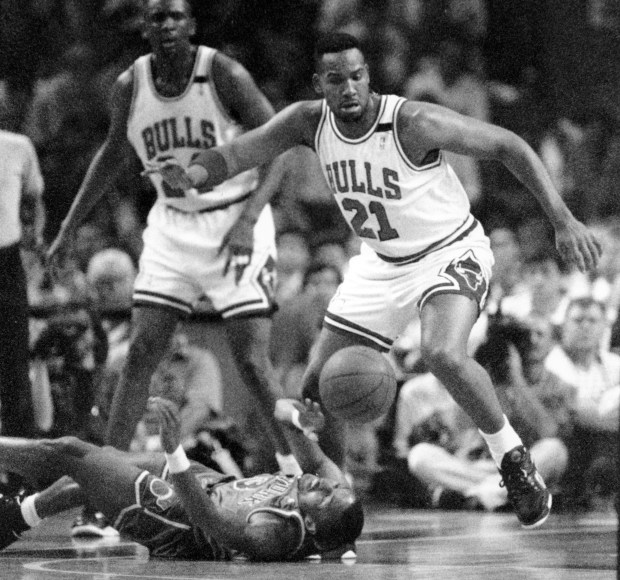
He might have appeared unfazed from the outside, but King was desperate to improve his standing after that season, both on the Bulls roster and in Chicago. He changed his jersey from No. 34 to No. 21. He spent the summer in the gym. Grant remembered feeling nervous when the team reconvened for training camp, noting the clear edge to King’s approach on the court.
Grant credits King for pushing his own game — “iron sharpens iron” — to a new level. And the Bulls needed King’s help to overcome a 15-point deficit in the fourth quarter of Game 6 in the 1992 NBA Finals, knocking down a late jumper against the Portland Trail Blazers that stood out as one of the most memorable highlights of his career.
“Stacey played his role and he played it well,” Grant said. “If it wasn’t for Stacey and the rest of the (bench) crew in ’92, I don’t think we win that series.”
The 1992-93 season redefined pressure for the Bulls. Fresh off back-to-back titles, they hoped to elevate themselves from a powerhouse to a genuine dynasty. Every mistake earned extra scrutiny. Every loss carried extra weight.
In January 1993, the Bulls dropped consecutive games in a home-and-away back-to-back. Their record was 22-9 — but that didn’t matter. The team boarded the bus in Cleveland after a 117-95 blowout by the Cavaliers in dead silence, an icy pall setting in among teammates desperate not to let losing become comfortable.
King was the last player to clamber up the steps, pausing at the head of the vehicle before fixing his eyes on Bill Cartwright. A smile followed. Then King opened his mouth and a perfect impression of the revered veteran tumbled out.
Grant can’t remember the particulars of the joke. Probably, he said, something about Cartwright’s haircut. But what he does remember is the laughter that followed, buoyant and resounding. Even Cartwright cracked a smile.
The mood shifted. Relief seeped in. The Bulls headed back to Chicago, where they trounced the Milwaukee Bucks two nights later and continued down the grueling gauntlet toward their third ring.
“He had that gift,” Grant said. “When people are down, he knows how to push their buttons and make them laugh.”
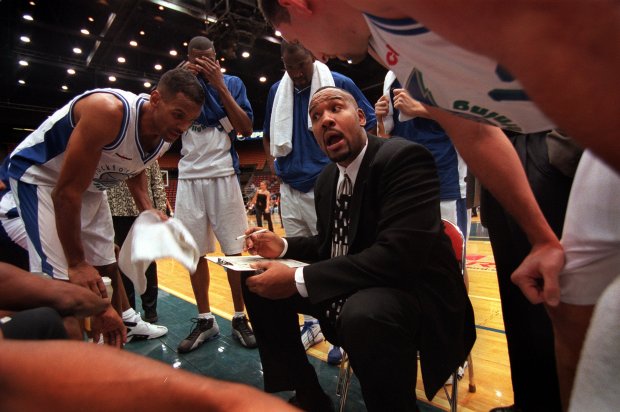
After he was traded to the Minnesota Timberwolves in 1994, King spent more than a decade working away from Chicago as a player and coach.
But even before he came back for good to begin his broadcasting career, King never really left. He raised his family here. And for close to three decades, he continued to choose Chicago, over and over again.
Bulls fan Joe Sislow recalls that King was a regular at Record City in Northbrook during his playing career. He earned the nickname “Pooh-Man” when Noreen Sobczyk, a longtime coworker at the shop, saw him checking out “Funky as I Wanna Be” in the hip-hop section.
Years later, Sislow noticed King as he was driving through a parking lot and shouted the nickname through his rolled-down window. King doubled over in laughter, turning in immediate recognition of a years-old inside joke.
This became the common refrain of King’s relationship with the Bulls fanbase. No interaction went unnoticed, no conversation was forgotten. King wanted to talk to anyone, anywhere, at any time.
His sons recalled this week, in a statement via the Bulls, how their father often would be stopped at the grocery store or on the street with the same question: “Are you a professional athlete?”
King loved to reply with the same wisecrack: “No, I’m just a tall Black guy.” The laughter that followed was inevitable. From the start, it was never hard to understand how he won the city over.
“It was very easy for him to exist in Chicago,” Brady said. “This is a city that it’s hard to be a person from outside. If you break through, it’s because Chicago has decided they’re going to accept you — and he was accepted because he also decided he wanted to be part of Chicago.”
After two years of working his way into local broadcast rosters, King became the lead color analyst for the Bulls in 2008. Two weeks later, the Bulls won the NBA draft lottery, a miraculous stroke of luck that allowed them to select hometown hero Derrick Rose.
Neither man knew it at the time, but they would come to shape each other’s lives.
“Red Kerr was to (Michael Jordan) what Stacey was to Derrick,” CHSN analyst Johnson said. “They were intertwined.”
It made sense, then, that King and Rose reached the stratosphere in the same moment on Jan. 22, 2010.
At this point, there’s no need to describe the dunk to a Chicagoan. It’s embedded in the lore of the city — the breakout pass, the bounding leap, the midair double clutch, the ferocious snarl.
That’s only half of the dunk, though. The other half is King’s reaction, memorized by fans who grew up in the hopefulness of the Rose years. Shouting at Rose to stop it. Asking broadcast partner Neil Funk to look around for his poster machine. Reminding anyone who would listen that this kid was from Chicago.

In an interview with The Score this week, Funk said that call was the moment he realized he was “no longer driving the car” on their broadcasts. King had the pedal glued to the floor, hurtling the tandem forward with one simple request: “I want to go higher!”
King wanted Rose to take himself and Chicago all the way to the top, back to the upper echelon of the NBA. And in his own way, King took Rose higher, providing the score for every climactic moment of the 2011 MVP’s Bulls career.
“You didn’t just call plays, you helped tell my story from the pain of the struggle to the height of the glory,” Rose reflected in a poem shared with the Tribune after King’s death. “So if my name still echoes, if my Rose still grows, a piece of that garden is yours I hope you know.”
Over time, a local broadcast team transcends the typical expectations for the medium. A familiarity develops. Fans don’t need their local color commentators to be objective or analytical. They need them to love their team. They need them to refuse to give up on their team. And King understood this dynamic better than most.
He knew that when he spoke into a microphone, he was speaking directly to a Bulls fan. For at least 82 nights of any given year, he knocked on the front door and settled onto the sofa of thousands of homes in Chicago and beyond. His commentary was a conversation, an ongoing dialogue with fans of a team that he loved like a family.
King bickered with fans on social media. He responded to nearly every direct message. Brady, the CHSN producer, joked that King’s autograph is probably worthless in Chicago simply due to the sheer volume of pictures and memorabilia he signed over the years.
When fans reached out on social media about hoping to meet him in person, King always responded with the same phrase: “Catch me after the game.”
“It was just as much fun for him as it was for the fan,” Brady said. “He was old school. He knew why he was popular. He got that the reason he was there was because of them and he appreciated them on that level.
“Just imagine if you had a chance to tell everyone in your life that you appreciate them, if you had an opportunity to thank them and shake their hands. Well, that was his thing.”
Humor was the foundation of King’s broadcasting talent. His one-liners formed a shared language among Bulls fans: “Gimme the hot sauce.” “Let me step back and kiss myself.” “Big-time players make big-time plays.” “There’s five Javontes out there.” “Does anyone know how to post videos to Facebook?”
A crucial piece of this approach was King’s knack for toeing a line of ridiculousness. He hit a faulty falsetto while singing advertising jingles. He dipped into a spot-on impression of Doc Rivers in the middle of a live take. He gleefully poked fun at himself.
“In my opinion, Stacey was a professional comedian who just happened to be doing color,” Brady said.
When he spotted a fan wearing an odd Michael Jordan jersey — the debate over whether it was vintage or fake never was officially settled — during a 2021 broadcast, King couldn’t hold back. He launched into a teasing tone, ribbing a stranger as if he were a cousin who showed up to a family function in a goofy outfit.
“Buy one, get two free!” King exclaimed, barely able to get the words out through laughter. “It looks like he might’ve made that at home.”
King’s greatest talent as an orator was improvisation. He didn’t cook up lines in advance. He never brought in notes for new nicknames or catchphrases. When Johnson moved to an on-air role with NBC Sports Chicago in 2019, King offered a singular piece of advice: “It’s not rocket science. Be authentic. Be true to yourself.”
Johnson and Brady felt King’s comedic timing and quick wit often overshadowed the genuine depth of his basketball knowledge. King was known for not sleeping much. After a Bulls game, he often headed home to catch the West Coast games, then flipped over to recordings to see what else he missed around the league. King didn’t flex his X’s and O’s analysis too often — that wasn’t the nature of his role — but behind the scenes he could break down the game with rare experience.
A voracious curiosity bled into every aspect of King’s persona on the mic. He devoured movies and television shows. He coined nicknames based on rappers mostly popular with teenagers. He quoted “Sanford and Son” despite the reference being a decade or two older than the knowledge of the average viewer. He whooped and hollered through Bears playoff games in the middle of live Bulls broadcasts. He refused to let his commentary feel restricted to the confines of a 48-minute basketball game.
“He was on the same level of everyone — players and fans alike — to the point where he never felt like he was above anyone,” Brady told the Tribune. “And who doesn’t like a guy who’s the life of the party?”
Although King reached rare air with the Bulls during Rose’s ascent, most of his tenure as a broadcaster was spent breathing life into ragged seasons. The Bulls reached the playoffs only twice in his last decade with the team. Still, King never wavered.
Contrary to popular belief, optimism isn’t easy. It takes skill. It takes work. It’s hard to love a team that loses. There’s a reason so many people stop. King dedicated himself to the effort of belief. He chose each day to trust that the Bulls had something better coming in the future. He truly thought the 14th man on the roster could really be something if he just got a little more playing time.

It didn’t matter if the Bulls were on a 10-game losing streak or sitting at the bottom of the Eastern Conference. It didn’t matter if the basketball wasn’t elite. King believed the Bulls were elite — as a franchise, as a community — and that in itself was worth celebrating.
Last summer, Ayo Dosunmu and Matas Buzelis called up King during a lengthy livestream at Dosunmu’s home. The pair burst into laughter as King, booming over the speakerphone, voiced his eagerness to see the young core deliver success — “I’m tired of this play-in stuff!” — and urged Buzelis to stay in the gym. He signed off with an earnest message to fans: “Stay loyal to the Bulls. Don’t jump off ship.”
The jokes and goofy monikers mattered. But it was this — the joyful relentlessness of his belief — that truly endeared King to fans of the Bulls and the NBA at large.
“It’s one of the few times in life where you actually understand you are living in the good old times,” Brady said. “And you knew it. Everybody knew it. If the Bulls played well, that was awesome. But you were always tuning in for something very special. We know it will never be the same.”
When the Bulls return to the court this fall, they will be accompanied by a newfound quiet. There is no replacement for King’s voice, his laugh, his warmth. Chicago understands this too well. King’s absence will serve as a reminder of what he offered this city during his many years here.
How to sing with abandon, how to laugh too hard to speak. How to find light in a joyless season. How to live a life that is celebrated with equal weight by your closest colleagues and strangers you’ve never met. King accomplished each of these feats, on and off the mic. And because of him, Chicago understands how to live a little better too.
Drive home safely. Beep beep.