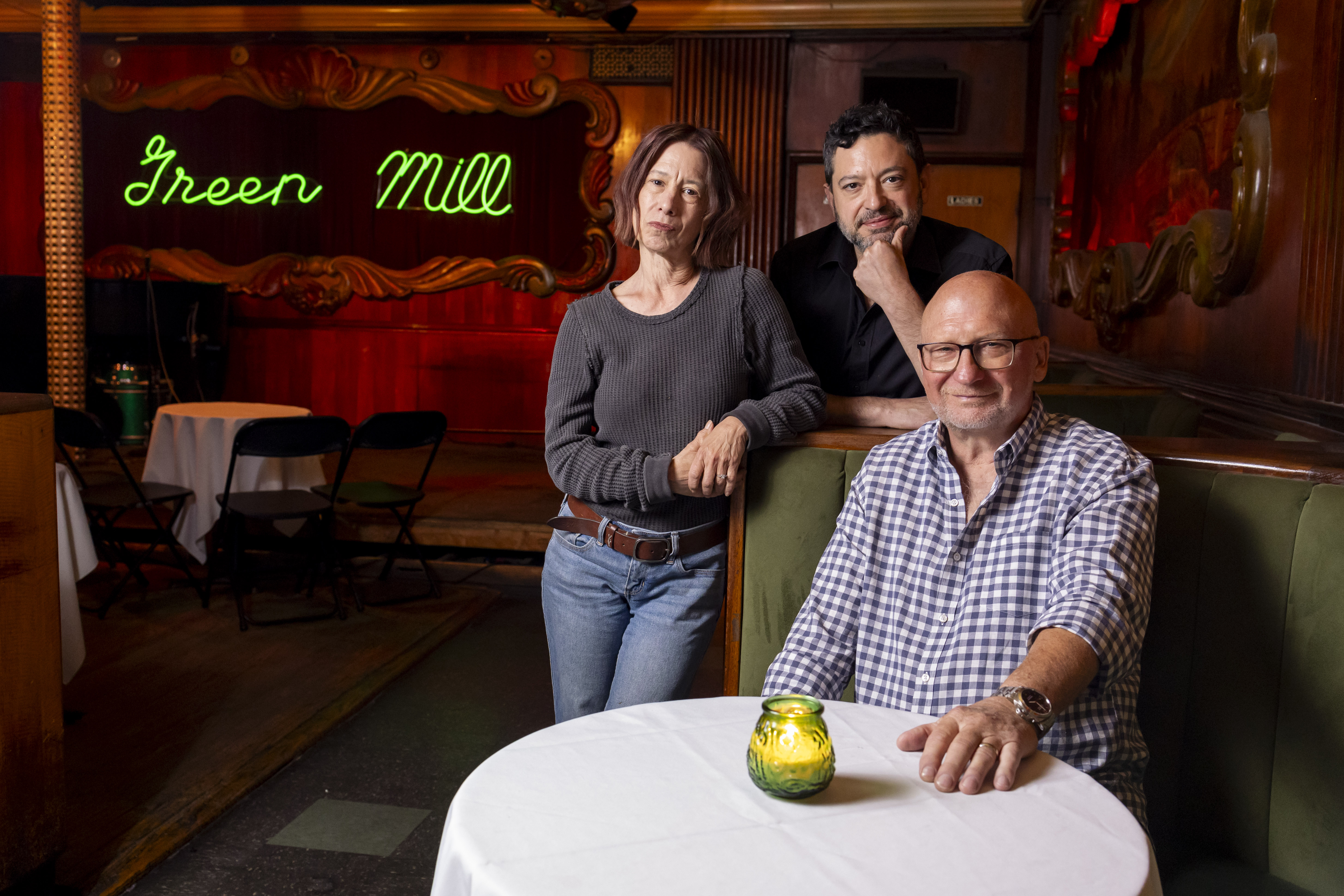

One of the greatest taverns and most impactful nightclubs in the history of this toddlin’ town, the Green Mill sits near the corner of Lawrence and Broadway, at night its neon sign a welcoming beacon. And next Friday night on June 19, it will celebrate its 40 years under the remarkable ownership of Dave Jemilo, who does not own it anymore but who has happily, confidently and gratefully placed it in the hands of two people who are like family members.
“This place has been my life for more than 40 years,” Jemilo said one recent afternoon, sitting in a Green Mill booth. “It was time. Nothing dramatic. I just don’t think I have the energy, that high level that it takes to be here every day until sometimes four in the morning. And there is other stuff in life I’d like to do.”
The new owners are Jason Cole and Jill Skintges, and any regular Green Mill patron will breathe a sigh of relief, erasing the anxiety and worry that arose when Jemilo, having in 2021 purchased the adjacent retail spots in the Green Mill building for $5 million, announced last summer that the Green Mill was for sale.
“There had been offers over the years,” Jemilo said. “But when the coronavirus came, I was working like crazy and still thinking, ‘Let’s just see what happens.’ But I was getting worn down. So, there were a lot of people interested, and one man in particular I really liked, but Jason and Jill made the most sense.”
He knew them both very well. The 55-year-old Cole has been, with a break or two, a bartender/manager since he was hired while in college at 22. Skintges, who has been a professional dancer with the Joffrey Ballet and math teacher before going to work as a Green Mill waitress and bartender nearly 30 years ago. They are bright and personable people, enthusiastic too.
“We have great confidence in the future,” says Cole, a native South Sider who grew up in Berwyn and now lives on the Northwest Side. “We have both been able to watch closely how Dave works and that has been an inspiring foundation.”
Says Skintges, who is originally from the West Side and now lives in Lincolnwood, “I like to think of us as stewards, caretakers.”
Cole and Skintges are both in what they describe as solid loving relationships. Skintges’ daughter, Ruby, is a 23-year-old biomedical engineer who often waits tables at the club. They know that owning and operating a tavern is not for the weak. It took them months of planning and conversations with attorneys and bankers to pull together the deal, which includes a few partners who will remain “silent.”
“Some of those partners are the same people you’ve been throwing out of here for years,” Jemilo said, and all three laughed.
History has always hung heavy in the air at the Mill.
Jemilo first heard of the place as a teenager, traveling north to visit his divorced father. “My dad would point the place out to me, tell me about hanging out there in the ’30s. The first time I walked in, even though it was in bad shape, heroin addicts were sleeping on the floor, I could see the beauty. I fell in love with it.”
Jemilo is a South Sider, born in 1956 at Holy Cross Hospital and a graduate of Brother Rice High School, where he was a good enough defensive end and linebacker to gain a football scholarship to the University of Dubuque. He later signed a pro contract with the Chicago Fire in 1981.
When that team went bust, Jemilo pieced together a “career,” working for the Chicago Park District, teaching school and doing what needed to be done to keep order at various nightclubs, investing in some. By the mid-1980s, he was part owner of Deja Vu, a popular Lincoln Avenue tavern and dance club.

When he learned that the Green Mill was for sale, he managed to put together enough money — maxing out his credit cards and borrowing $300 from his attorney — to become the fifth owner in its long history. He was 30.
He opened on June 19, 1986, and Larry Kart, then Tribune jazz critic, wrote that it was, “As comfortable as an old shoe and as friendly as your favorite roadhouse waitress. And as a setting for music, the club is just about ideal—with a long curving bar, a plethora of booths, an ample bandstand and a good sound system.”
One of its other attractions was that it was reasonably priced, a dollar cover on Monday through Wednesday, maybe two bucks the rest of the week. That made the place accessible to, well, most anybody, and cab drivers could be found sitting next to bank presidents. Like Jemilo, it was and remains appealingly unfussy. He may be a visionary but he’s a straightforward sort. There is no drink menu. It is a cash-only joint. No credit cards. No pretensions. No talking during performances.
He booked musical acts that mostly reflected his own eclectic tastes. Among the first and most important bookings came early, with Marc Kelly Smith hosting what would be known as the Uptown Poetry Slam. It took place weekly, still does, and in time, there were hundreds of poetry slams taking place around the globe.
Earlier this week, Smith wrote to me from his home near the banks of the Mississippi River: “Dave gave a lot of people needing a chance — musicians, servers, bartenders, performers–an opportunity to steer their lives/careers toward a life-changing direction. He did so for me. All of us became a family of sorts — the Green Mill family, a collection of eccentric personalities akin to Dave himself. Jason and Jill are a part of that family, and I am pretty sure they’ll carry his legacy forward and keep the dive the beloved dive it is.”
Joannie Pallatto is a singer and songwriter who, with her musician-producer husband Bradley Parker Sparrow, has played the Mill, as have many of the recording artists on their Southport label. She tells me, “Dave is like a musician, and his instrument was the ability to book a revolving cast of the greatest jazz ensembles in Chicago, and the world, over the years. His love and appreciation for venerable artists like Von Freeman, George Freeman and Willie Pickens made the Green Mill one of the greatest places to play. Sparrow and I felt that every time we played there was the best gig ever.”
Many others share that opinion. And Jemilo also provided what amounted to a launching pad for such once young talents as Kurt Elling, Patricia Barber and Frank Catalano.

The lively history of the Green Mill has been well charted in stories going back to its 1907 opening as Pop Morse’s Roadhouse; its heyday as a speakeasy and nightclub; its associations with Al Capone and comic Joe E. Lewis; and the hard times, along with its Uptown neighborhood, until Jemilo came around. Much has been written about it, including by local historian and Tribune contributor Robert Loerzel.
There is a fine movie making the film festival rounds, “The Green Mill: A Real Chicago Joint.” It is the work of Paul Carr, who was among the guests at the recent retirement party for Jemilo at the Green Mill, a bash of which he wrote, “I’m proud to have been there since Day One when Dave hired me to be his first bartender. Dave made The Green Mill the world class joint that it is and he launched many many careers and helped folks make a living. In the often cut throat world called the bar business, Dave was the fair and always honest guy who did right by people.”
Column: Inside the Green Mill, the Malört and stories flow in a new movie
Jemilo will likely not be at the Mill on June 19, even though it will mark the formal beginning of the Cole-Skintges ownership and the return to its late closing weekend hours (4 a.m. and 5.a.m.) that were pushed earlier during the pandemic.
In a sense, no matter where he is, the joint is with him, for tattooed on his upper right arm is an image of the statue that has forever stood near the Green Mill stage. Some musicians refer to the statute as Stella, as in “Stella by starlight” from the jazz standard, but it is actually a representation of Ceres, the Goddess of Harvest.
That makes some sense too because for decades Jemilo, this ultimate city kid, has owned a couple of farms. He has one now and it’s in Wisconsin, and he is there getting ready for a July trip, driving to Alaska.
He told me about his farm’s 165 acres, on 30 of which he grows corn and soy beans. I reminded him of something he said on June 19, 2016, the 30th anniversary of his club when he was asked by Tribune critic Howard Reich if he would keep working.
“Yeah, I hope,” he said, mentioning longtime Jazz Showcase owner Joe Segal, who had recently turned 90 and worked the front desk at his club. “I don’t know if I’ll live as long as Joe, but I’d sure try. I don’t ever see not doing this.
“Man, you could get hit by a beer truck tomorrow.”
Or you could also fall in love and get married, as Jemilo did two years ago, to a Brazilian woman named Rosemeire. They met three years ago, when she and a friend came to the Mill to hear George Freeman. As the music played, it was love at first sight.
rkogan@chicagotribune.com