
Here’s a look back at what happened in the Chicago area on March 20, according to the Tribune’s archives.
Is an important event missing from this date? Email us.
Front page flashback: March 21, 1969

1969: A group that later became known as the Chicago 7 was charged with conspiracy, inciting to riot and other crimes during the 1968 Democratic National Convention.
The original eight defendants were Abbie Hoffman, Jerry Rubin, David Dellinger, Tom Hayden, Rennie Davis, John Froines, Lee Weiner and Bobby Seale. Weiner was the only Chicagoan. Seale was tried separately during the proceedings.
Separately, eight police officers were charged with violating the civil rights of demonstrators by use of excessive force.
The Chicago 7: A timeline of the protests, the clashes, the trial and the fallout
A jury decided in 1970, five of the Chicago 7 defendants — Hoffman, Rubin, Hayden, Davis and Dellinger — had incited riots, but had not conspired to do so.
Defendants Weiner and Froines were acquitted of all charges. Judge Julius Hoffman, however, sentenced all seven defendants and two defense lawyers to contempt-of-court jail sentences. Those convictions were later reversed.
Weather records (from the National Weather Service, Chicago)
- High temperature: 85 degrees (2012)
- Low temperature: 4 degrees (1885)
- Precipitation: 0.96 inches (1935)
- Snowfall: 6 inches (1964)

1880: South Works began life. Orrin W. Potter, president of the North Chicago Rolling Mill Co., broke ground on 73 acres of land in South Chicago for a steelmaking plant intended to build railroad tracks. The site on Lake Michigan and the Calumet River assured access for deep-draught ore boats. Chicago’s rail hub guaranteed transport for finished product. Deep seams of coal in Illinois and Indiana promised cheap energy. Immigrant labor abounded.
The manufacturing plant remained open until April 10, 1992.
“The Works turned out the structural steel that built Chicago and beyond,” the Tribune reported just before the plant’s closure. “South Works steel holds up McCormick Place, Sears Tower, the Amoco Building, the John Hancock Center, the Wrigley Building and Tribune Tower. It built the Cape Kennedy assembly structure and the Birmingham, Ala., Municipal Airport parking structure.”
Steelworkers Park occupies about 17 acres of the long-vacant site, but the rest is now planned for a national computer hub. The Chicago Plan Commission approved its creation in November 2024.

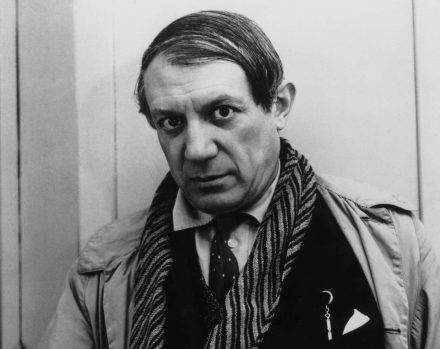
1923: The first solo exhibition of Pablo Picasso’s drawings in the United States opened at the Art Institute of Chicago, hosted by the Arts Club of Chicago.
Tribune critic Eleanor Jewett, however, wasn’t impressed: “Only one or two, those the comparatively speaking finished pictures, will place Picasso for him as a man deserving of the name the art world has given him as ‘great.'”
In 1913, a culture war erupted over an exhibition of modern works at the Art Institute of Chicago
According to a catalog for the exhibition, 53 drawings and five pieces of sculpture were displayed until April 22, 1923, but Picasso himself didn’t attend it, the 1913 exhibition of his painting “The Woman and the Pot of Mustard,” or the 1967 unveiling of his namesake steel sculpture in Civic Center Plaza (now Daley Plaza).

2020: Gov. JB Pritzker issued a stay-at-home order for Illinois due to the coronavirus.
Pritzker announced the order as Illinois reached 585 confirmed cases across 25 counties, including 163 new cases. The death toll had risen to five.

2024: Chicago voters rejected the Bring Chicago Home tax hike referendum, a major political blow to Mayor Brandon Johnson. The measure, which sought to raise the city’s real estate transfer tax on property purchases above $1 million to generate up to $100 million annually for homeless services, had survived several setbacks since advocacy groups first coalesced behind the idea years ago.
Want more vintage Chicago?
Subscribe to the free Vintage Chicago Tribune newsletter, join our Chicagoland history Facebook group, stay current with Today in Chicago History and follow us on Instagram for more from Chicago’s past.
Have an idea for Vintage Chicago Tribune? Share it with Kori Rumore and Marianne Mather at krumore@chicagotribune.com and mmather@chicagotribune.com