

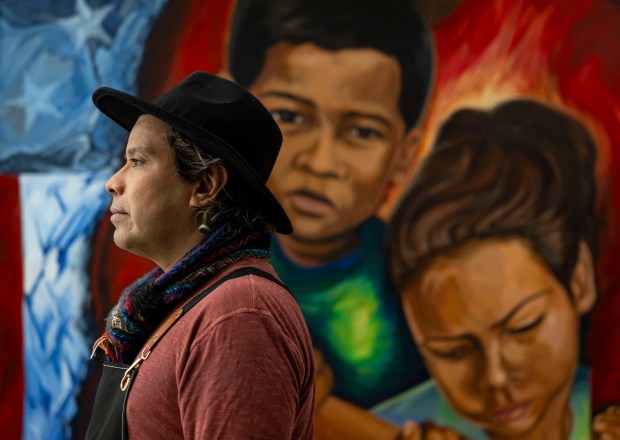
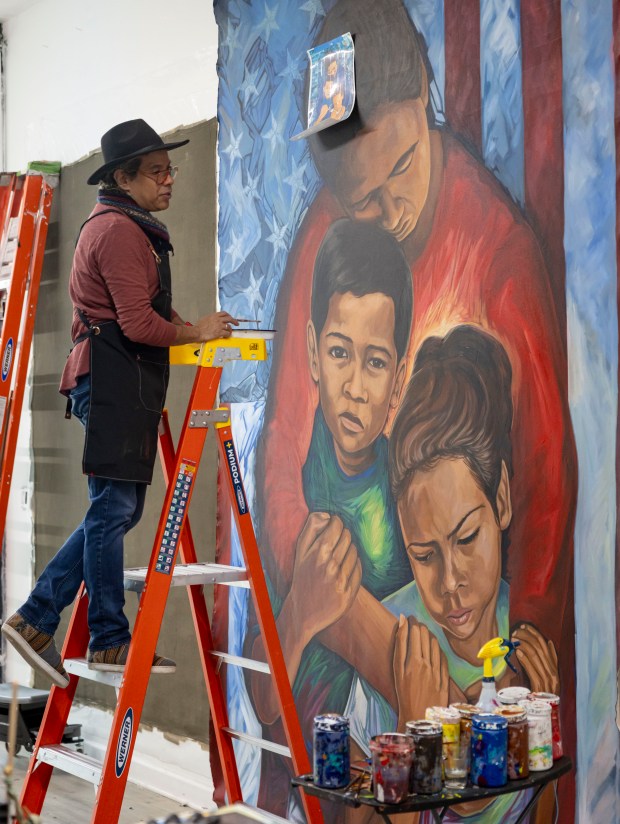
As the son of an undocumented mother and father, Pablo Serrano of Chicago says it would be painful for him – and harmful to the nation – if America were to end its longstanding practice of birthright citizenship for future generations.
His mom was seven months pregnant when his parents left Durango, Mexico in summer 1979, searching for a better life and reuniting with other family members in the United States.
She gave birth to Serrano at the old Cook County Hospital just a few months after their arrival. The newborn became an automatic U.S. citizen by virtue of his place of birth, according to the 14th Amendment and well-established American law, despite his mixed-status family.
Yet on the first day of Donald Trump’s second term, the president signed an executive order on birthright citizenship declaring that some children whose parents are here illegally or temporarily, such as certain visa holders, are not American citizens.
The order, which has been blocked by the courts, would apply to children born on or after Feb. 19, 2025, potentially affecting the status of millions of babies.
It has also ignited broader political and public debate over who should have the right to call themselves an American, based on the circumstances of their birth and parentage.
As an American with birthright citizenship, Serrano worries that if Trump’s order were allowed to go into effect “we will be deporting babies soon,” with a spiral of consequences that could reshape the legal and cultural landscape of the country.
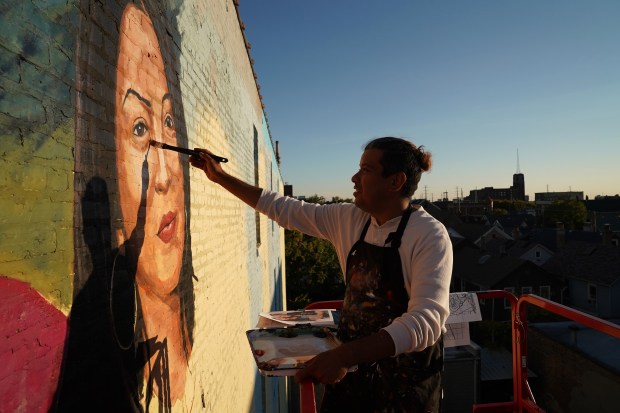
“Whether you’re from Ireland, Italy, Mexico, Colombia, Venezuela, China, if you were blessed to be born here, you are a citizen of this country,” said Serrano, an artist in the Pilsen neighborhood and father of three. “I don’t think people fully understand what that means” for the spirit and fabric of the nation.
The Supreme Court will soon decide the constitutionality of Trump’s attempt to restrict birthright citizenship, which conflicts with more than a century of legal understanding that the Constitution’s 14th Amendment guarantees citizenship to everyone born on American soil, with extremely limited exceptions for children of international diplomats or a foreign occupying force.
Oral arguments in the case Trump v. Barbara are slated to begin April 1, with a ruling expected by the summer.
Trump’s order titled “Protecting the Meaning and Value of American Citizenship” states that the 14th Amendment “has never been interpreted to extend citizenship universally to everyone born in the United States.” Trump has argued that the amendment, ratified in 1868, was intended to confer citizenship to the children of slaves.
The order, which has been challenged in multiple lawsuits around the country, specifically asserts that a child born in the U.S. is not a citizen if its mother doesn’t have legal immigration status or is in the country legally but temporarily, and its father is not a citizen or lawful permanent resident.
The president has repeatedly attacked the concept of birthright citizenship during both terms, calling it “ridiculous” and a “magnet for illegal immigration.” Trump has also falsely claimed that the U.S. is “the only country in the world” that confers citizenship in this manner, even though Canada, Mexico and a few dozen other countries mainly in the Americas also grant birthright citizenship.
The American Civil Liberties Union – which filed a class-action lawsuit against Trump’s order on behalf of babies born to parents who are undocumented or have temporary status – rebuked the president’s end to birthright citizenship as “a direct violation of the 14th Amendment.”
“Birthright citizenship isn’t just a legal doctrine — it’s central to who we are as a nation,” the ACLU said in a statement. “It reflects that all children born in this country belong here, and are equal members of our national community, no matter who their parents may be.”
The Chicago-based American Bar Association has also warned that an end to birthright citizenship could leave a large contingent of residents essentially stateless.
“And in many cases, proving citizenship would prove difficult or impossible even with representation — needlessly complicating the lives of many native-born Americans,” the organization said in an amicus brief. “Those unable to afford attorneys, or left in legal limbo even with legal assistance, would subsist as a ‘shadow population’…. This ‘self-perpetuating, multigenerational underclass’ potentially created by the Executive Order could persist for generations.”
Targeting birthright citizenship is just one piece of the Trump administration’s sweeping immigration crackdown, which has included mass detentions, deportations and turbulent protests in the Chicago area and other parts of the country.
Serrano believes the underlying goal of this anti-immigration campaign is to “maintain the dominant culture against the great civilizational change that extremists have been venting about…the multicultural identity of the U.S.”
The federal government is “basically trying to stop that,” he said.
“Not just at the border, but at hospitals in delivery rooms,” Serrano added. “Places where, in other times, were places of hope – of how exciting our future is when new citizens come into the world.”
‘What it means to be American’
To Carson Wang of the Uptown neighborhood, the principle of birthright citizenship is “deeply American.”
His parents moved from China to the United States on work visas in 1998 and he was born in 1999, later attending high school in downstate Carbondale and the University of Illinois in Urbana-Champaign, before moving to Chicago a few years ago.
This is the only country Wang has ever known.
“This is my world,” he said. “I could not imagine living my life and being in constant fear of losing this entire world that I know. That at any time, I could be pulled away from my home and my family and taken somewhere that I have no connection to – just a completely different society and culture.”

He recalled studying the 14th Amendment in high school and feeling an affinity to the landmark 1898 Supreme Court case United States v. Wong Kim Ark.
Wong had been born in San Francisco to Chinese immigrant parents. Following a visit to China, he was denied reentry to the United States under the 1882 Chinese Exclusion Act, which heavily restricted immigration from China and barred Chinese immigrants from becoming U.S. citizens.
But in a 6-2 decision, the high court sided with Wong; citing the 14th Amendment, a majority of justices affirmed that everyone born in the United States – regardless of the citizenship or nationality of their parents – are automatic citizens, with rare and narrow exceptions.
“I felt that closeness with his history. The fact that I could relate to just Asian Americans being a huge part of what America is today. The Wong Kim Ark case is a huge example of this,” Wang said. “To know that he fought for justice and was part of establishing or reaffirming what had already been a constitutional precedent.”
Dismantling birthright citizenship would destroy “a fundamental part of what it means to be American and how we’ve understood our collective equal protection under the law,” added Wang, a University of Chicago graduate student and volunteer with Asian Americans Advancing Justice Chicago.
The stakes of the upcoming Supreme Court case are enormous, said Jason Mazzone, professor of law at the University of Illinois at Urbana-Champaign and director of the Illinois Program in Constitutional Theory, History, and Law.
If Trump’s order were allowed to go into effect, “it would impact the lives of millions of babies born who are entitled as a matter of constitutional and statutory law to being recognized and treated as equal citizens of the United States.”
“In that sense, there are few cases that are more important than this one,” he added. “The disruptive effect… would just be tremendous.”
Yet Mazzone believes the Supreme Court must invalidate Trump’s order, citing the citizenship clause of the 14th Amendment as well as the Immigration and Nationality Act enacted in 1952, which provides that almost all people born in the United States are U.S. citizens at birth, regardless of the immigration status of their parents.
He added that the language of the 14th Amendment “couldn’t be more clear, more decisive.”
“This is not a provision of the constitution that is technical, that is hard to understand,” he said. “If you read the president’s executive order and you match it to the language of the 14th Amendment I think most people will see the flat contradiction between those two texts.”
Many proponents of Trump’s order argue that most other countries don’t have unrestricted birthright citizenship. But some legal experts say this has been a foundational American principle, part of a broader rejection of parentage or lineage determining an individual’s status or rights.
“We rejected bloodlines in virtually every arena when we created the Constitution,” said Vikram Amar, professor of law at the University of California, Davis School of Law. “The difference between the United States and Europe when we created the Constitution is that in the United States your stature, your status, is not about who you were born to. … Everyone is born equal.”
The nation also turned away from the practice of granting titles of nobility, he added.
“In Europe, they have dukes and earls and counts and princes,” he said. “The United States is very different from much of the world in this regard. It’s based on a particular political theory.”
Many American religious and spiritual leaders have defended birthright citizenship as well.
The United States Conference of Catholic Bishops called Trump’s order “immoral” in an amicus brief.
More than 50 faith groups also submitted an amicus brief supporting the principle of birthright citizenship, declaring their “shared moral imperative to ‘welcome the stranger.’” Those organizations include the Council on American-Islamic Relations, American Jewish Committee, the National Council of Churches and the Hindu American Foundation.
The Claremont Institute’s Center for Constitutional Jurisprudence submitted an amicus brief in October urging the court to reconsider granting automatic citizenship to children born of “temporary visitors and illegal aliens.”
The conservative think-tank argued that the phrase “subject to the jurisdiction thereof” in the citizenship clause of the 14th Amendment actually “imposed a requirement of ‘complete jurisdiction’ and undivided allegiance” that would exclude children of parents “owing allegiance to foreign powers,” such as those here illegally or on a temporary basis.
The center is led by John Eastman, a former Trump administration attorney who faces disbarment by the State Bar of California for his alleged role in the effort to overturn the results of the 2020 presidential election.
In November, Trump granted Eastman, along with a slew of other high-profile allies, a “full, complete and unconditional” pardon.
Heated political debate
Many Illinois politicians have also weighed in on the matter of birthright citizenship, typically along party lines.
Joining roughly 20 other states, Attorney General Kwame Raoul sued to block the Trump administration’s order in January 2025.
“As a birthright citizen myself, born to an immigrant mother not yet naturalized at the time, the fight to preserve birthright citizenship is a personal one,” Raoul said in a statement last month.
During a Senate hearing on birthright citizenship earlier this month, Sen. Dick Durbin declared Trump’s order “illegal,” adding that it’s “not just an attack on the Constitution.”
“It’s an attack on millions of immigrants who have contributed in countless ways to our culture and our economy, but this just isn’t about notable birthright citizens,” he said. “The executive order would create a permanent underclass of American-born children who would contribute to our nation and yet be denied the opportunity of citizenship.”
But some two-dozen predominantly Republican states have backed Trump’s order, asking the Supreme Court to side with the president in an amicus brief.

Illinois Republican U.S. Rep. Mary Miller, 15th District, has also railed against birthright citizenship.
Miller, an avid Trump proponent and native of Naperville, posted on Facebook in June that “77 MILLION Americans voted for President Trump’s America First agenda. End birthright citizenship!!”
The message spurred intense debate in the comments.
One supporter liked her post and responded “get ur done.” Another referred to birthright citizenship as “birth tourism.” A third post said that “America is being made great again.”
“You must have legal parents to be a citizen at birth,” another Facebook user commented. “Things change. Don’t blame the average American, illegal immigrants have made it impossible to let this continue because of their abuse of American policies…anyone who doesn’t like it can express their freedom to leave.”
However, many criticized Miller’s post, arguing that the executive order is unconstitutional, racist or an example of fascism.
“Your desire to vote away the Constitution of the United States speaks volumes about you and your ilk,” one Facebook user commented. “That document means nothing to you people, you don’t understand the basic structure of it, and you claim to be patriots.”
A Pew Research Center poll in early 2025 found 56% of American adults disapproved of Trump’s executive order on birthright citizenship while 43% favored the restrictions.
But another Pew survey released in June showed Americans were split on whether children born in the U.S. to undocumented parents should be citizens.
That poll found 94% of respondents said children born in the U.S. to immigrants who are here legally should be citizens while 5% were opposed; however, only 50% of those surveyed said children born in the U.S. to parents who immigrated illegally should be citizens while 49% said they should not be conferred citizenship.
To Wang, there’s an unsettling randomness to Trump’s executive order suddenly altering the nation’s understanding of citizenship that feels “deeply unjust and un-American.”
“People who are born after this order could take effect, they’d be no less American than me or anyone else. They would have had the same experience,” he added. “But they wouldn’t be able to have the normalcy that I had. I don’t think we should be placing (anyone in) an arbitrary, different category.”
Serrano fears that if birthright citizenship were to end, more rights and longstanding protections could be under fire, threatening other historically marginalized groups like LGBTQ folks and those in poverty.
“If they succeed in challenging birthright citizenship, I’m pretty sure a lot of other laws are going to be challenged too,” he added. “To remake this country in the image of people who are controlling it now.”
The Associated Press contributed.


