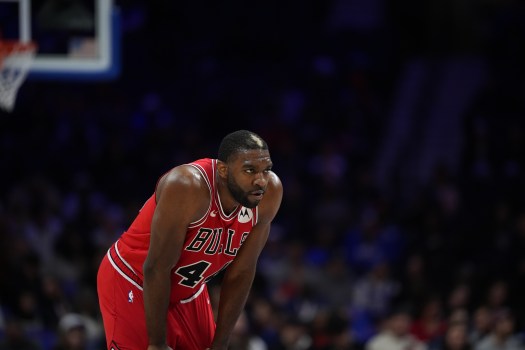

PHILADELPHIA — In the waning days of this Chicago Bulls season, Patrick Williams has begun to fade out of focus.
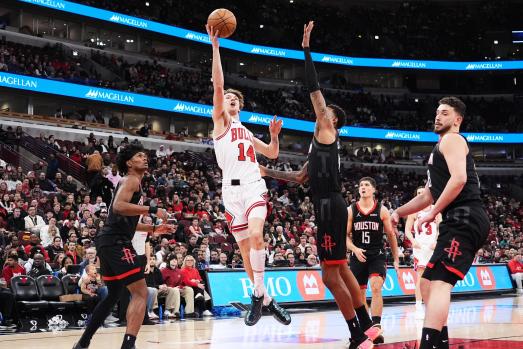
The forward is hardly playing. When he makes it onto court, he often flashes a brief, promising display of the same talent that lured the Bulls to select him with the No. 4 draft pick nearly six years ago — a catch-and-shoot 3-pointer, a sudden lurch toward the rim for an offensive rebound. Then, just as quickly, Williams dissolves into the background. Easy to miss. Hard to explain. A question that the Bulls seem incapable of answering.
The trade deadline was supposed to offer a change. Or, at the least, an opportunity. The Bulls traded away seven of their most important players, clearing the runway for the remaining young core to earn significant playing time. But even in that environment, Williams can’t win.
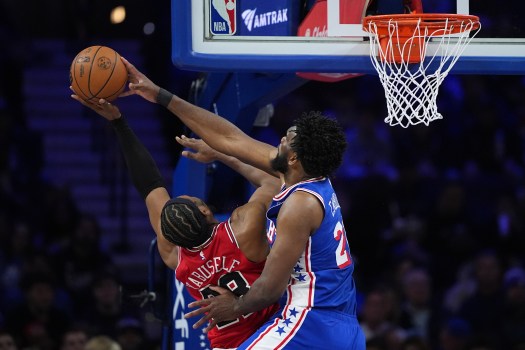
Since the All-Star break, Williams has spent 240.8 total minutes on the court. Only five players have logged fewer minutes in that span: two-way players Yuki Kawamura and Lachlan Olbrich, and injured teammates Jaden Ivey, Jalen Smith and Anfernee Simons. Williams tallied five blocks and 25 rebounds in that span. And new addition Leonard Miller — a second-year forward who barely cracked the rotation in Minnesota — has nearly doubled his playing time.
How does the forward handle his plummet down the team’s list of priorities?
“I just try to learn from all of it,” Williams told the Tribune. “That’s where I’m at.”

Williams couldn’t offer a clear-cut reason for his lack of playing time. The forward said he hasn’t talked with the coaching staff or the front office about his role reduction. He’s trying to learn from each game, make the most of the minutes he receives and absorb the feedback given by the coaching staff.
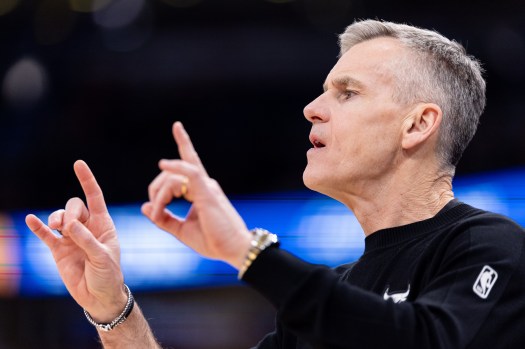
But coach Billy Donovan had a simple explanation: nothing has changed.
In his sixth season, Williams is still struggling with the same weaknesses that plagued the first years of his career. The forward is the longest-tenured player on the Bulls roster. He was the first player drafted under Donovan, the first project to which the coach fully committed himself in Chicago. And six years later, Donovan is still prodding and cajoling the forward to crash the boards and control his dribble and contribute physically to the game.
“It bothers me because there are things I see in him that I want to see him do more consistently,” Donovan said. “I wouldn’t say I’m disappointed. … But when someone shows signs of being able to do something, you feel like you want to try to get him to do it more consistently. He’s just got to take ownership of those minutes and just try to make them as valuable as possible.”
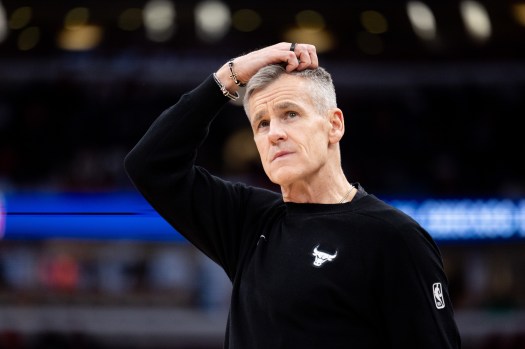
More often than not, Donovan and his staff find themselves mulling over the same questions: What do we need to do to motivate Williams to play this way more consistently? What are we missing? What does he need?
Those questions have not changed since his rookie season. They’ve grown more flustered, more confounding. Donovan doesn’t fully understand why Williams doesn’t pursue offensive rebounds at a higher rate. He can’t wrap his head around the forward’s lack of finishing ability as a dunker. He doesn’t know why this player — big, strong, smart, dedicated — can’t get this thing to click after years of trying.
Internally, the Bulls coaching staff has reached a point of bafflement with the forward. To those who work with Williams, none of this makes sense. As a one-and-done who mostly came off the bench at Florida State, it’s not as if the forward was never a surefire guarantee as a top-5 pick. Still, Williams always had the makings to meet a baseline of physicality and finishing that he’s simply never reached in Chicago.
Stardom is more nuanced than height and weight and wingspan, but Williams clearly has the physical gifts and general profile of a solid NBA player. His teammates often marvel at his strength both in the weight room and in team drills. He has a yawning reach, deft hands and light feet. So why has that never translated into consistency — of any kind — on the court?
This is the worst season of Williams’ career. He is averaging the fewest points (6.8) and rebounds (2.8) of his six years in the league. He logs less than one offensive board per game. His 2-point shooting percentage has dropped below 40%. His assist-to-turnover ratio is nearly 1-to-1.
As a result, Williams’ career trajectory has stalled out to a standstill. There are still three years left on the forward’s five-year, $90 million deal. The Bulls did not seriously pursue trade options for Williams at the deadline due to a lack of interest on the market, per a source. Perhaps that will change once he nears the end of his contract. But in the meantime, Williams is treading water — and retreading the same talking points that have defined the last three years of his development.
“I kind of look at it as — whenever I do get out there, what can I learn from it?” Williams said. “To be completely honest, we’re not competing for a championship this year. So when I’m out there, I’m trying to learn different things. I’m trying to work on things in a game. It might look a little bit crazy, but that’s kind of what the development part of it is for me.”
Williams still talks like a young player at the start of his career. When he thinks about this season in the big picture, the forward points to foundational aspects of his game that he hopes to improve — playing at a higher pace, filling in the gaps in an undersized frontcourt.
“I hope that in Year 10, Year 12, Year 15, these lessons will start to come back around again,” Williams said. “I’ll say, ‘OK, I learned that early on when I was in Chicago.’”
There’s some sense to this outlook. After all, Williams is only 24 years old. Life is long.
But NBA careers are not. And as he fails to fight for minutes even on a floundering Bulls roster, Williams is only adding to the stagnation of his career — and the team as a whole.